
Direct and Indirect Speech Quiz
How the Scales are Structured
Who Usually Takes This Test?
See How You Compare
Below is a preview of how scores are typically distributed across each scale.
Example Questions From the Test
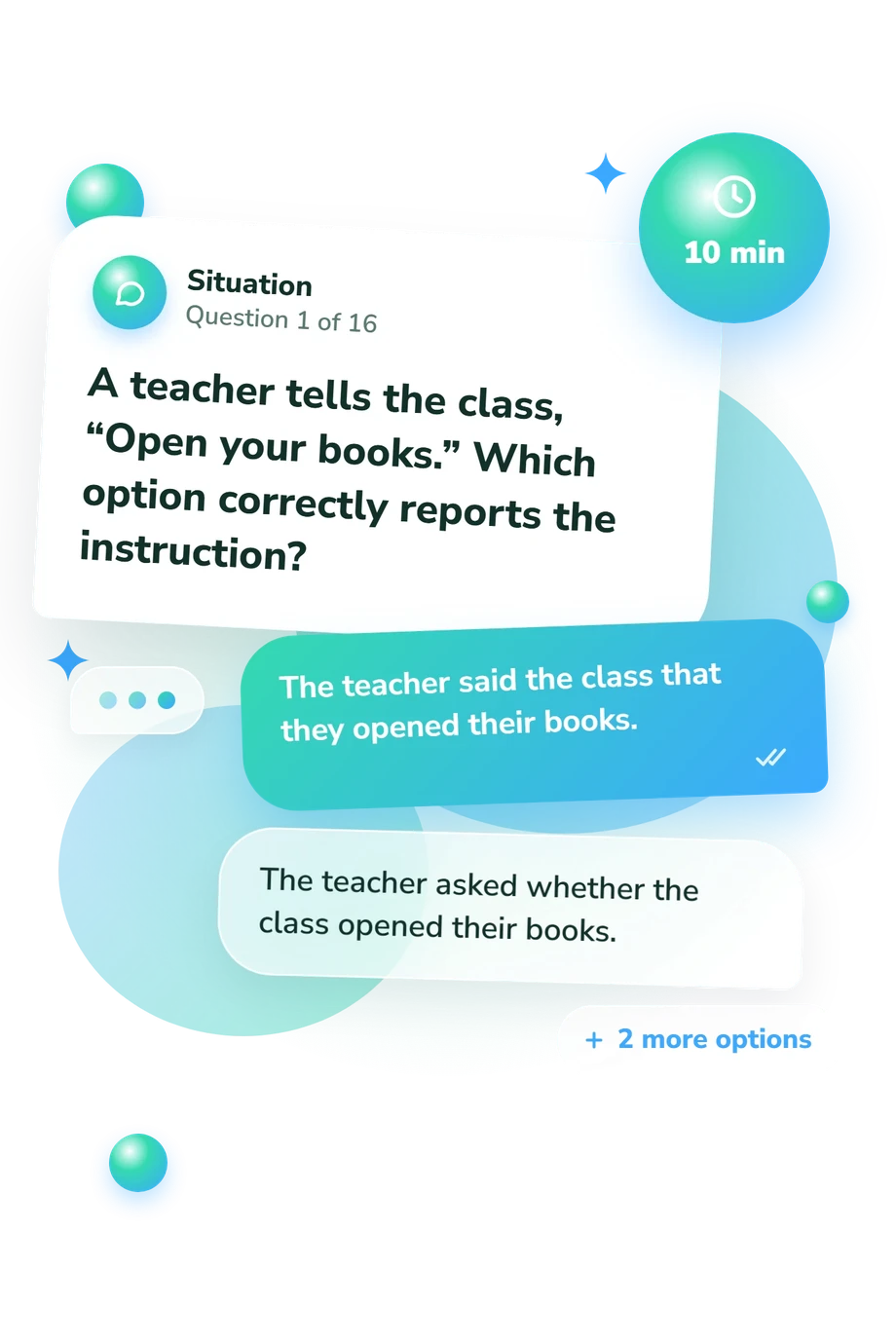
- The teacher said the class that they opened their books.
- The teacher asked whether the class opened their books.
- The teacher told that the class open their books.
- The teacher told the class to open their books.
- According to Nina, the train was late.
- Nina said that the train was late.
- Nina said, “The train is late.”
- Nina described the train as being late.
- Rosa asked Ben why was he laughing.
- Rosa asked Ben that why he was laughing.
- Rosa asked Ben why he was laughing.
- Rosa asked Ben why did he laugh.
Direct and Indirect Speech Quiz - Description and methodology of the test
For learners who want to check their command of reported language, this direct and indirect speech quiz focuses on practical transformations rather than isolated terminology. As an indirect speech quiz, it suits students, teachers, and independent learners who want to test whether a sentence preserves meaning when spoken words become a report. The result shows which grammar decisions are secure and which deserve targeted revision.
What This Test Measures
The assessment distinguishes exact quotations from reported clauses and checks whether the original meaning survives changes in grammar. Situations involving classrooms, family talk, travel, and everyday conversation make it suitable for learners or teachers reviewing English.
The main dimensions are:
- Recognizing quoted language shows whether you identify exact words and correct quotation punctuation.
- Reporting questions measures whether you keep statement word order and suitable reporting patterns.
- Handling commands and warnings shows whether you form positive and negative instructions accurately.
- Managing tense, pronoun, and time shifts reflects whether you adjust forms without changing meaning.
Its direct speech quiz items therefore test grammar decisions rather than vocabulary alone. A lower result points to rules for focused review, while a stronger result indicates control of transformations.
Methodology and Scientific Basis
Each item presents a short situation and four answer choices. You select the option that identifies, reports, or transforms speech while preserving its meaning. The direct indirect speech quiz format combines recognition with application: items address word order, tense, pronouns, punctuation, and time expressions.
Scoring is direct. Direct and Indirect Speech Knowledge ranges from 0-16, with one point for each correct answer. The bands are Foundations to build (0-6), Developing knowledge (7-12), and Strong knowledge (13-16). They describe performance on this questionnaire, not fixed ability categories.
The content is conceptually consistent with Parrott’s treatment and Huddleston and Pullum’s grammatical analysis. It also addresses the bidirectional classroom skill examined by Dalimunte and Salmiah (2019), but this questionnaire is not an adaptation of those published works. Tasks in the direct to indirect speech quiz require controlled changes while preserving context.
As an online, self-completed knowledge check, the result can be influenced by attention, terminology familiarity, and guessing. No population norms are stated, so use the score to target practice rather than to make a broader judgment about language ability.
- Dalimunte, Muhammad, and Maryati Salmiah. “Students’ Ability at Changing Direct into Indirect Speech and Indirect into Direct Speech.” Budapest International Research and Critics Institute-Journal (BIRCI-Journal): Humanities and Social Sciences, vol. 2, no. 2, 2019, pp. 178-185. 10.33258/birci.v2i2.249
- Parrott, Martin. “Reported and Direct Speech.” In Grammar for English Language Teachers, 2nd ed., pp. 257-271. Cambridge University Press, 2010. 10.1017/9781009406536.021
- Huddleston, Rodney, and Geoffrey K. Pullum. The Cambridge Grammar of the English Language. Cambridge University Press, 2002. 10.1017/9781316423530
Updated: