
Spanish Food Quiz
How the Scales are Structured
Who Usually Takes This Test?
See How You Compare
Below is a preview of how scores are typically distributed across each scale.
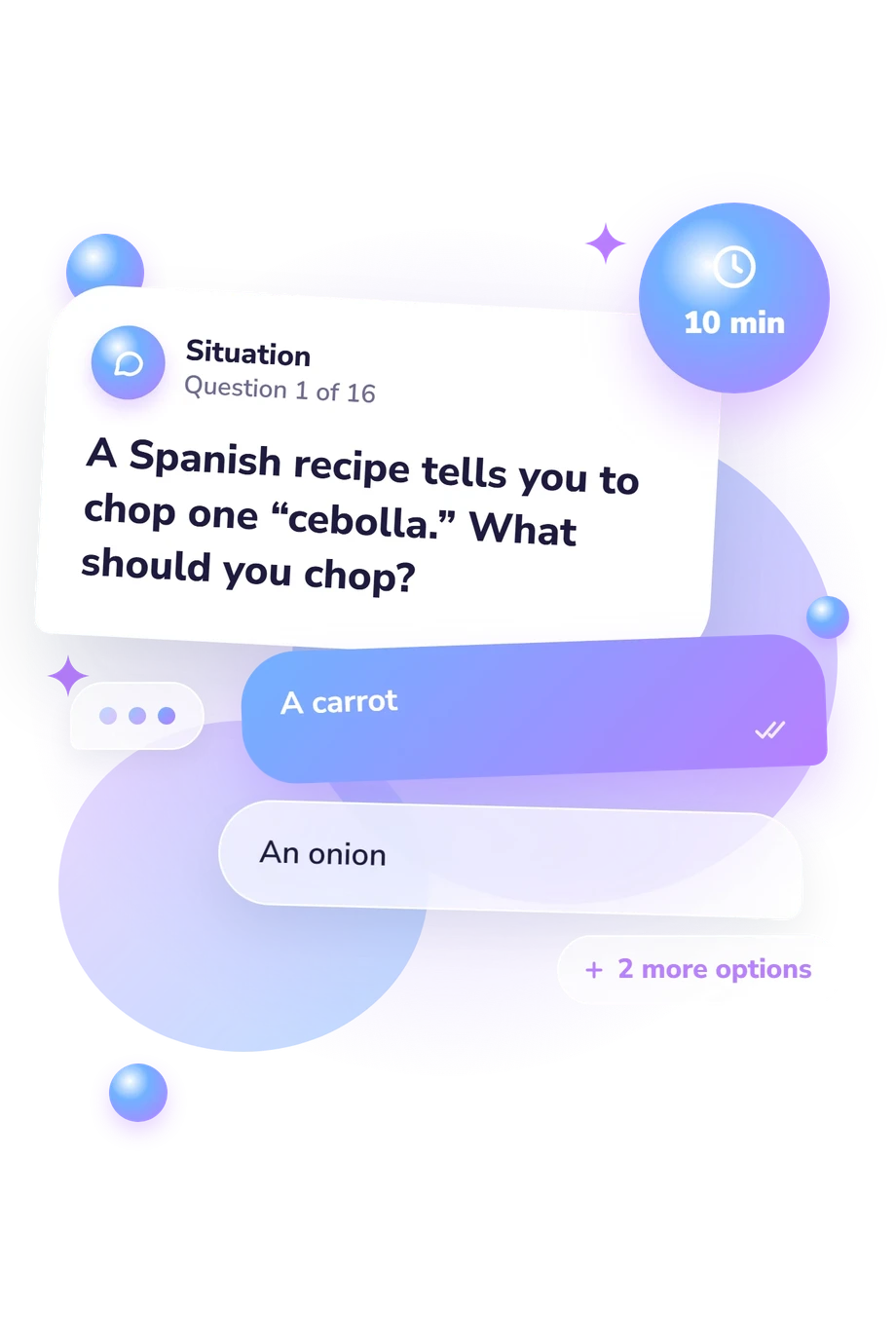
Example Questions From the Test
- A carrot
- An onion
- A potato
- A pepper
- Carne
- Jamón
- Pollo
- Pescado
- Bebidas
- Entrantes
- Postres
- Platos principales
Spanish Food Quiz - Description and methodology of the test
For learners, travelers, and curious home cooks, everyday food language offers a practical route into Spanish. The Spanish Food Quiz checks how confidently you recognize ingredients, meals, menu sections, and short phrases used when ordering. As a Spanish food vocabulary quiz, it suits readers who want a focused way to identify useful gaps before travel, classwork, or conversation.
What This Assessment Measures
Rather than estimating overall proficiency, the assessment focuses on culinary vocabulary in familiar food situations. It examines ingredient names, meal words, menu categories, cooking methods, dietary requests, and brief restaurant expressions. The result is useful as a Spanish food vocabulary test for the language encountered around meals, not as a broad measure of grammar, speaking, or listening.
The main result is Spanish Food Knowledge: 0-16. Its bands explain the practical meaning of the score:
- Foundation (0-6) shows recognition of some food terms, with review still useful for common ingredients, meals, and restaurant phrases.
- Developing (7-12) indicates understanding of much core vocabulary, with gaps in familiar food situations.
- Strong (13-16) reflects reliable command of the covered vocabulary in practical contexts, not complete Spanish fluency.
This focus suits learners, travelers, and anyone reviewing everyday food language. It can highlight situations that deserve further practice.
Methodology and Evidence Base
Each item uses multiple choice: a Spanish word, menu term, or short situation is followed by four options, with one fitting the meaning or context. The format tests recognition rather than free production, so knowing a word receptively does not show that the participant can use it spontaneously.
The questions cover ingredients, ordering, preparation, dietary preferences, drinks, and meals. Together, they make this a Spanish food knowledge test for everyday contexts, not the whole Spanish lexicon. One overall result is reported; no separate subscales or broader fluency estimate are given.
The method is conceptually consistent with 3K-LEx-MC (Robles-García et al., 2023), a multiple-choice vocabulary placement approach, but this questionnaire is not an adaptation of that instrument. Lextale-Esp (Izura et al., 2014) provides a related model for efficient Spanish lexical recognition. Gyllstad, Vilkaitė, and Schmitt (2015) show why guessing and vocabulary sampling matter when interpreting multiple-choice scores.
This online questionnaire has no reported norms, reliability estimates, or validation study. Prior exposure, guessing, outside assistance, and current attention can influence the result, so it is best read as a focused snapshot of the culinary vocabulary represented here.
- Robles-García, Pablo, Glen H. Wallace, and Claudia Helena Sánchez-Gutiérrez. 2023. 3K-LEx-MC: The creation and validation of a multiple-choice vocabulary placement test for Spanish language learners. ITL - International Journal of Applied Linguistics 174(1): 135-165. 10.1075/itl.22008.rob
- Izura, Cristina, Fernando Cuetos, and Marc Brysbaert. 2014. Lextale-Esp: A test to rapidly and efficiently assess the Spanish vocabulary size. Psicológica 35(1): 49-66. 10.17575/PSICOLOGIA.V35I1.1623
- Gyllstad, Henrik, Laura Vilkaitė, and Norbert Schmitt. 2015. Assessing vocabulary size through multiple-choice formats: Issues with guessing and sampling rates. ITL - International Journal of Applied Linguistics 166(2): 278-306. 10.1075/itl.166.2.04gyl
Updated: