
Indigo Child Quiz
How the Scales are Structured
Who Usually Takes This Test?
See How You Compare
Below is a preview of how scores are typically distributed across each scale.
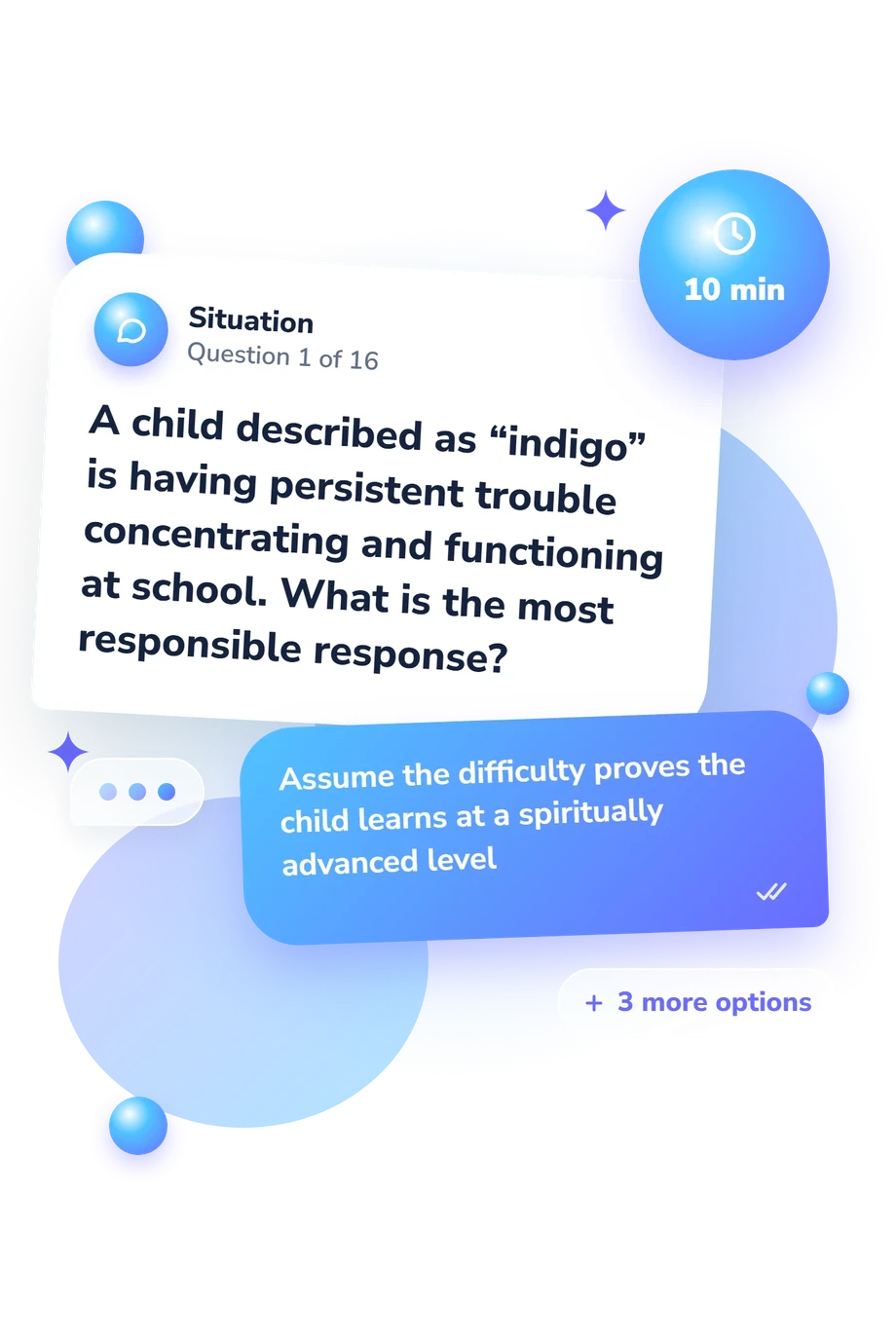
Example Questions From the Test
- Controlled evidence has not established a distinctive indigo aura
- Aura color reliably predicts creativity but not behavior
- The aura appears only in children below a certain age
- Researchers accept the aura but disagree about what it signifies
- A temperament category from a standardized personality inventory
- A symbolic stage in a child’s intellectual development
- A color perceived in the person’s aura or life color
- A traditional term for children born during a particular season
- Elaine Aron
- Elisabeth Kübler-Ross
- Maria Montessori
- Nancy Ann Tappe
Indigo Child Quiz - Description and methodology of the test
Readers who want to examine the indigo idea critically can use this indigo child quiz as a focused knowledge check, not as a personality label. It suits anyone weighing spiritual explanations for a child’s behavior, identity, or sensitivity and anyone using a quiz about indigo children to examine their own assumptions. The result shows how clearly you distinguish historical claims, reasoning errors, and evidence-based support.
What This Assessment Explores
The questionnaire examines the label’s meaning, aura-based origins, scientific status, and risks of applying it to learning concerns. Questions about whether you are an indigo child prompt claim evaluation, not evidence of identity.
Three knowledge domains are covered:
- The origins theme tests whether you distinguish a New Age label from clinical or educational categories.
- The reasoning theme tests whether you notice circular claims, broad descriptions and missing evidence.
- The application theme tests whether you recognize when observed needs should take priority over a label.
Together, these themes contribute to one knowledge score. The Indigo Child Knowledge score runs from 0-16. Foundation to Build (0-6) signals a need to strengthen source evaluation; Developing Knowledge (7-12) reflects understanding of the history and cautions; Strong Knowledge (13-16) reflects accurate distinctions between the concept, claims, and scientific status. It measures knowledge only.
Methodology and Evidence Base
Each item presents a claim, scenario, or reasoning problem with four choices. Intended responses favor evidence-aware interpretation, reject spiritual labeling as a substitute for assessment, or expose flaws in a claim. The total reflects knowledge distinctions, not an aura, personality type, or clinical trait.
This quiz about the indigo idea may invite identity-based answers, but its actual task is knowledge checking. It covers definitions, historical associations, unfalsifiable reasoning, evidence standards, and responsible responses to concerns.
Conceptually, the questionnaire is consistent with the Indigo Child concept described by Singler in 2018, its closest conceptual reference, which connects New Age belief, personal identity, and claims about science. Carroll and Tober’s 1999 book and Tappe’s 2009 work provide historical context for the popular presentation and aura-colour claims represented in the questions. These works neither validate nor constitute an adaptation of this online questionnaire.
The displayed bands are descriptive feedback rather than norm-based cutoffs for this online knowledge questionnaire. Topic familiarity and confidence in evaluating evidence can affect performance, so interpret the result as a structured learning prompt rather than a measure of identity.
- Singler, Beth. The Indigo Children: New Age Experimentation with Self and Science. Routledge, 2018. 10.4324/9781315100845
- Whedon, Sarah W. "The Wisdom of Indigo Children: An Emphatic Restatement of the Value of American Children." Nova Religio, vol. 12, no. 3, 2009, pp. 60-76. 10.1525/nr.2009.12.3.60
- Carroll, Lee, and Jan Tober. The Indigo Children: The New Kids Have Arrived. Hay House, 1999
- Tappe, Nancy Ann. Understanding Your Life Through Color., 2009
Updated: