
Anime Trap Quiz
How the Scales are Structured
Who Usually Takes This Test?
See How You Compare
Below is a preview of how scores are typically distributed across each scale.
Example Questions From the Test
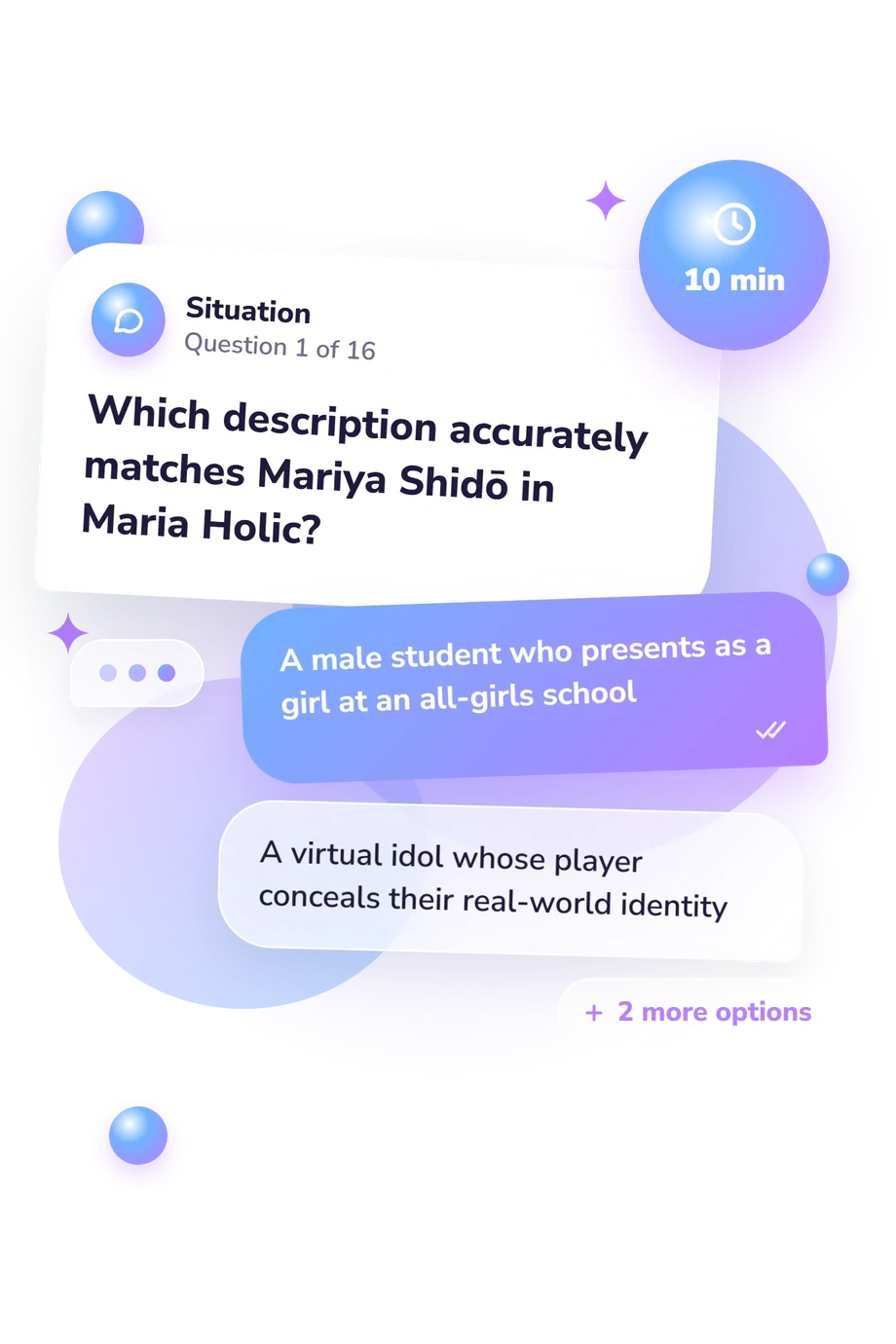
- A male student who presents as a girl at an all-girls school
- A virtual idol whose player conceals their real-world identity
- A female student who disguises herself as her twin brother
- A supernatural being whose appearance changes involuntarily
- Monthly Girls' Nozaki-kun
- Princess Jellyfish
- Princess Tutu
- Ouran High School Host Club
- A magical curse changes Tetra’s body whenever a spell is cast.
- Tetra swaps places with a twin sister during battles.
- Tetra is a male player represented by a female game avatar.
- Tetra is an actress playing a male role inside the game world.
Anime Trap Quiz - Description and methodology of the test
Visitors who want to test anime knowledge while separating appearance from canon and identity can use this questionnaire as a focused reference exercise. The Anime Trap Quiz asks readers to evaluate character descriptions through dialogue, canon, context, and reliable source material. That makes the question of whether it is a trap quiz specific to the evidence rather than to a character's appearance.
What This Assessment Explores
Anime viewers can use this assessment to distinguish feminine or androgynous presentation from disguise, avatars, gender expression, and stated identity. It tests recognition across familiar series.
Three recurring themes shape the questions; one aggregate score reflects all three:
- Character recognition connects descriptions with the correct series.
- Presentation and identity analysis separates clothing, avatars, canon, and assumptions.
- Source judgment prioritizes scenes, dialogue, translations, and creator material over fan images.
The test's trap or not quiz distinction concerns canonical context and stated identity, not feminine appearance.
Anime Trap Knowledge totals correct answers from 0-16: Foundation (0-6) reflects mixed recognition, canon, or terminology; Developing (7-12) reflects solid knowledge with room to refine distinctions and source awareness; Strong (13-16) reflects broad, precise knowledge and respectful interpretation of presentation versus identity. This is an unofficial fandom result, not an authority on anyone's gender.
Methodology and Evidence Base
Each item presents a question with four answer choices. The set tests anime character knowledge through identification, series knowledge, presentation, terminology, translation, and evaluation of canon evidence. Selecting an option produces a score based on correct responses, so the display describes knowledge demonstrated on this questionnaire rather than a personality trait or clinical state.
The questionnaire is conceptually consistent with Gilbert and Ito's account of gender-nonconforming representation. Kinsella's analysis shows why otoko no ko requires attention to context and usage, while Lewicki examines otokonoko through a comparative trans perspective. These works support the interpretive distinctions, but this questionnaire is not presented as an adaptation of any of them.
Results classify the raw correct-answer total on this item set into the displayed bands; they should not be read as norm-referenced scores unless that status is verified. Translation differences can alter pronoun or terminology meaning, incomplete canon knowledge can change an answer, and personal assumptions or contextual interpretation can leave more than one plausible fictional reading. Careful attention to wording improves interpretation.
- Gilbert, Catherine, and Rika Ito. "Neither Hero nor Heroine: Problematizing the Representation of Gender Non-Conforming Characters in Japanese Anime." In Proceedings of the 28th Central Association of Teachers of Japanese Conference (CATJ28), 2020, pp. 43-56.
- Kinsella, Sharon. "Cuteness, josō, and the Need to Appeal: Otoko no Ko in Male Subculture in 2010s Japan." Japan Forum 32, no. 3 (2020): 432-458. 10.1080/09555803.2019.1676289
- Lewicki, Riley Hannah. "Prefiguring the Otokonoko Genre: A Comparative Trans Analysis of Stop!! Hibari-Kun! and No Bra." Journal of Anime and Manga Studies 3 (2022): 62-84. 10.21900/j.jams.v3.868
Updated: