
Software Testing Quiz
How the Scales are Structured
Who Usually Takes This Test?
See How You Compare
Below is a preview of how scores are typically distributed across each scale.
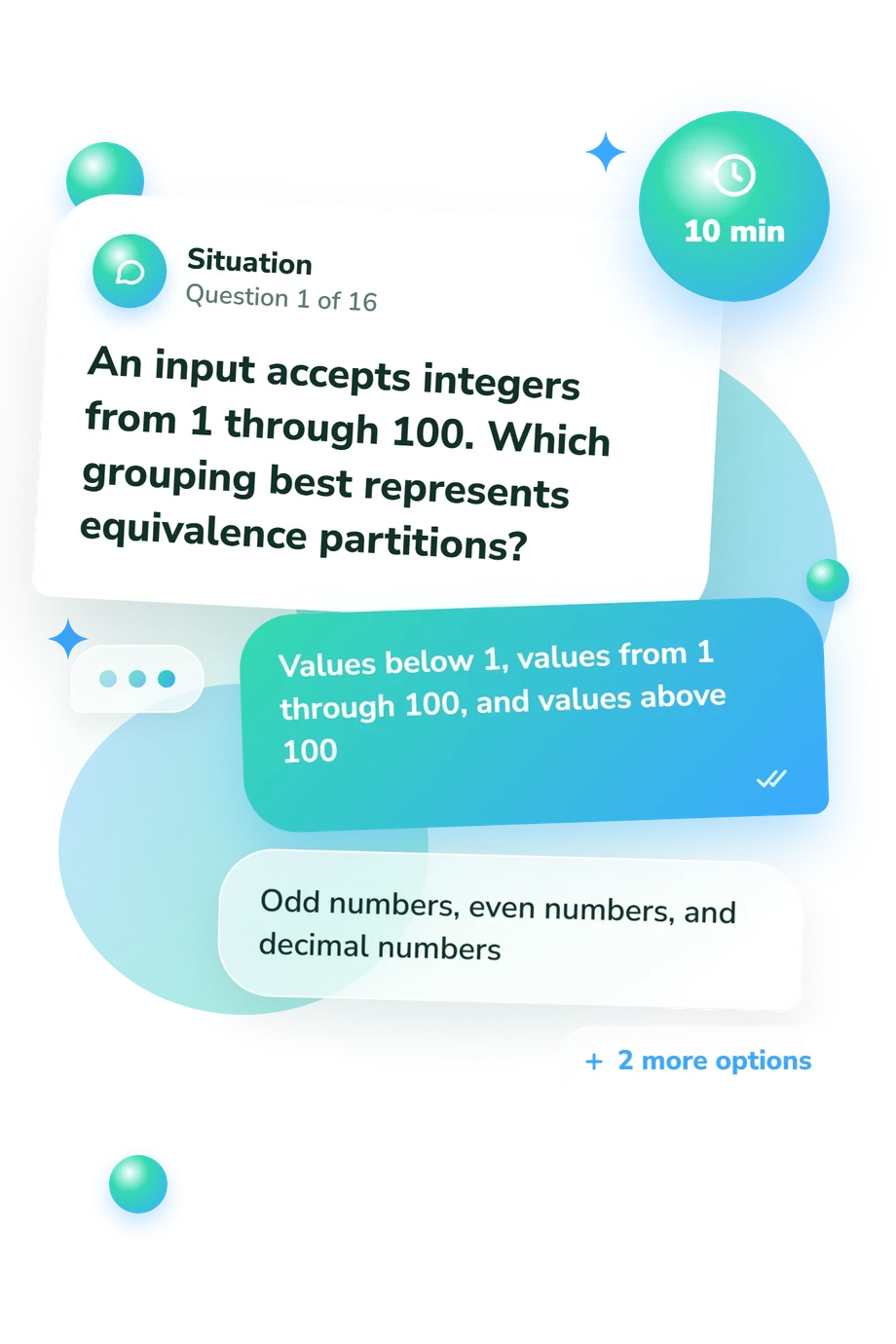
Example Questions From the Test
- State transition testing
- Equivalence partitioning
- Statement coverage
- Pairwise testing
- 18, 30, 50, and 65
- 20, 35, 50, and 60
- 1, 17, 66, and 100
- 17, 18, 65, and 66
- A tool that automatically generates every possible test case
- A source used to determine the expected result of a test
- A production database copied into the test environment
- A meeting where stakeholders prioritize reported defects
Software Testing Quiz - Description and methodology of the test
Independent learners and practitioners can use this assessment to review testing terminology, revisit foundational techniques, or prepare for discussions about testing decisions at work. The software testing online quiz presents short scenarios in a format suited to focused revision. The software testing quiz keeps attention on practical concepts that arise in everyday testing work.
What This Assessment Measures
Rather than measuring programming ability or workplace performance, this assessment checks whether a respondent can recognize and apply foundational testing concepts in realistic situations. It suits learners, practitioners refreshing their knowledge, and anyone seeking a structured self-check.
Several software testing quiz questions cover technique selection, testing levels, defect decisions, risk, reporting, and test oracles.
The tested areas can be read through these practical groupings:
- Design techniques show whether you can match a method to a testing condition.
- Testing levels and types show whether you can distinguish unit, integration, regression, smoke, exploratory, and acceptance work.
- Defect and risk decisions show how you weigh impact, urgency, and limited time.
- Software Testing Knowledge (0-16) gives an educational summary of common principles and practical decisions: Foundations to Build (0-6), Developing Knowledge (7-12), or Strong Knowledge (13-16).
Methodology and Evidence Base
Each item presents a short scenario followed by four answer choices. Selecting the option that best fits the testing principle emphasizes recognition and application rather than written explanation. The themes span test design, levels, defects, risk, terminology, and business acceptance.
Scoring produces one knowledge total from the selected responses and displays it through descriptive bands. This format supports study planning while keeping interpretation focused on the concepts sampled by the questionnaire.
Methodologically, the questionnaire is conceptually consistent with the Certified Tester Foundation Level (CTFL), which organizes foundational knowledge around testing principles, activities, techniques, levels, and types. The question set is also consistent with the subject coverage and single-best-answer format of the ISTQB sample exam set, a structure familiar from software testing exam questions. The ISTQB glossary supports terms such as severity, priority, test oracles, and testing activities. This questionnaire is not an adaptation of those publications.
Adam Roman’s work offers a further reference point for equivalence partitioning, boundary value analysis, and state transition testing. The result is an educational summary limited to the concepts sampled, and interpretation can be affected by memory, wording, and current study exposure; one score cannot establish broad professional competence.
- Renzo Cerquozzi, Wim Decoutere, Jean-François Riverin, Arnika Hryszko, Martin Klonk, Meile Posthuma, Eric Riou du Cosquer, Adam Roman, Lucjan Stapp, Stephanie Ulrich, and Eshraka Zakaria. Certified Tester Foundation Level Syllabus v4.0.1. International Software Testing Qualifications Board, 2024.
- Laura Albert, Wim de Coutere, Arnika Hryszko, Gary Mogyorodi, Meile Posthuma, Gandhinee Rajkomar, Stuart Reid, Jean-François Riverin, Adam Roman, Lucjan Stapp, Stephanie Ulrich, Yaron Tsubery, and Eshraka Zakaria. Certified Tester Foundation Level Sample Exam Set A: Questions, Version 1.7. International Software Testing Qualifications Board, 2025.
- International Software Testing Qualifications Board. Standard Glossary of Terms Used in Software Testing, Version 4.7. International Software Testing Qualifications Board, 2026.
- Adam Roman. A Study Guide to the ISTQB Foundation Level 2018 Syllabus: Test Techniques and Sample Mock Exams. Springer, 2018. 10.1007/978-3-319-98740-8
Updated: