
Virgo Quiz
How the Scales are Structured
Who Usually Takes This Test?
See How You Compare
Below is a preview of how scores are typically distributed across each scale.
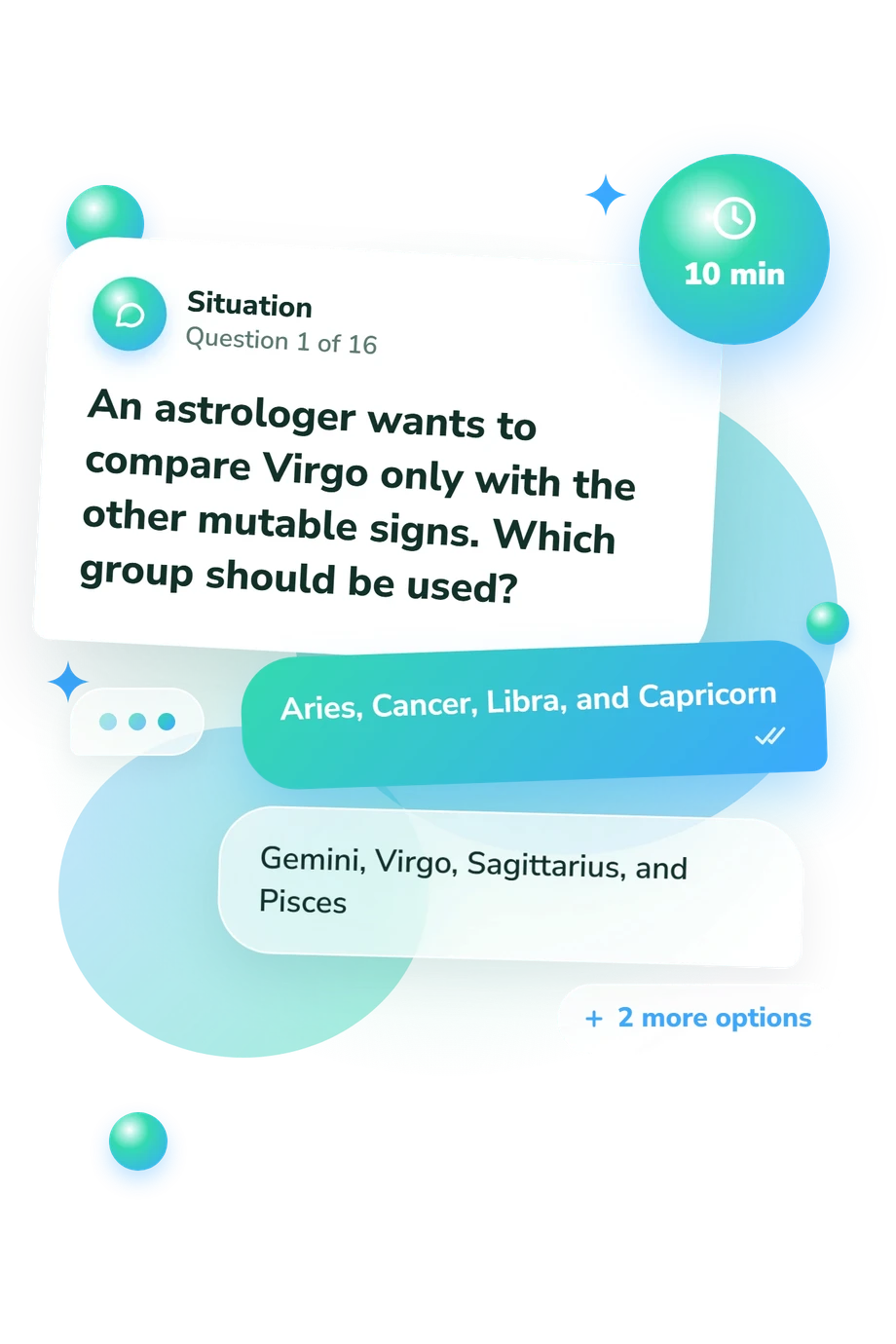
Example Questions From the Test
- Aries, Cancer, Libra, and Capricorn
- Gemini, Virgo, Sagittarius, and Pisces
- Taurus, Virgo, Capricorn, and Aquarius
- Taurus, Leo, Scorpio, and Aquarius
- Fire
- Air
- Water
- Earth
- Dramatic self-expression, visibility, and performance
- Analysis, discernment, practical craft, and service
- Emotional protection, home, and family continuity
- Exploration, broad philosophy, and long-distance adventure
Virgo Quiz - Description and methodology of the test
Readers who want to check their grasp of traditional zodiac conventions can use the virgo quiz as a focused knowledge assessment rather than a personality judgment. For beginners, astrology learners, and anyone revisiting Virgo’s place in a natal-chart framework, it functions as a Virgo astrology quiz focused on established conventions. The questionnaire tests established Virgo classifications and symbols, so its purpose is to assess astrology knowledge rather than infer character from a birth chart.
What This Assessment Explores
This assessment checks knowledge of Virgo in Western tropical astrology. Its questions cover the sign’s element, modality, glyph, figure, ruler, seasonal position, opposite sign, neighbouring signs, and relationships among earth and mutable signs. Several also test chart language, including domicile and what a Sun in Virgo means.
The Virgo knowledge test reports one result as Virgo Knowledge (0-16), with Foundations to Build (0-6), Developing Knowledge (7-12), and Strong Knowledge (13-16). These bands describe familiarity with conventions, not personality accuracy or astrology’s scientific validity.
The main areas are:
- Element and modality place Virgo among basic zodiac classifications.
- Symbolism and glyphs cover its traditional imagery.
- Rulership and dignity explain Mercury and related chart language.
- Zodiac relationships test oppositions, squares, trines, and neighbouring signs.
Methodology and Evidence Base
Each item uses four-option multiple choice. Prompts combine direct recall, such as Virgo’s element or ruler, with applied recognition of sign groups, zodiac relationships, and chart placements. This structure checks whether the respondent can use traditional conventions rather than recognize isolated labels.
The displayed result records performance on the tested Virgo classifications and terminology. The questionnaire reports the displayed knowledge bands, so the score is a snapshot of familiarity with this material rather than all astrology knowledge. Prior exposure and fixed answer choices can affect performance.
Its framework is conceptually consistent with the traditional zodiac correspondences described by Ptolemy, while Beck supplies historical context for ancient astrology. The questionnaire is not an adaptation of either source. Dean and Kelly provide a critical perspective on astrology’s broader claims about consciousness and psi, helping distinguish knowledge of astrological conventions from evidence that they predict personality or events.
In practice, this Virgo knowledge quiz can show which parts of Virgo terminology are secure and which need review. The result covers the listed Virgo conventions, leaving broader astrological topics outside its scope.
- Ptolemy, Claudius. Tetrabiblos. Edited and translated by Frank Egleston Robbins. Cambridge, MA: Harvard University Press; London: William Heinemann, 1940.
- Beck, Roger. A Brief History of Ancient Astrology. Malden, MA: Blackwell Publishing, 2007. 10.1002/9780470773772.
- Dean, Geoffrey, and Ivan W. Kelly. “Is Astrology Relevant to Consciousness and Psi?” Journal of Consciousness Studies, 10(6-7), 2003, 175-198.
Updated: