
Who Do I Like More Quiz
How the Scales are Structured
Who Usually Takes This Test?
See How You Compare
Below is a preview of how scores are typically distributed across each scale.
Example Questions From the Test
- I am usually pleased, but I may leave it until later.
- I feel mostly neutral and respond when convenient.
- I feel a quick spark of interest and want to see what they said.
- Replying tends to feel more like an obligation than a draw.
- I would be unlikely to tell them unless it came up naturally.
- I would probably share it in a group or general conversation.
- I would want to tell them fairly soon after processing it myself.
- They are among the people I would most want to tell right away.
- Sometimes, especially when something reminds me of them.
- Hardly ever; my attention usually stays elsewhere.
- Frequently; I notice their presence even while talking to others.
- Once or twice, without feeling especially drawn toward them.
Who Do I Like More Quiz - Description and methodology of the test
People weighing two connections can use this assessment to organize feelings that are often easier to notice than to name. The Who Do I Like More Quiz is intended for anyone comparing attention, comfort, curiosity, and desire for shared time with Person A and Person B. It is especially useful when you are trying to understand who you love more without forcing a premature choice.
What This Assessment Explores
The questionnaire examines emotional and everyday pull through situations involving attention, shared time, personal disclosure, future imagining, cancelled plans, disagreement, and changing preferences. It also reflects uncertainty linked to limited experience or outside expectations.
The result profiles are:
- Person A Affinity (0-15) shows Person A’s pull: Limited Pull (0-5), Meaningful Interest (6-10), or Strong Affinity (11-15).
- Person B Affinity (0-15) shows Person B’s pull: Limited Pull (0-5), Meaningful Interest (6-10), or Strong Affinity (11-15).
- Still Deciding (0-15) reflects uncertainty: Clearer Direction (0-5), Mixed Signals (6-10), or Open Question (11-15).
The profile helps compare feelings for two people without reducing the outcome to a forced winner. The highest score is the strongest affinity, while any score within one point of it creates a blended result. It describes current reactions, not a permanent verdict.
Methodology and Scientific Basis
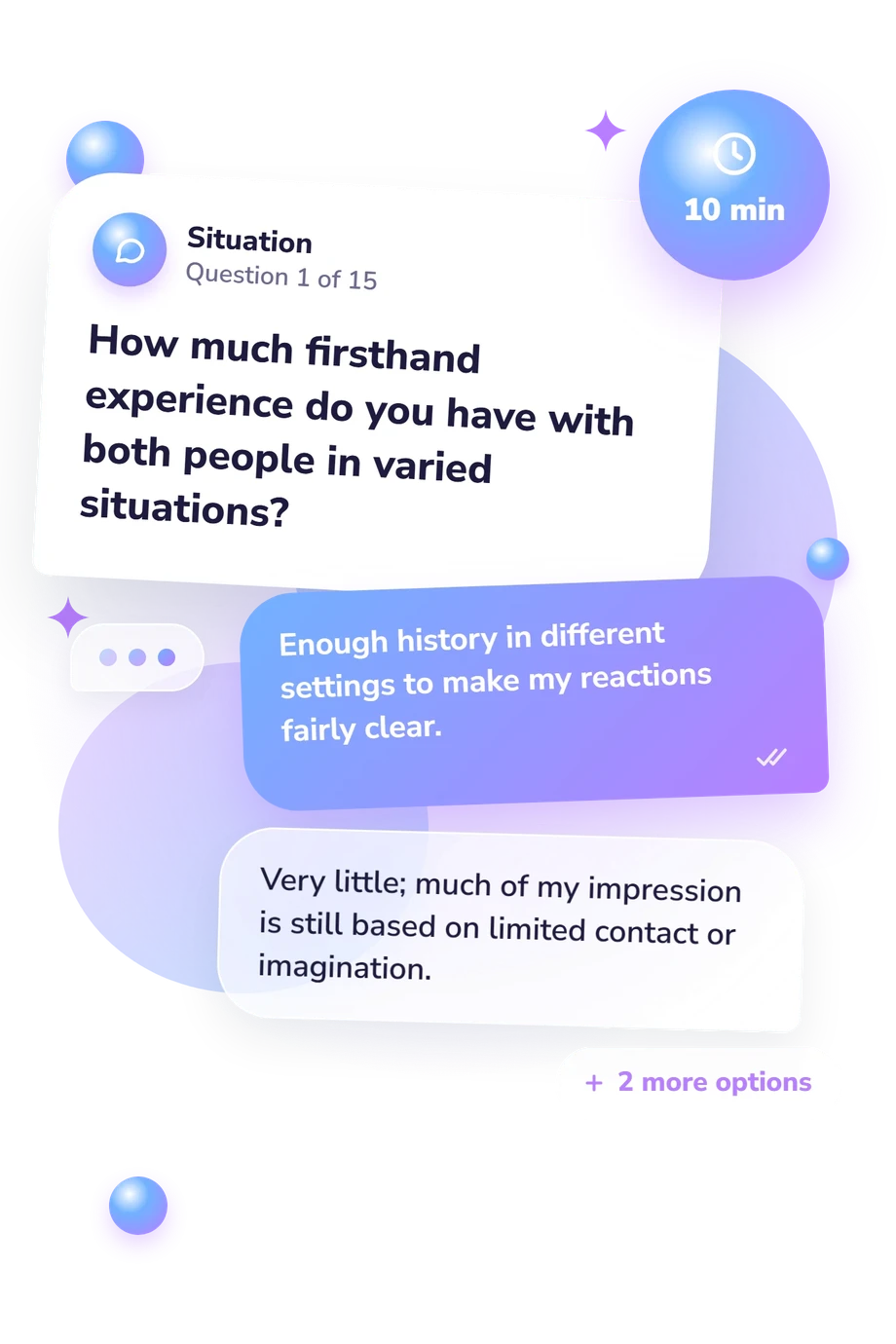
Each item presents a social situation with four response options. The choices distinguish direct experience from imagination, situational interest from stable preference, and personal reactions from outside pressure. Together, the prompts sample attention, disclosure, shared time, future expectations, conflict, and preference stability.
In practice, this relationship preference test converts responses into three profile totals rather than letting one answer decide the outcome. The scoring is comparative; this online questionnaire is not presented with its own norms, reliability estimates, or clinical cutoffs.
The main conceptual reference is the Relationship Closeness Inventory (Berscheid et al., 1989), which links closeness with everyday interdependence through frequency, diversity, and strength. The questionnaire is conceptually consistent with that model. Rubin’s measure adds attachment, helping, and absorption, while Aron, Aron, and Smollan’s Inclusion of Other in the Self Scale adds a perspective on felt connection. This is not a direct administration of any cited instrument.
Because answers are self-reported, mood, recent contact, social pressure, and incomplete knowledge can affect the result. Read it as a structured snapshot of your perspective, not a diagnosis or fixed statement about either relationship.
- Berscheid, Ellen, Mark Snyder, and Allen M. Omoto. “The Relationship Closeness Inventory: Assessing the Closeness of Interpersonal Relationships.” Journal of Personality and Social Psychology, 57(5), 792-807, 1989. 10.1037/0022-3514.57.5.792
- Rubin, Zick. “Measurement of Romantic Love.” Journal of Personality and Social Psychology, 16(2), 265-273, 1970. 10.1037/h0029841
- Aron, Arthur, Elaine N. Aron, and Danny Smollan. “Inclusion of Other in the Self Scale and the Structure of Interpersonal Closeness.” Journal of Personality and Social Psychology, 63(4), 596-612, 1992. 10.1037/0022-3514.63.4.596
Updated: