
What House Should I Live In Quiz
How the Scales are Structured
Who Usually Takes This Test?
See How You Compare
Below is a preview of how scores are typically distributed across each scale.
Example Questions From the Test
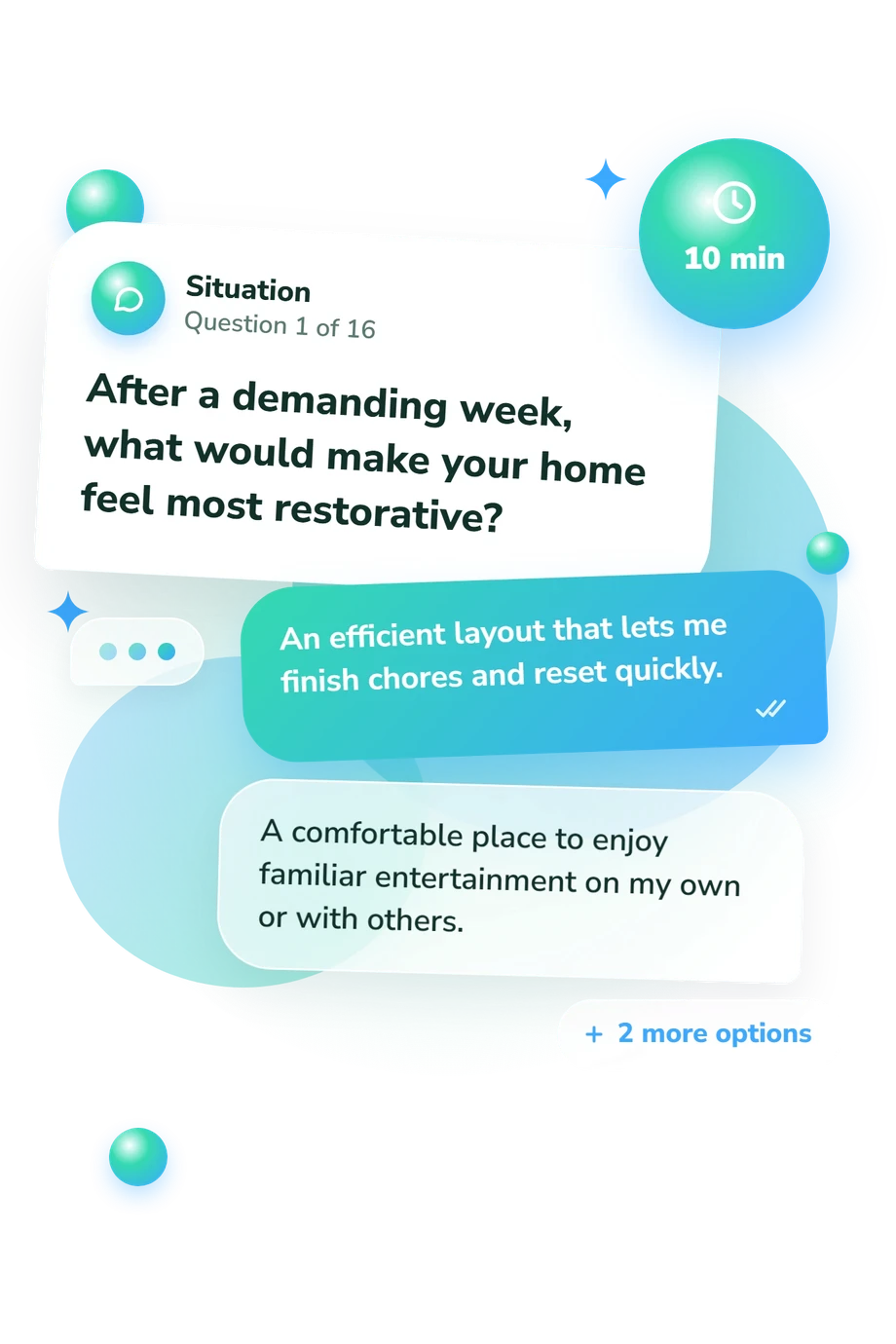
- An efficient layout that lets me finish chores and reset quickly.
- A comfortable place to enjoy familiar entertainment on my own or with others.
- A graceful, welcoming room where conversation and small rituals can unfold.
- An intimate sanctuary where music, candlelight, and meaningful company make ordinary life feel cinematic.
- Leave it alone and focus on whether the desk is useful.
- Ask a restoration expert to inspect it during a future visit.
- Research the desk's history before carefully trying to open it.
- Clear my evening and follow every clue until I uncover what is inside.
- I would want most of them replaced with clean, predictable features.
- I could enjoy one or two quirks if the main rooms remained conventional.
- I would happily adapt because those imperfections give the home character.
- I would treasure the quirks and hope the cupboards concealed a secret or two.
What House Should I Live In Quiz - Description and methodology of the test
Readers who want their surroundings to express personality and imagination can use the What House Should I Live In Quiz to explore which fictional home atmosphere feels most appealing. Its playful what house will i live in quiz premise turns that curiosity into aesthetic self-reflection. The result points toward a preferred mood and design language, helping visitors gather décor ideas and describe what makes a space feel like home.
What This Assessment Explores
These questions explore four imagined home worlds. They turn the what house should you live in quiz question into an aesthetic profile. The result shows imaginative fit, not practical suitability. Readers asking what type of house should i live in quiz can use its language of atmosphere.
The four dimensions are:
- Cinematic Sci-Fi Home (0-12) measures tech affinity: Analog Observer (0-4) prefers familiarity; Selective Innovator (5-8) balances comfort; Future-World Resident (9-12) favors innovation.
- Enchanted Fantasy Cottage (0-12) measures whimsy: Grounded Visitor (0-4) prefers order; Cottage Dreamer (5-8) welcomes charm; Woodland Main Character (9-12) favors imagination.
- Gothic Mystery Manor (0-12) measures history and secrets: Daylight Guest (0-4) prefers lightness; Curious Resident (5-8) enjoys character; Keeper of Secrets (9-12) favors shadowed elegance.
- Romantic Storybook Retreat (0-12) measures warmth: Practical Admirer (0-4) keeps romance occasional; Sentimental Stylist (5-8) values detail; Storybook Romantic (9-12) weaves memories into home.
Methodology and Evidence Base
Each question presents a home situation or design choice with four ordered responses, moving from practical convention toward imaginative commitment. Respondents choose the closest reaction, and responses are grouped across the four dimensions. Displayed ranges identify result bands, not a rule for predicting a property purchase.
For a visitor treating what kind of house should i buy quiz as a décor question, the result suggests styles and atmospheres, but it does not assess price, maintenance, location, safety, accessibility, or construction quality. It is a self-report exercise for comparing environmental preferences.
Purcell and Nasar (1992) provide the closest anchor for experiencing environmental settings. Mehrabian (1998) connects home preference with temperament and everyday emotional conditions; Osborn (1988) treats interiors as behavior-setting choices; Vartanian et al. (2021) examine individual differences in architectural-interior preferences. The questionnaire is conceptually consistent with these works but is not a standardized adaptation of one published instrument.
Current mood, memories, genre familiarity, and self-awareness can shape self-report. Use the result for reflection, while evaluating real housing with separate practical criteria.
- Purcell, A. T., & Nasar, J. L. (1992). Experiencing other people's houses: A model of similarities and differences in environmental experience. Journal of Environmental Psychology, 12(3), 199-211. 10.1016/S0272-4944(05)80135-5
- Mehrabian, A. (1998). Relations of home preference with temperament and with prevailing emotional conditions in everyday life. Imagination, Cognition and Personality, 18(1), 43-58. 10.2190/227H-R9YP-TQC2-CRPW
- Vartanian, O., Navarrete, G., Palumbo, L., & Chatterjee, A. (2021). Individual differences in preference for architectural interiors. Journal of Environmental Psychology, 77, 101668. 10.1016/j.jenvp.2021.101668
- Osborn, D. R. (1988). Personality traits expressed: Interior design as behavior-setting plan. Personality and Social Psychology Bulletin, 14(2), 368-373. 10.1177/0146167288142014
Updated: