
6 Times Table Quiz
How the Scales are Structured
Who Usually Takes This Test?
See How You Compare
Below is a preview of how scores are typically distributed across each scale.
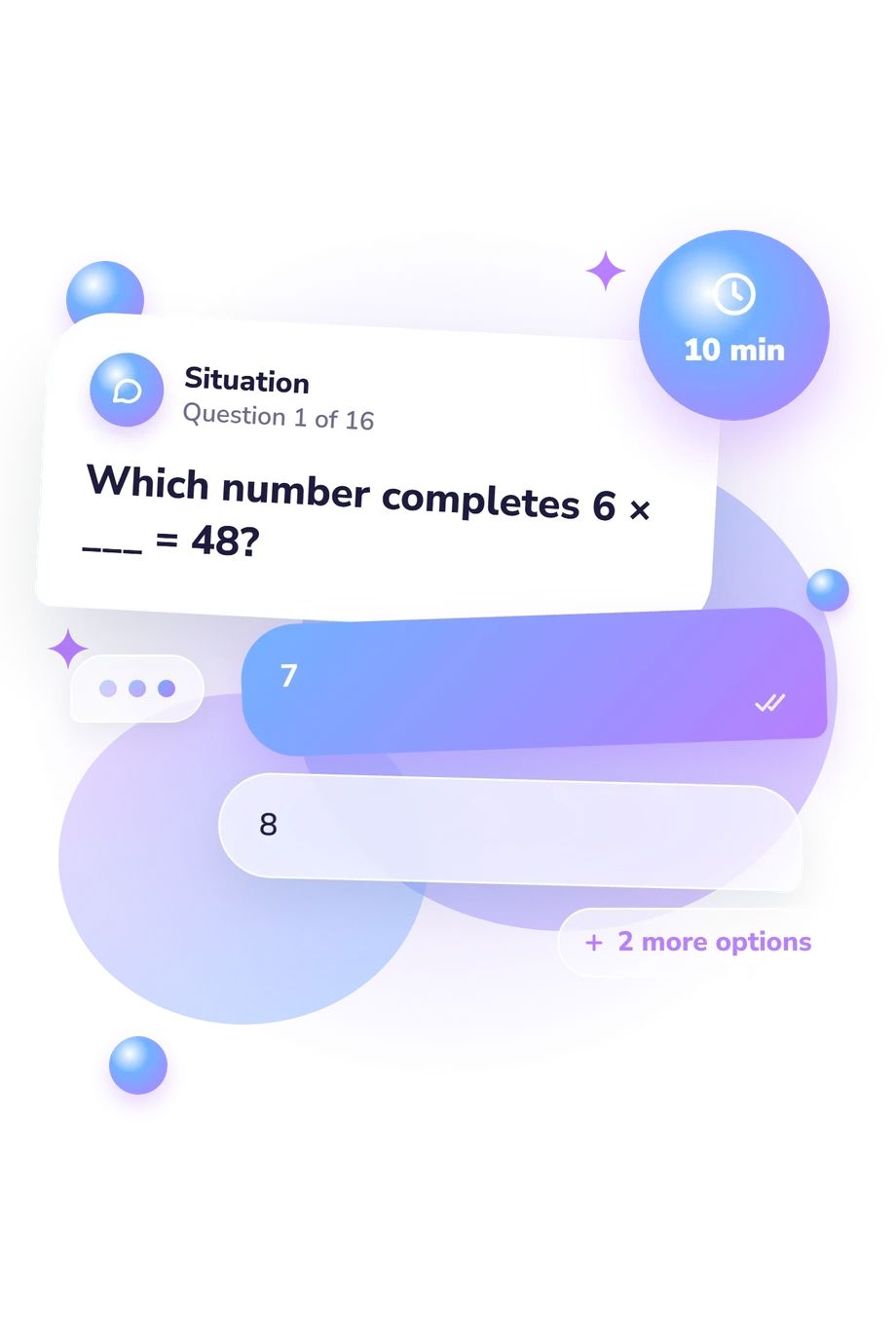
Example Questions From the Test
- 7
- 8
- 9
- 6
- 20
- 22
- 26
- 24
- 7
- 8
- 9
- 10
6 Times Table Quiz - Description and methodology of the test
Children, families, and educators can use this assessment to see where knowledge of the six times table is secure and where practice may help. The 6 Times Table Quiz gives learners and their supporters a clear basis for choosing useful next steps. Learners using this six times tables quiz work with sequences, equal groups, and practical situations, so the result can point to targeted practice.
What This Assessment Explores
Knowledge of multiplication facts involving six includes accurate recall and application in different forms. This 6 times table test uses sequences, equal groups, arrays, comparisons, and short word problems. These formats show whether facts are used accurately and flexibly.
Three aspects of the question set help explain the performance:
- The 6 Times Table Knowledge scale runs from 0-16: Foundations to build (0-6) indicates some recognized facts that need practice; Developing knowledge (7-12) indicates many known facts with some products needing reinforcement; Strong knowledge (13-16) indicates accurate recall and application in direct calculations and practical problems.
- Direct-recall questions show accurate retrieval of familiar products such as 6 × 7 or 9 × 6.
- Applied questions show how patterns, arrays, comparisons, and everyday quantities lead to an answer.
Together, these formats show accurate recall and application of multiplication knowledge involving six.
Methodology and Learning Evidence
Each item offers four answer choices. Some require direct retrieval; others complete a sequence, compare products, interpret an array, or solve a contextual problem. This format samples accurate recall and links multiplication with equal groups, decomposition, and practical quantities.
One point is awarded for each correct response. The displayed bands classify the questionnaire's 16-point score. The result is a snapshot of knowledge of facts involving six and can guide 6 times table practice, but it cannot capture every aspect of mathematical understanding.
The design is conceptually consistent with classroom research by Ophuis-Cox and colleagues on retrieval practice for multiplication facts. Developmental work by Jordan and colleagues, alongside Koshmider and Ashcraft's research on mental multiplication, connects fact mastery with learning processes. McNeil and colleagues describe arithmetic fluency as accurate access to learned knowledge. Together, these sources provide context for interpreting accurate recall and application here.
Attention, prior rehearsal, and wording familiarity can affect performance, while this short set cannot represent every aspect of multiplication understanding. Read the result alongside observed work and practice over time.
- Ophuis-Cox, F. H. A., Catrysse, L., & Camp, G. (2023). The effect of retrieval practice on fluently retrieving multiplication facts in an authentic elementary school setting. Applied Cognitive Psychology, 37(6), 1463-1469. 10.1002/acp.4141
- Jordan, N. C., Hanich, L. B., & Kaplan, D. (2003). Arithmetic fact mastery in young children: A longitudinal investigation. Journal of Experimental Child Psychology, 85(2), 103-119. 10.1016/S0022-0965(03)00032-8
- Koshmider, J. W., & Ashcraft, M. H. (1991). The development of children's mental multiplication skills. Journal of Experimental Child Psychology, 51(1), 53-89. 10.1016/0022-0965(91)90077-6
- McNeil, N. M., Jordan, N. C., Viegut, A. A., & Ansari, D. (2025). What the science of learning teaches us about arithmetic fluency. Psychological Science in the Public Interest, 26(1), 10-57. 10.1177/15291006241287726
Updated: