
Big 3 Quiz
How the Scales are Structured
Who Usually Takes This Test?
See How You Compare
Below is a preview of how scores are typically distributed across each scale.
Example Questions From the Test
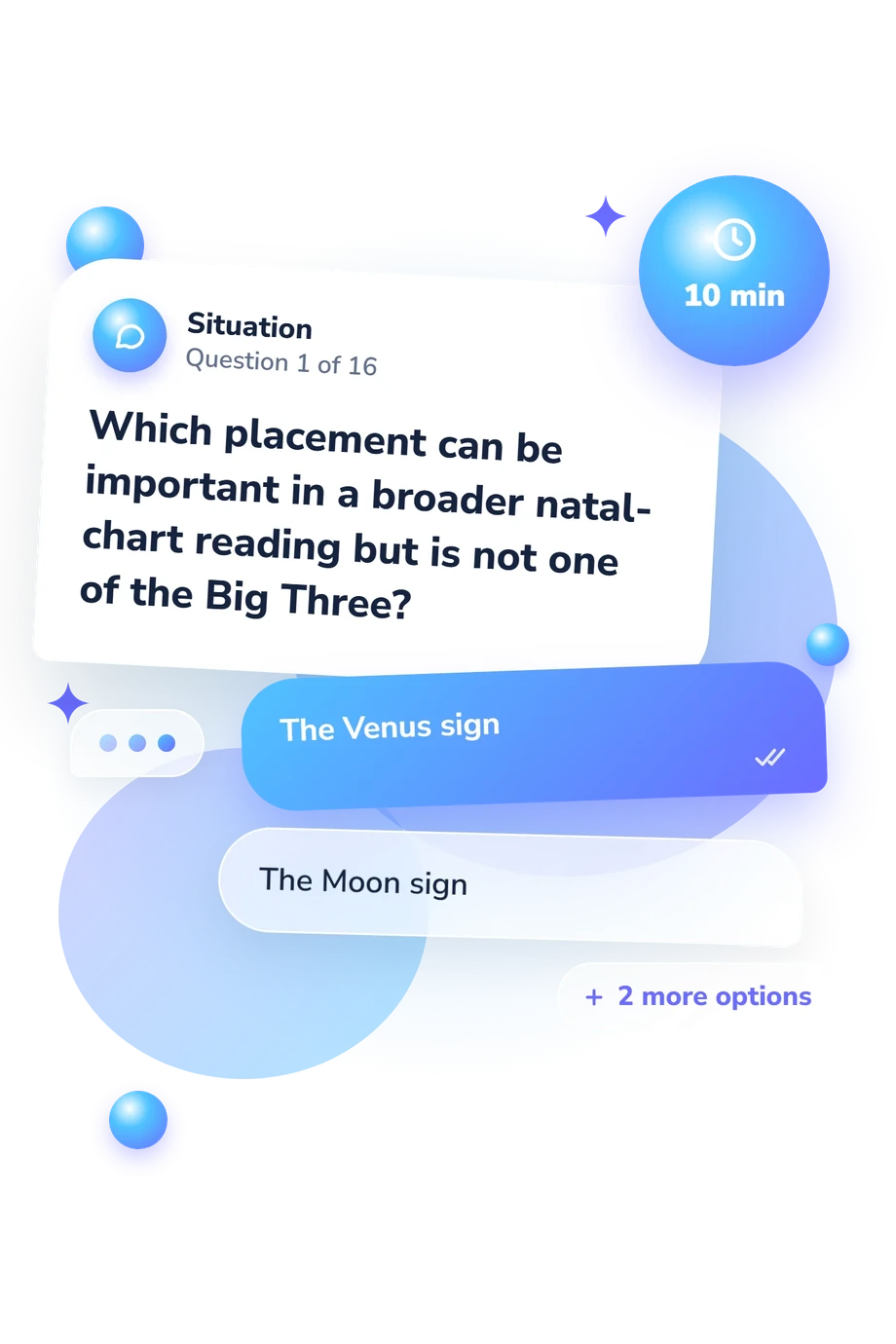
- The Venus sign
- The Moon sign
- The rising sign
- The Sun sign
- Venus
- Jupiter
- Mars
- Mercury
- Public ambitions and long-term reputation
- Romantic taste and aesthetic preferences
- Emotional needs, habitual reactions, and inner comfort
- Outward style and first impressions
Big 3 Quiz - Description and methodology of the test
Readers who want to distinguish the Sun, Moon, and Ascendant can use this assessment as a focused knowledge check. The Big 3 Quiz tests whether you recognize the placements, the birth data used to calculate them, and their conventional meanings. It suits beginners and curious chart readers who want a clearer foundation before interpreting a natal chart. As a big three quiz, it moves from terminology to short applied questions.
What This Assessment Explores
The assessment checks whether a reader can identify and connect the three placements used in Western natal charts. This big 3 zodiac quiz measures astrology knowledge rather than personality: it asks about terminology, the birth information used for calculation, and interpretations of the Sun, Moon, and rising sign.
The questions group into three areas:
- Sun-sign knowledge shows whether you recognize its links with identity, vitality, and conscious expression.
- Moon-sign knowledge shows whether you connect it with emotional needs, habitual reactions, and inner comfort.
- Rising-sign knowledge shows whether you understand the Ascendant, its eastern-horizon basis, and its dependence on birth time.
Astrology Big 3 Knowledge runs from 0-16: Foundational (0-6) signals partial recognition, Developing (7-12) shows workable understanding with gaps, and Strong (13-16) indicates clear command of the conventions. These bands describe quiz knowledge, not scientific proof or a psychological assessment.
Methodology and Evidence Base
Each item uses a short scenario or definition with four answer choices. The respondent selects the option that best matches standard Western astrology usage, combining recall with simple application: identifying a chart ruler, recognizing the birth data needed for calculation, and distinguishing the Ascendant from the Midheaven. The score counts correct answers across the item set, and the displayed band summarizes the resulting knowledge level.
George and Bloch (2006) supply the closest conceptual reference for the placement meanings, while Sakoian and Acker (1973) provide a comparable treatment of natal-chart symbolism and angles. The questionnaire is an online knowledge quiz, and its displayed bands describe knowledge of Western astrology rather than a psychological assessment. The score from this big three astrology quiz reflects familiarity with astrology’s conventions.
Carlson’s (1985) double-blind study helps separate those questions: it examined astrological claims under controlled conditions, whereas this assessment tests recognition of astrology concepts. Results from this big 3 astrology quiz can vary with guessing, prior study, wording, and attention; read the band as a learning snapshot of astrology knowledge.
- Demetra George and Douglas Bloch. Astrology for Yourself: How to Understand and Interpret Your Own Birth Chart. Ibis Press, 2006. ISBN 9780892541225.
- Frances Sakoian and Louis S. Acker. The Astrologer's Handbook. Harper & Row, 1973. ISBN 0060137347.
- Shawn Carlson. A double-blind test of astrology. Nature, 318(6045), 419-425, 1985. DOI 10.1038/318419a0.
Updated: