
What Periodic Element Am I Quiz
How the Scales are Structured
Who Usually Takes This Test?
See How You Compare
Below is a preview of how scores are typically distributed across each scale.
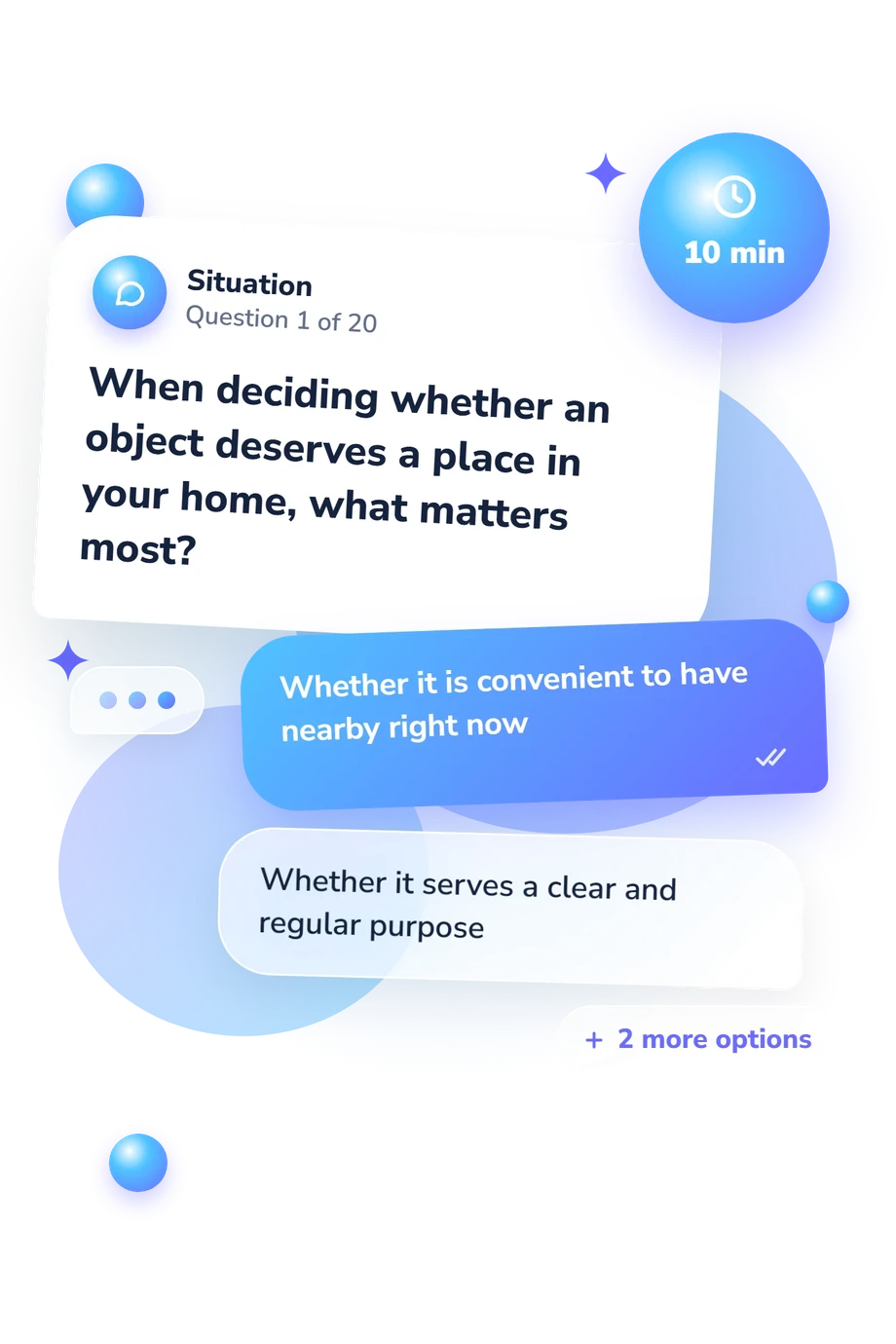
Example Questions From the Test
- Select the clearest single thread and concentrate on it
- Sort the notes into a few straightforward categories
- Map how the people, themes, and dependencies connect
- Create a flexible outline that can accommodate several themes
- A novel design that changes how the object is used
- An elegant design with a balanced set of features
- A sturdy design that can withstand years of regular use
- A practical design with parts that can be maintained or repaired
- Something understated and familiar that lets me blend in
- A classic look with one carefully chosen detail
- A noticeable color or accessory that shows some personality
- An unexpected combination that feels unmistakably mine
What Periodic Element Am I Quiz - Description and methodology of the test
People drawn to personality quizzes that connect everyday choices with symbolic patterns can use the What Periodic Element Am I Quiz to explore how they approach work, relationships, possessions, visibility, and change. For many readers, this element personality quiz offers a playful way to explore what periodic element you are across different situations rather than reducing personality to a single label.
What This Assessment Explores
The questions examine ordinary choices involving organization, quality, individuality, effort, and social energy. They point to relative tendencies rather than a fixed identity.
Readers seeking language for recurring styles in work, social settings, possessions, and self-expression may find this personality profile quiz useful. The five displayed scales describe these dimensions:
- Carbon Affinity (0-12) shows Carbon Trace (0-4), Carbon Blend (5-8), or Carbon Core (9-12): self-contained focus to connection.
- Gold Affinity (0-12) shows Gold Trace (0-4), Gold Blend (5-8), or Gold Core (9-12): utility to lasting value.
- Iron Affinity (0-12) shows Iron Trace (0-4), Iron Blend (5-8), or Iron Core (9-12): flexibility to dependable strength.
- Neon Affinity (0-12) shows Neon Trace (0-4), Neon Blend (5-8), or Neon Core (9-12): reserve to vivid individuality.
- Oxygen Affinity (0-12) shows Oxygen Trace (0-4), Oxygen Blend (5-8), or Oxygen Core (9-12): conserved energy to momentum.
Methodology and Scientific Basis
Each item presents an everyday scenario with four response options. The situations cover organization, pressure, personal space, recognition, social energy, and commitment. Selecting the most characteristic response lets the questionnaire compare patterns across contexts instead of asking for one abstract trait rating.
Scoring produces a separate affinity value for each element. The highest score is the leading profile, while scores within one point form a blend. This logic shows which metaphors stand out in your responses.
Conceptually, this separate questionnaire is consistent with the Periodic Table of Personality, a published model, but it is not an adaptation of that framework. Fetterman and Robinson's work supports treating metaphors as meaningful cues for interpreting personality-related patterns. This element personality quiz uses symbolism as a lens, not a literal classification.
The displayed bands are descriptive categories for this questionnaire, not clinical thresholds. As a self-report tool, current mood, context, self-presentation, and limited self-awareness may shift a respondent’s profile. Read the result as a reflective profile and compare it with your behavior across situations.
- Woods, Stephen A., and Neil R. Anderson. “Toward a periodic table of personality: Mapping personality scales between the five-factor model and the circumplex model.” Journal of Applied Psychology 101, no. 4 (2016): 582-604. 10.1037/apl0000062
- Fetterman, Adam K., and Michael D. Robinson. “What Can Metaphors Tell Us about Personality?” In-Mind, issue 20 (2014).
- Paulhus, Delroy L. “Measurement and Control of Response Bias.” In Measures of Personality and Social Psychological Attitudes, edited by John P. Robinson, Phillip R. Shaver, and Lawrence S. Wrightsman, 17-59. Academic Press, 1991. 10.1016/B978-0-12-590241-0.50006-X
Updated: