
What Is My Best Quality Quiz
How the Scales are Structured
Who Usually Takes This Test?
See How You Compare
Below is a preview of how scores are typically distributed across each scale.
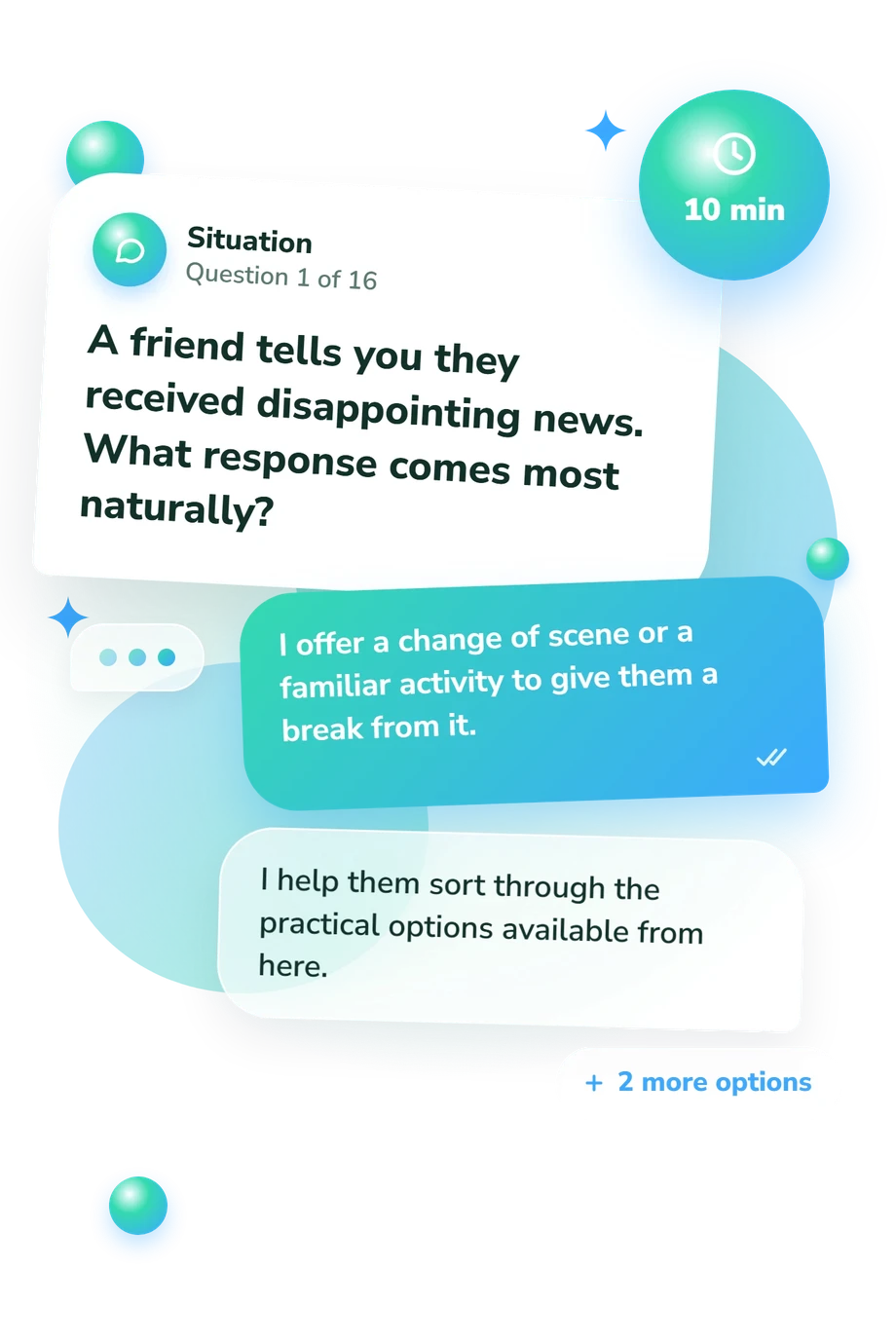
Example Questions From the Test
- I offer a change of scene or a familiar activity to give them a break from it.
- I help them sort through the practical options available from here.
- I ask what kind of support they want and remain available.
- I listen closely and give them room to express how the news feels.
- I let circumstances narrow the options before committing.
- I continue researching until I feel reasonably comfortable.
- I seek one informed opinion to strengthen my judgment.
- I choose a reversible first step that will generate more information.
- Practical features, such as where to sit or where the exits are.
- The room's main purpose and what I am expected to do next.
- A handful of distinctive details in the space.
- The atmosphere and the subtle ways people are interacting.
What Is My Best Quality Quiz - Description and methodology of the test
People who want to understand the strength they bring to decisions, setbacks, social situations, and new possibilities may find the What Is My Best Quality Quiz useful. This personal strengths assessment looks for a pattern across four qualities rather than reducing personality to one behavior. It suits reflective readers seeking a clearer picture of their natural tendencies and likely contributions.
What This Assessment Explores
Situations in this questionnaire cover uncertain decisions, setbacks, social connection, emotional support, context, and subtle cues. Taking my best quality quiz can show which strength is most prominent and help you identify your best quality without reducing your personality to a fixed label.
The four displayed scales are:
- Initiative (0-12) measures beginning, deciding, experimenting, and turning possibilities into action: Considered Starter (0-4), Purposeful Starter (5-8), Natural Catalyst (9-12).
- Perceptiveness (0-12) measures detecting patterns, context, details, and underlying meanings: Concrete Observer (0-4), Context Reader (5-8), Pattern Spotter (9-12).
- Resilience (0-12) measures regaining direction, adapting, and continuing after difficulty: Deliberate Recovery (0-4), Adaptive Recovery (5-8), Steady Rebound (9-12).
- Warmth (0-12) measures noticing, welcoming, and emotionally supporting others: Quiet Warmth (0-4), Responsive Warmth (5-8), Natural Connector (9-12).
Methodology and Scientific Basis
Each item presents an everyday situation with four response options. The choices describe different ways of noticing, deciding, recovering, or relating, so you select the response that feels most natural rather than the one that seems most admirable. Answers are combined into the displayed scale scores; any scale within one point of the highest is also part of a blended best-quality result.
Conceptually, the structure is consistent with the VIA Inventory of Strengths (Park et al., 2004), which connects character strengths with well-being, and with the VIA classification described by Peterson and Seligman. It is not an adaptation of that published inventory. The German VIA-IS validation study does not validate this online questionnaire, whose four displayed qualities and scoring have not been established through that study.
As an online self-report questionnaire, it can reflect current circumstances, self-awareness, and response style. This online questionnaire has no published standardization, clinical norms, or diagnostic thresholds, so interpret the profile as a structured snapshot and compare it with repeated experience and trusted feedback.
- Park, Nansook, Christopher Peterson, and Martin E. P. Seligman. “Strengths of Character and Well-Being.” Journal of Social and Clinical Psychology 23, no. 5 (2004): 603-619. 10.1521/jscp.23.5.603.50748
- Peterson, Christopher, and Martin E. P. Seligman. Character Strengths and Virtues: A Handbook and Classification. Washington, DC: American Psychological Association; New York: Oxford University Press, 2004.
- Ruch, Willibald, René T. Proyer, Claudia Harzer, Nansook Park, Christopher Peterson, and Martin E. P. Seligman. “Values in Action Inventory of Strengths (VIA-IS): Adaptation and Validation of the German Version and the Development of a Peer-Rating Form.” Journal of Individual Differences 31, no. 3 (2010): 138-149. 10.1027/1614-0001/a000022
Updated: