
Music Quiz for Kids
How the Scales are Structured
Who Usually Takes This Test?
See How You Compare
Below is a preview of how scores are typically distributed across each scale.
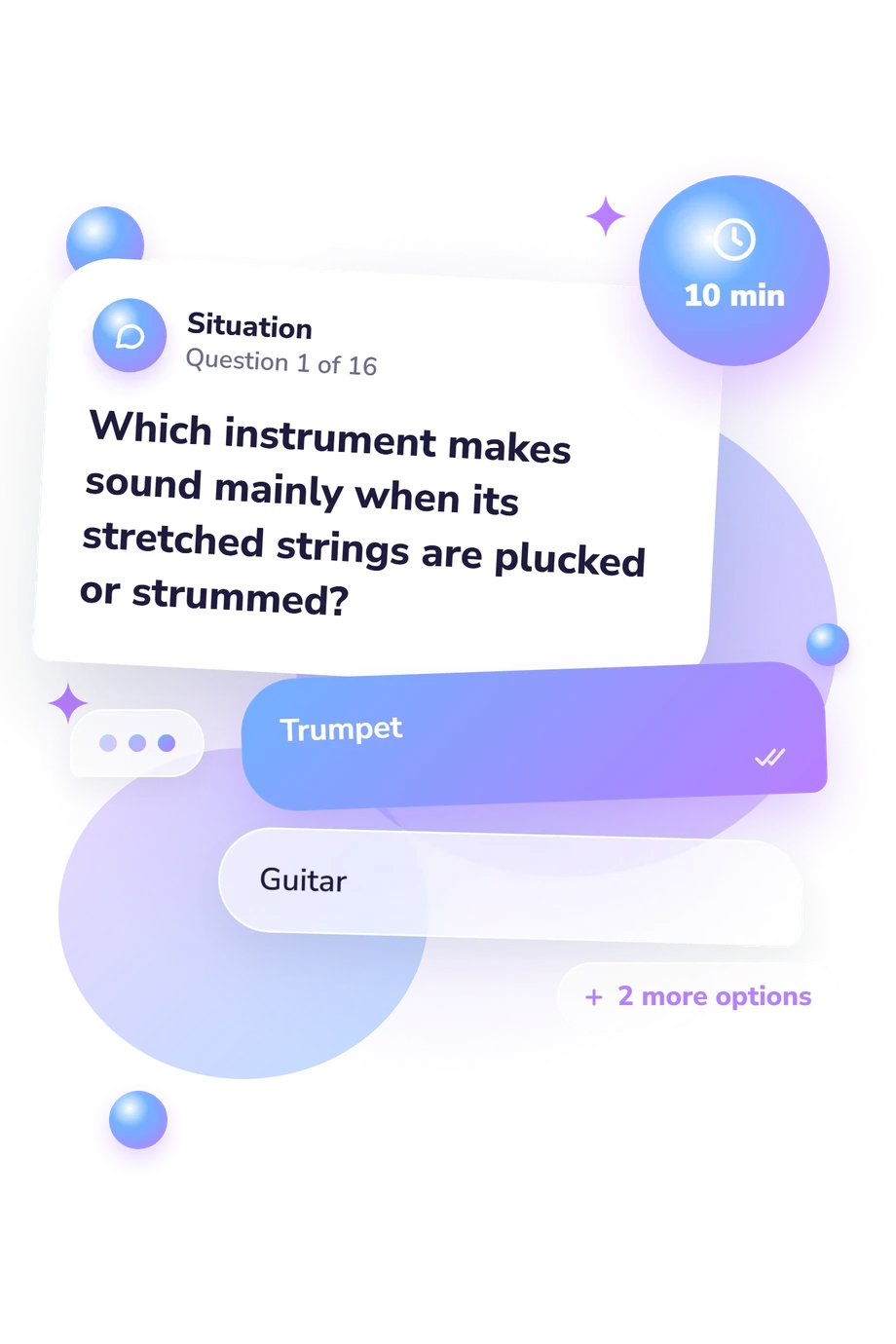
Example Questions From the Test
- Trumpet
- Guitar
- Flute
- Drum
- Brass
- Strings
- Percussion
- Woodwind
- On a chair
- On a horse
- On a rooftop
- On a wall
Music Quiz for Kids - Description and methodology of the test
Children who enjoy songs, instruments, and playful musical questions can use this assessment to check what they already recognize and understand. As a children's music quiz, it is intended for informal learning and self-reflection, whether a child is beginning to notice musical patterns or already talks confidently about familiar tunes. The music quiz for kids gives a clear starting point for choosing what to listen to, sing, or practise next.
What This Assessment Explores
Questions cover children's songs, lyrics, instruments, musical families, and concepts such as beat, rhythm, melody, pitch, tempo, dynamics, and harmony. These music quiz questions for kids mix recall with simple application.
The items examine four areas:
- Songs and lyrics show recall of words and details from familiar children's music.
- Instruments and families indicate recognition of sounds and classifications.
- Musical elements reveal understanding of beat, rhythm, melody, harmony, pitch, tempo, and dynamics.
- Listening situations show whether a child can apply terms to simple performance examples.
The result uses one scale, Music Knowledge (0-16), summarizing recognition of children's songs, lyrics, instruments, and concepts. Starting Note (0-6) indicates an emerging foundation; Growing Musician (7-12) indicates a solid grasp with areas to practise; Music Star (13-16) indicates strong knowledge across the covered topics. A higher band reflects performance here, not a judgment about talent.
Methodology and Scientific Basis
Each item presents a question with four answer choices, so the child selects a response instead of writing an explanation. The format combines recognition, vocabulary, and application: the test uses easy music quiz questions and answers for kids, with answer choices about lyrics, instrument families, and changes in tempo, pitch, or dynamics.
One score is presented rather than separate subscores. It summarizes performance across the items and is descriptive rather than norm-referenced, with no weighting or penalty rule specified. The approach describes knowledge in familiar musical situations, not musicianship, creativity, or potential.
Conceptually, it is consistent with the Elementary Music Achievement Test (Colwell, 1965), but is not an adaptation of that instrument. Asztalos and Csapó (2017) and Buren, Müllensiefen, and Degé (2025) assess related musical abilities, but neither study validates this questionnaire.
Interpretation can be affected by attention, language comprehension, song familiarity, and context. The result is best used as a snapshot for discussion and musical exploration, rather than as a full measure of ability or a diagnosis.
- Colwell, Richard. 1965. Elementary Music Achievement Test Manual: EMAT. Follett Publishing Company.
- Asztalos, Kata, and Benő Csapó. 2017. Development of musical abilities: Cross-sectional computer-based assessments in educational contexts. Psychology of Music, 45(5), 682-698. 10.1177/0305735616678055
- Buren, Verena, Daniel Müllensiefen, and Franziska Degé. 2025. Screening musicality in children: Development and initial validation of a new tool for rapid assessment of musical profiles. PLOS ONE, 20(3), e0317962. 10.1371/journal.pone.0317962
Updated: