
Appositive Quiz
How the Scales are Structured
Who Usually Takes This Test?
See How You Compare
Below is a preview of how scores are typically distributed across each scale.
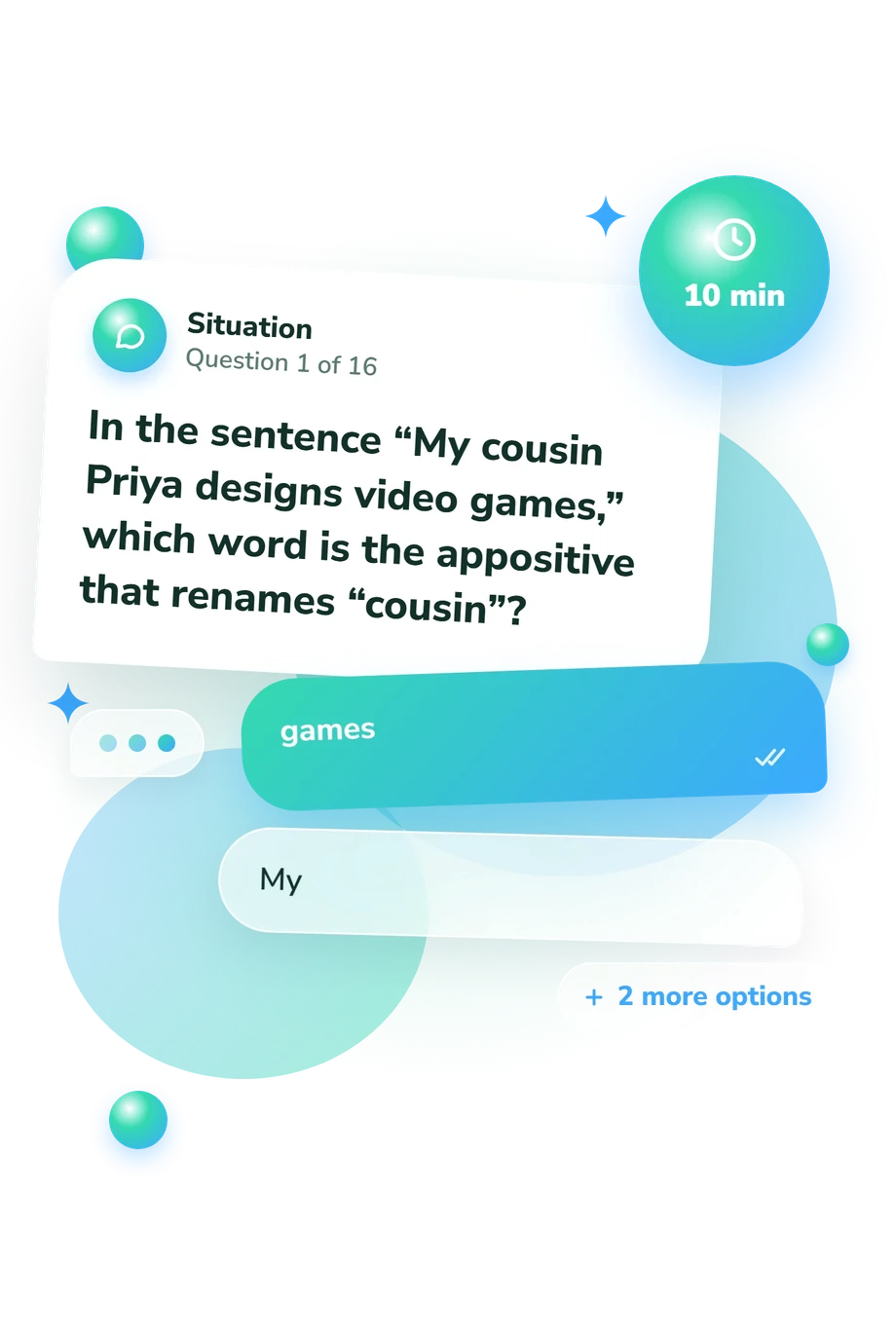
Example Questions From the Test
- games
- My
- designs
- Priya
- It describes how the meetings will be led.
- It renames “a new chair” as an appositive.
- It serves as the sentence’s main verb.
- It identifies the committee as Luis Ortega’s.
- Open with an em dash but close with a comma after “storm.”
- Open with a comma and close with an em dash after “storm.”
- Enclose the entire appositive with paired em dashes.
- Place both em dashes inside the phrase rather than around it.
Appositive Quiz - Description and methodology of the test
Readers who want to strengthen sentence-level grammar can use this appositive quiz to examine how they recognize naming phrases and choose punctuation. It suits students, writers, and anyone reviewing the difference between essential and nonessential information. This appositive online quiz offers focused practice by turning familiar-looking sentences into clear decisions about meaning and punctuation.
What This Assessment Explores
The assessment asks whether you can identify an appositive, determine what noun it renames, and decide whether the information is essential or supplemental. Examples use names, titles, occupations, places, and descriptive phrases, so punctuation depends on context.
As a quiz about appositive phrases, it connects grammatical function with paired commas for nonessential information, no commas for essential identification, and colons or em dashes where structure permits. Appositive Knowledge runs from 0-16: Foundations (0-6), Developing Control (7-12), and Strong Command (13-16). These bands are instructional summaries, not formal certification. The result is a focused snapshot of rule application. The questions cover three related skills:
- Identifying the appositive locates the renaming element.
- Judging essentiality links punctuation with intended reference.
- Applying punctuation selects marks that fit meaning.
Methodology and Evidence Base
In this appositive punctuation quiz, each item presents a sentence or editing problem with four answer choices. Some ask you to identify an appositive or its referent; others ask you to choose punctuation for essential and nonessential phrases, names, titles, or list-like constructions. The format tests applied recognition rather than isolated definitions.
The total is reported on the displayed scale, but no separate item-weighting formula is stated, so point values should not be inferred from the range alone. Because its questions focus on appositive punctuation, this questionnaire offers a focused snapshot of the constructions represented here, not of every grammar skill.
Meyer (1992) is the primary conceptual anchor for attention to naming relationships and information status; Huddleston and Pullum (2002) and Lee (2015) add grammatical and syntactic perspectives. The questionnaire is conceptually consistent with these works, asking about grammatical function and punctuation; its displayed bands are instructional summaries rather than published norms.
Interpret the result in context: terminology, attention, and current learning can affect performance, and a short focused test cannot establish overall writing proficiency. Use it to target review of essential appositives, paired punctuation, and context-sensitive editing.
- Charles F. Meyer. Apposition in Contemporary English. Cambridge: Cambridge University Press, 1992. 10.1017/CBO9780511597824
- Rodney Huddleston and Geoffrey K. Pullum. The Cambridge Grammar of the English Language. Cambridge: Cambridge University Press, 2002. 10.1017/9781316423530
- Hyeyeon Lee. The Syntax and Semantics of English Appositives. Studies in Modern Grammar 86 (2015): 71-95. 10.14342/smog.2015.86.71
Updated: