
Roman God Quiz
How the Scales are Structured
Who Usually Takes This Test?
See How You Compare
Below is a preview of how scores are typically distributed across each scale.
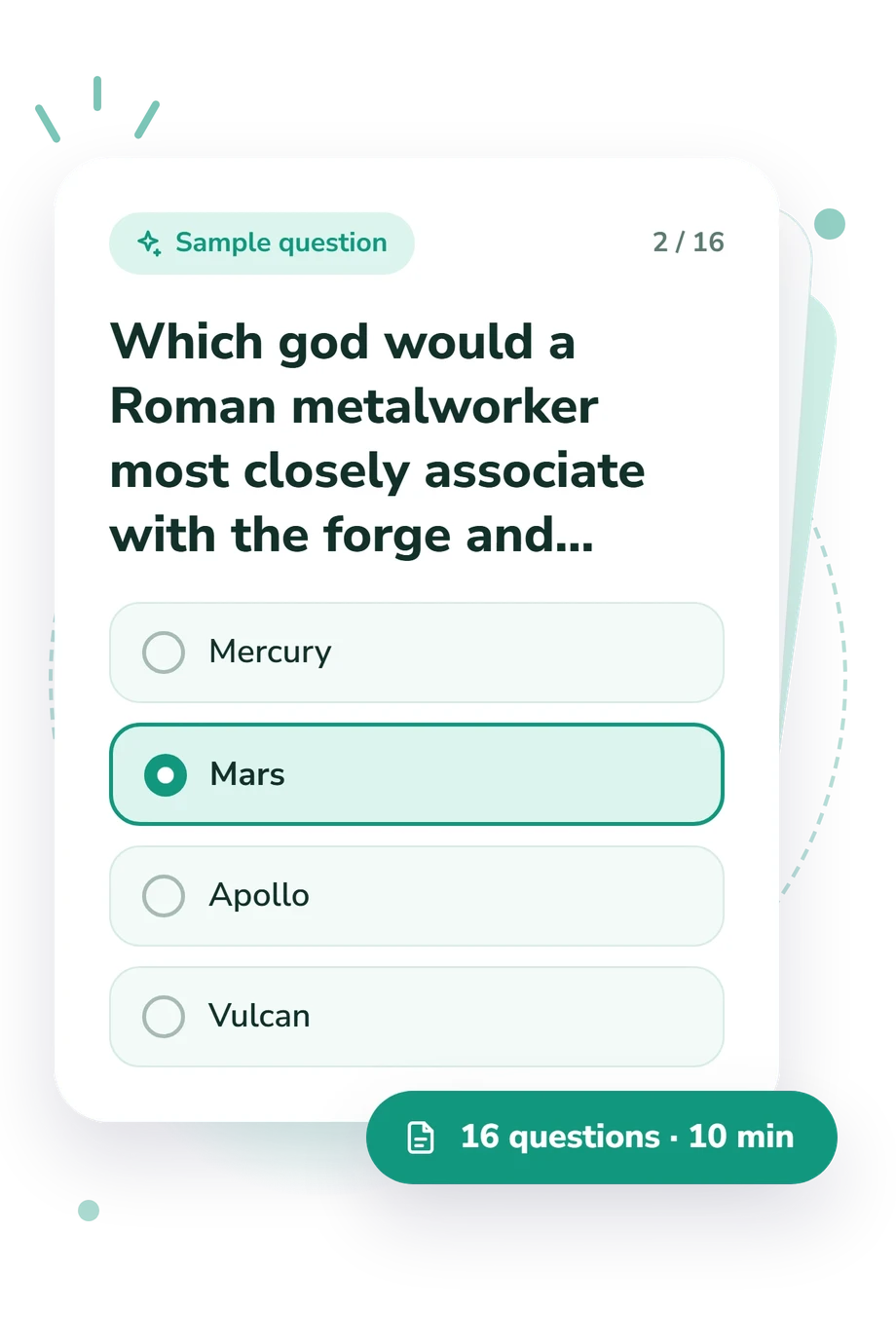
Example Questions From the Test
- Venus
- Minerva
- Diana
- Juno
- Mercury
- Mars
- Apollo
- Vulcan
- Janus
- Saturn
- Mercury
- Terminus
Roman God Quiz - Description and methodology of the test
Curious readers can use this Roman mythology quiz to connect familiar names with their roles, symbols, and traditions. The Roman God Quiz is designed for learners, mythology enthusiasts, and anyone revisiting classical culture. Its result shows how accurately you identify divine functions and religious references, helping you choose useful topics for further study without turning mythology into a personality label.
What This Assessment Measures
Questions link deities and spirits with marriage, smithing, gateways, hearth, hunting, sea, trade, wisdom, agriculture, wine, and household protection. They suit readers checking divine roles, symbols, myths, and religious practice; each asks which figure fits a role, story, or setting.
Rather than functioning as a quiz about which Roman god you are, this assessment checks knowledge rather than personality. Its result reflects accuracy across the traditions represented.
The question content covers three related areas:
- Divine domains ask you to match gods with their spheres.
- Ritual symbolism asks you to recognize sacred objects, festivals, household spirits, and foundation stories.
- Cultural roles ask you to distinguish civic, domestic, agricultural, commercial, and maritime functions.
Roman God Knowledge runs from 0-16: Foundations to Build (0-6), Developing Knowledge (7-12), and Strong Knowledge (13-16). These bands move from partial recognition to a solid working grasp and then broad, accurate command.
Methodology and Evidence Base
Each item presents four answer options and asks the respondent to select the deity or spirit that best fits a role, story, symbol, or setting. The format tests recognition of related divine functions. The questionnaire reports a single total; no separate weighting rule is stated, so the displayed bands guide interpretation.
Its content is conceptually consistent with Turcan (2000), which treats Roman gods through civic, household, and everyday religious life. Lipka (2009) offers a complementary account of divine roles, while Beard, North, and Price (1998) connect beliefs and practices with ancient evidence. The question topics overlap with discussions in Turcan (2000), Lipka (2009), and Beard, North, and Price (1998), but these books do not validate or supply the scoring for this questionnaire.
The questions ask what Roman god fits a role, not what deity a respondent resembles; the format reports knowledge, not identity. Its quiz format may invite the question of what Roman god you are, but it addresses recognition rather than identity. Because it has no stated norm group, reliability estimate, or validation study, results may also reflect guessing, prior education, cultural familiarity, and current attention.
- Robert Turcan, The Gods of Ancient Rome: Religion in Everyday Life from Archaic to Imperial Times, translated by Antonia Nevill. Edinburgh: Edinburgh University Press, 2000, 180 pp.
- Michael Lipka, Roman Gods: A Conceptual Approach. Religions in the Graeco-Roman World, vol. 167. Leiden and Boston: Brill, 2009, 219 pp. 10.1163/ej.9789004175037.i-222.
- Mary Beard, John North, and Simon Price, Religions of Rome: Volume 2, A Sourcebook. Cambridge: Cambridge University Press, 1998, 430 pp. ISBN 9780521456463.
Updated: