
Fortune Teller Quiz
How the Scales are Structured
Who Usually Takes This Test?
See How You Compare
Below is a preview of how scores are typically distributed across each scale.
Example Questions From the Test
- Geomancy
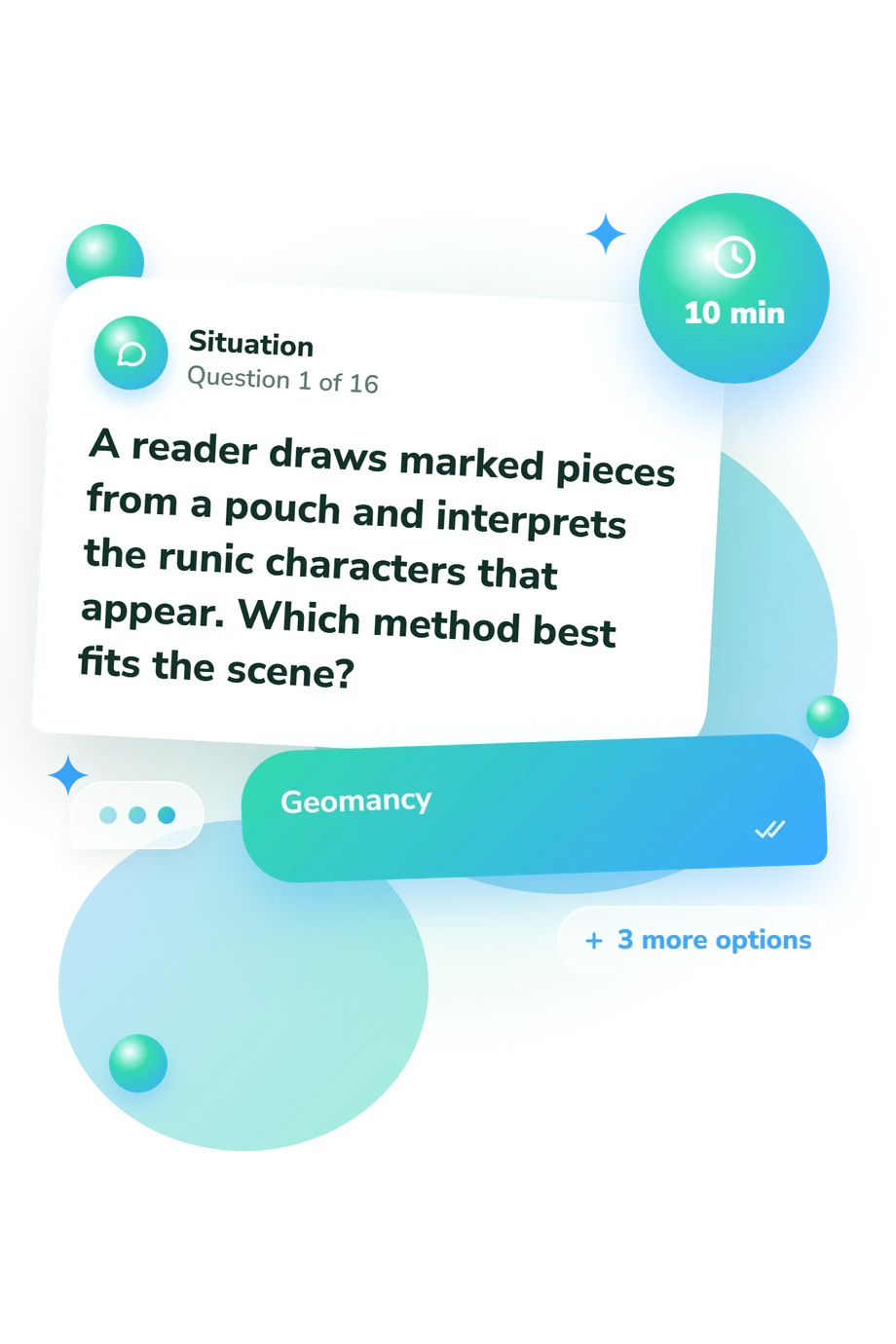
- Rune casting
- Bibliomancy
- Tasseography
- Tasseography
- Cartomancy
- Palmistry
- Numerology
- Phrenology
- Graphology
- Palmistry
- Oneiromancy
Fortune Teller Quiz - Description and methodology of the test
Readers who want to understand divination more clearly can use this assessment as a focused knowledge check. The fortune teller quiz helps curious learners clarify what they know, distinguish unfamiliar traditions, and recognize principles for evaluating claims about prediction. This fortune-telling quiz suits curious learners who want to identify gaps, settle unfamiliar distinctions, and approach claims about prediction more carefully.
What This Assessment Measures
Questions cover named practices rather than personal belief. They ask you to distinguish rune casting, tasseography, palmistry, scrying, cartomancy, numerology, astrology, tarot, natal charts, and the I Ching. The result reflects familiarity with concepts and accurate identification.
For readers studying fortune-telling traditions, this assessment functions as a divination knowledge quiz. It suits readers checking whether terms are used accurately and clarifying how practices and systems are described.
The questions cover these knowledge areas:
- Methods identify what practitioners do with cards, objects, books, leaves, lines, or impressions.
- Symbolic systems test tarot structures, runic characters, astrological placements, and I Ching lines.
- Critical-reading principles test knowledge of recording predictions clearly and limiting hindsight.
The displayed Fortune Teller Knowledge score is 0-16: Foundations to build (0-6), Developing knowledge (7-12), or Strong knowledge (13-16). This result describes the assessed knowledge, not predictive ability.
Methodology and Evidence Base
Each item presents a short scenario or definition with four answer choices. You select the best match among plausible alternatives, so the format tests recognition and discrimination rather than agreement or personal experience. The questionnaire reports one overall displayed result; there is no separate scale for belief or predictive ability.
Conceptually, the content aligns first with Buckland (2003), which catalogs divination methods and terminology. Davies (2026) adds historical context for oracles and prophecy. The cold-reading item matches Dutton (1988), while Marks and Kammann (1980) support critical examination of psychic claims. This questionnaire is conceptually consistent with those works; the cited sources are not validation studies for this questionnaire.
The questionnaire reports one educational score with clear interpretive bands for fortune-telling knowledge. Use that result for focused reading and self-reflection, while familiarity, guessing, cultural exposure, or ambiguous wording can affect performance.
- Buckland, Raymond. The Fortune-Telling Book: The Encyclopedia of Divination and Soothsaying. Visible Ink Press, 2003.
- Davies, Owen. Art of Divination: A Visual History of Oracles, Prophecy, and the Search for Secret Knowledge. Yale University Press, 2026. ISBN 9780300282511.
- Dutton, D. L. The Cold Reading Technique. Experientia, 1988, 44(4), 326-332. 10.1007/BF01961271.
- Marks, David F., and Richard Kammann. The Psychology of the Psychic. Prometheus Books, 1980. ISBN 0879751215.
Updated: