
Is He a Player Quiz
How the Scales are Structured
Who Usually Takes This Test?
See How You Compare
Below is a preview of how scores are typically distributed across each scale.
Example Questions From the Test
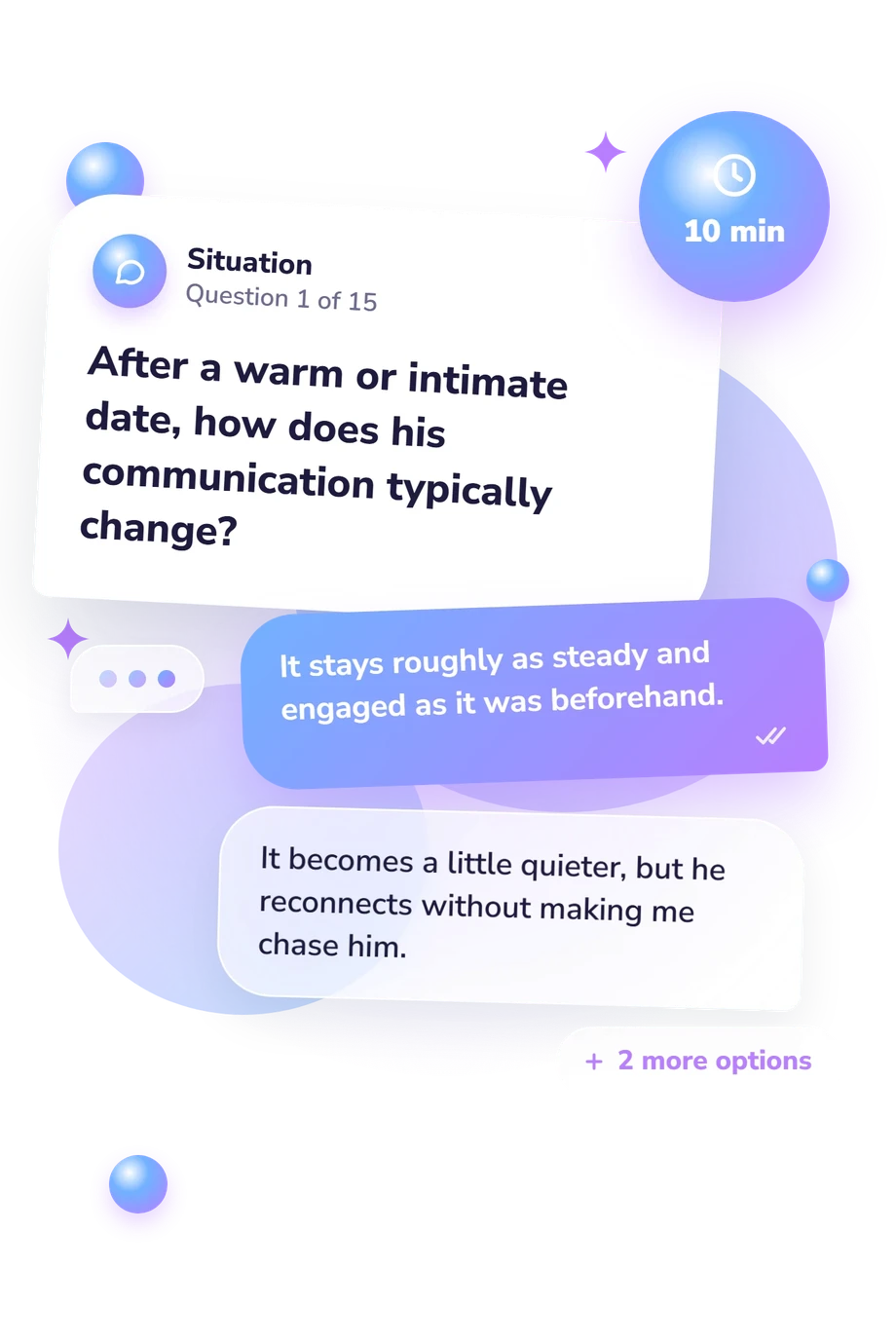
- It stays roughly as steady and engaged as it was beforehand.
- It becomes a little quieter, but he reconnects without making me chase him.
- It often drops off noticeably, then becomes intense again when he wants to meet.
- He commonly vanishes after closeness and returns as if the silence needs no explanation.
- He explains the context calmly and is willing to discuss the boundaries we each expect.
- He sees it differently from me but stays engaged in a respectful conversation.
- He dismisses the question without clarifying what romantic boundaries apply.
- He gives conflicting explanations or blames me for noticing while refusing any honest discussion.
- His account is clear, consistent, and supported by how he conducts the relationship.
- I know the basic situation, although we have not discussed every assumption.
- I mostly rely on hints because direct questions produce incomplete answers.
- I have discovered significant partners or dating activity that he had directly denied or concealed.
Is He a Player Quiz - Description and methodology of the test
People uncertain about a romantic connection can use the Is He a Player Quiz to examine repeated behavior instead of relying on one moment. It is intended for anyone weighing mixed communication, unclear expectations, or uneven effort. People wondering whether they are being played by him can use this assessment as an Am I Being Played by Him Quiz, examining observable patterns to support reflection and a more direct conversation.
What This Assessment Explores
Rather than labeling a person, it examines changing plans, communication that intensifies after distance, unclear dating status, boundary reactions, and responses when harm is raised. Someone wondering whether a romantic interest is serious can approach this assessment as an Is My Crush a Player Quiz, examining behavior rather than assigning a label. Results describe patterns in his actions and communication; they do not establish motives or character, and privacy alone is not evidence of deception.
The result separates three dimensions:
- Consistency and Follow-Through (0-15) reflects whether actions match interest and plans: Generally consistent (0-5), Mixed signals (6-10), Strong inconsistency pattern (11-15).
- Respect and Accountability (0-15) reflects responses to boundaries, concerns, and impact: Respectful foundation (0-5), Strained respect (6-10), Serious concern pattern (11-15).
- Romantic Clarity and Transparency (0-15) reflects communication about status, intentions, and connections: Mostly clear (0-5), Important ambiguity (6-10), Major transparency gaps (11-15).
Methodology and Evidence Base
Each item presents four ordered response choices, moving from clear, consistent, accountable behavior toward ambiguity, pressure, concealment, or disregard. The scoring key combines selected responses into the three displayed dimensions; a higher result indicates more concerns within that dimension.
The displayed bands organize results descriptively; they are not presented as established population norms or clinical cutoffs. Its themes are conceptually consistent with Cole (2001), which examines deception in romantic relationships; Knobloch and Solomon (1999), which examines uncertainty in close relationships; and Tolman (1999), which measures psychological maltreatment. It is not presented as an adaptation of those instruments.
For someone asking whether he is serious about them, the result addresses the question behind an Is He Serious About Me Quiz by organizing observations about communication, boundaries, follow-through, and clarity rather than identifying his character. Self-report can be shaped by memory, current emotions, limited information, or a desire to preserve hope, so read it alongside concrete examples and relationship agreements. If interactions feel coercive, threatening, or unsafe, respond to that experience regardless of the total.
- Tim Cole. Lying to the One You Love: The Use of Deception in Romantic Relationships. Journal of Social and Personal Relationships, 2001, 18(1), 107-129. 10.1177/0265407501181005
- Leanne K. Knobloch and Denise Haunani Solomon. Measuring the Sources and Content of Relational Uncertainty. Communication Studies, 1999, 50(4), 261-278. 10.1080/10510979909388499
- Richard M. Tolman. The Validation of the Psychological Maltreatment of Women Inventory. Violence and Victims, 1999, 14(1), 25-37. 10.1891/0886-6708.14.1.25
Updated: