
Macbeth Quotes Quiz
How the Scales are Structured
Who Usually Takes This Test?
See How You Compare
Below is a preview of how scores are typically distributed across each scale.
Example Questions From the Test
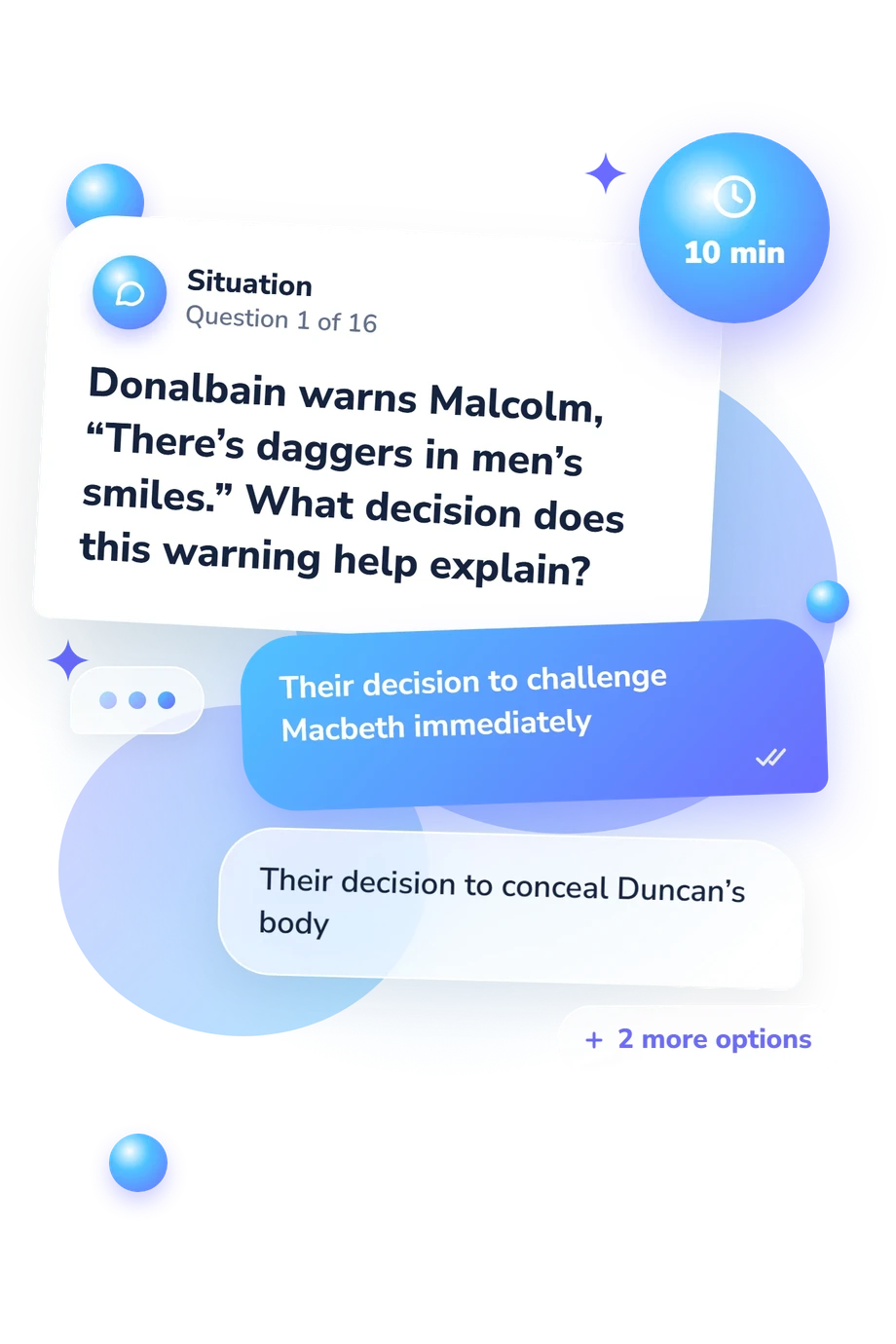
- Their decision to challenge Macbeth immediately
- Their decision to conceal Duncan’s body
- Their decision to accuse the guards in public
- Their decision to flee because the murderer may target them next
- Macbeth
- Banquo
- Macduff
- Malcolm
- Malcolm has been captured along with his army
- Banquo and Fleance have disappeared
- Duncan’s sons have fled Scotland
- His wife and children have been murdered
Macbeth Quotes Quiz - Description and methodology of the test
Readers who want to check their command of Shakespeare’s tragedy can use this assessment to connect memorable wording with characters, scenes, and turning points. The Macbeth Quotes Quiz suits students, theatre readers, and anyone revisiting the play who wants a focused measure of quotation knowledge. As a Macbeth quotation quiz, it turns recall into a practical guide for deciding which speeches and dramatic moments deserve closer review.
What This Assessment Explores
Questions ask you to identify a speaker, complete a line, explain its meaning, or connect it with the surrounding action. They test quotation recall alongside context, including motives, prophecy, imagery, and political change.
When familiar lines blur together, the quiz links speaker, wording, and context within one aggregate knowledge result. It is a Macbeth quote identification quiz for readers checking whether remembered phrases retain dramatic purpose.
The result brings together these aspects of knowledge:
- Macbeth Quotes Knowledge runs from 0-16 and places performance in Emerging (0-6), Developing (7-12), or Strong (13-16), indicating how securely the play’s major quotations are recognized.
- Speaker and wording recognition contribute to the score by showing whether you connect lines with characters and select the correct wording.
- Context recognition shows whether you can link a quotation to its event, conflict, or reversal.
Methodology and Evidence Base
Each item presents a quotation or dramatic situation with four answer choices. Questions ask who speaks, how a line is completed, what it means, or which event surrounds it. One point is awarded for each correct answer, producing the single knowledge score used for the result. The questionnaire has no external norms; its displayed bands are questionnaire-specific.
Shakespeare’s Macbeth provides the textual basis, while Hope and Witmore’s analysis provides an interpretive basis for imagery, voice, and dramatic force. This online questionnaire uses selected quotations and situations from the play, asking readers about wording, speakers, meanings, and surrounding action. Its aggregate result reflects performance across those content areas.
Revision can feel engaging when this Macbeth trivia quiz turns recall into practice, but the result is a snapshot of quotation recognition and context in the tested material. A high band suggests command of those lines; a lower band points to speeches, characters, or scenes worth revisiting. Previous study, edition familiarity, and guessing can affect performance, so the score does not capture complete literary understanding.
- Shakespeare, William. Macbeth. Edited by A. R. Braunmuller. Updated edition. The New Cambridge Shakespeare. Cambridge University Press, 2008. 10.1017/9780511810381
- Hope, Jonathan, and Michael Witmore. "The Language of Macbeth." In Macbeth: The State of Play, edited by Ann Thompson, pp. 183-208. Bloomsbury Publishing, 2014.
Updated: