
What Is Wrong with Me Quiz
How the Scales are Structured
Who Usually Takes This Test?
See How You Compare
Below is a preview of how scores are typically distributed across each scale.
Example Questions From the Test
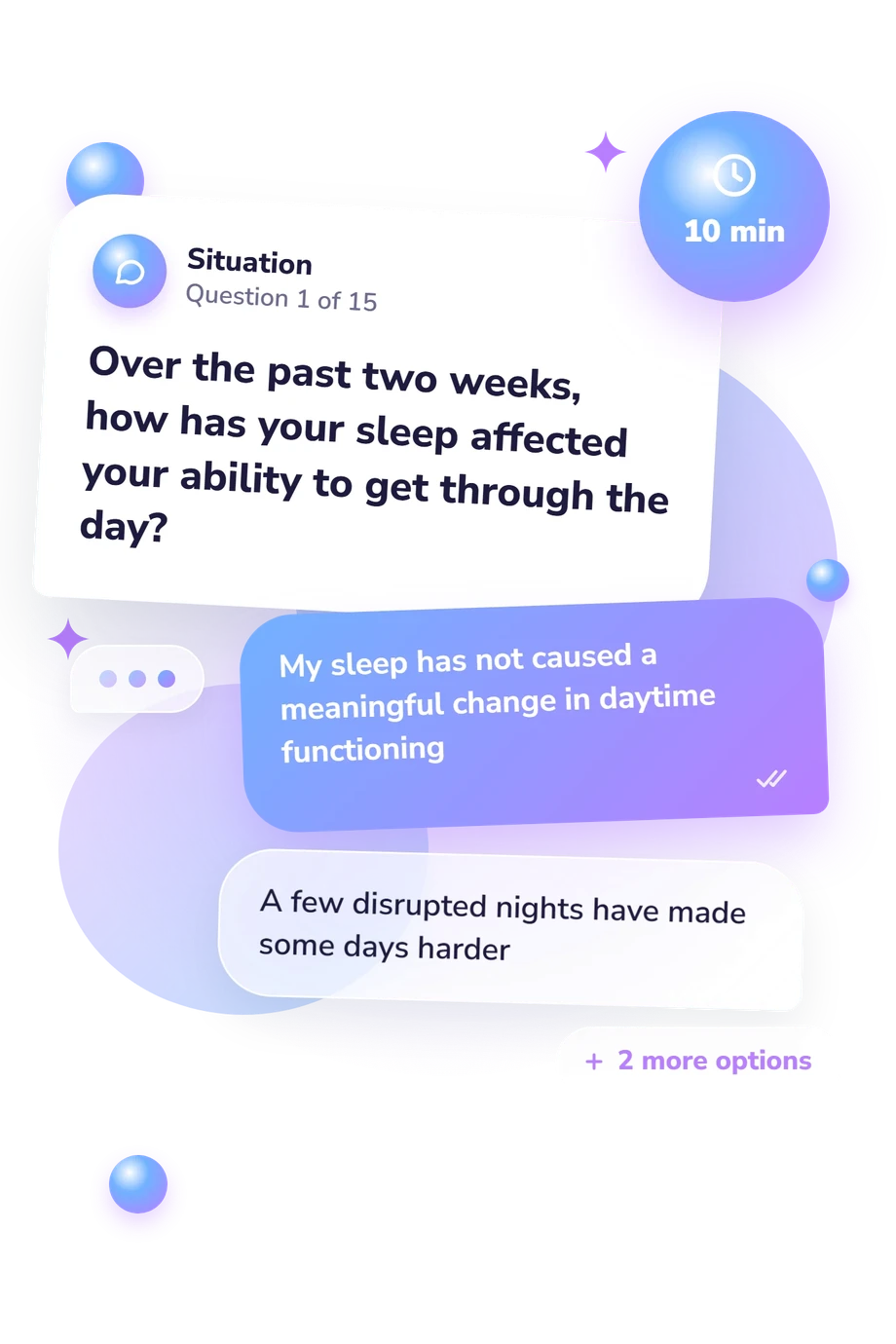
- My sleep has not caused a meaningful change in daytime functioning
- A few disrupted nights have made some days harder
- Sleep problems regularly interfere with my energy, mood, or responsibilities
- I am sleeping so little, so much, or so irregularly that basic daily functioning feels unmanageable
- My interest has remained about the same
- I have felt less interested occasionally, especially when tired or stressed
- I have regularly struggled to enjoy or engage with things that usually matter
- I feel almost entirely disconnected from activities or people I normally value
- No; I have remained oriented and able to interpret my surroundings
- I have briefly felt detached or mentally foggy while tired or stressed
- I have had repeated episodes of losing track of time, surroundings, or what seemed real
- I currently cannot reliably tell where I am or what is real, or I perceive commands to cause harm
What Is Wrong with Me Quiz - Description and methodology of the test
For people who feel unlike themselves, less able to manage ordinary demands, or unsure whether distress deserves attention, the What Is Wrong with Me Quiz, a what is wrong with you quiz, offers a structured self-check. It organizes recent experiences into areas rather than assigning a label. The result helps a reader use a what is actually wrong with me quiz to decide what to notice, discuss, or address next.
What This Assessment Explores
Questions cover sleep, interest, concentration, emotional recovery, self-care, basic needs, safety, and harm-related thoughts. The result shows which area needs attention, separating current difficulties from personal fault. It also addresses the worry behind a what am I doing wrong quiz. The three displayed dimensions are:
- Daily Functioning Changes (0-15) shows disruption in sleep, concentration, self-care, needs, or responsibilities. Bands: No current change reported (0); A change to watch (1-2); Practical support is warranted (3-15).
- Emotional Distress (0-15) reflects difficulty managing sadness, fear, anger, emptiness, dread, or intrusive worry. Bands: No indicator reported (0); Something to notice (1-2); Support is warranted (3-15).
- Urgent Support Indicators (0-15) identifies immediate danger, unmet essential needs, or possible harm. Bands: No urgent indicator reported (0); Needs attention (1-2); Act now (3-15).
Methodology and Scientific Basis
Each item offers four ordered choices, moving from no meaningful change toward persistent disruption, inability to manage essentials, or urgent danger. The response design gives structure to an exasperated what the f is wrong with you quiz question without turning it into a diagnosis. It does not specify universal per-answer weighting or item-to-scale mapping, so the 0-15 displays should not be reverse-engineered.
The closest comparison for self-harm and suicidal-thought items is the Columbia-Suicide Severity Rating Scale. CORE-OM offers a self-report framework for distress, functioning, and risk, while CORE provides routine-outcome context; functioning also aligns with WHODAS 2.0. These instruments clarify related constructs, but this questionnaire is not an adaptation of them.
A wtf is wrong with me quiz reaction may prompt taking the assessment, but displayed bands are unvalidated reflective summaries rather than clinical cutoffs or severity ratings. Read each band alongside the endorsed experience: a single red-flag response scored 3 overrides the score and should be acted on regardless of the total. Self-report remains sensitive to current context, self-awareness, and response bias, so urgent safety concerns call for human support.
- Evans, C., Connell, J., Barkham, M., Margison, F., McGrath, G., Mellor-Clark, J., & Audin, K. (2002). Towards a standardised brief outcome measure: Psychometric properties and utility of the CORE-OM. British Journal of Psychiatry, 180(1), 51-60. 10.1192/bjp.180.1.51
- Evans, C., Mellor-Clark, J., Margison, F., Barkham, M., Audin, K., Connell, J., & McGrath, G. (2000). CORE: Clinical Outcomes in Routine Evaluation. Journal of Mental Health, 9(3), 247-255. 10.1080/jmh.9.3.247.255
- World Health Organization. (2010). Measuring health and disability: Manual for WHO Disability Assessment Schedule (WHODAS 2.0). World Health Organization. ISBN: 9789241547598
- Posner, K., Brown, G. K., Stanley, B., Brent, D. A., Yershova, K. V., Oquendo, M. A., Currier, G. W., Melvin, G. A., Greenhill, L., Shen, S., & Mann, J. J. (2011). The Columbia-Suicide Severity Rating Scale: Initial validity and internal consistency findings from three multisite studies with adolescents and adults. American Journal of Psychiatry, 168(12), 1266-1277. 10.1176/appi.ajp.2011.10111704
Updated: