
Indian Constitution Quiz
How the Scales are Structured
Who Usually Takes This Test?
See How You Compare
Below is a preview of how scores are typically distributed across each scale.
Example Questions From the Test
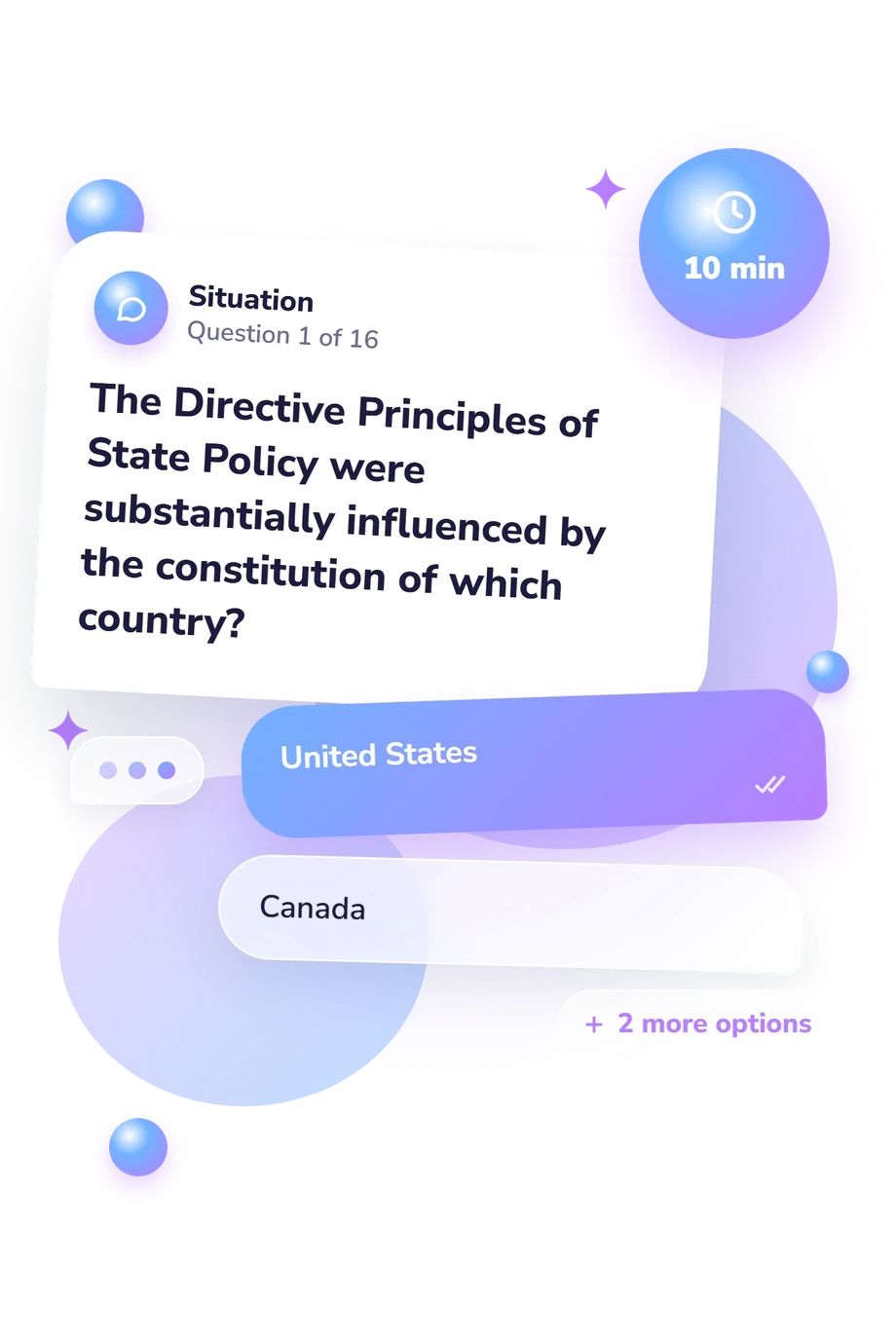
- United States
- Canada
- Australia
- Ireland
- Part III
- Part IV
- Part II
- Part IVA
- Article 356
- Article 360
- Article 324
- Article 368
Indian Constitution Quiz - Description and methodology of the test
For students, civics learners, and readers revisiting India’s constitutional framework, this assessment checks core provisions and institutions. It presents constitutional questions with answer choices, making its Indian Constitution quiz questions and answers a practical check of recall and short legal-scenario reasoning; the result can show which areas deserve further study. The format works as a quiz on Indian Constitution with answers to each item, supporting independent learning and structured revision.
What This Assessment Explores
The questions examine constitutional knowledge rather than personal attitudes. They cover Fundamental Rights, Directive Principles, equality in public employment, language, parliamentary responsibility, constitutional offices, amendment power, federal relations, and landmark dates. Several items ask which article, institution, or consequence applies in a scenario.
The result is organized as Indian Constitution Knowledge on a 0-16 range. Its displayed bands are:
- Foundation to build (0-6) shows recognition of some constitutional ideas and points to review of structure, rights, institutions, and procedures.
- Developing knowledge (7-12) shows understanding of many core provisions while leaving room to strengthen distinctions and scenario-based application.
- Strong knowledge (13-16) shows a broad grasp of major principles that can usually be applied accurately.
The score from reviewing quiz questions about the Constitution of India in this assessment maps revision needs rather than legal competence.
Methodology and Scientific Basis
Each item uses a multiple-choice format with four answer options. Some questions ask for an article or date; others describe an institutional event and ask what follows. The output is an educational score that summarizes performance across constitutional recall and scenario-based application; it is not a professional qualification.
Its conceptual anchor is the Indian Constitution, which supplies the provisions, institutions, and procedures addressed. Choudhry, Khosla, and Mehta’s 2016 discussion of Indian constitutionalism provides broader context, while the 1973 Kesavananda Bharati decision is relevant to the basic structure doctrine tested in one scenario. The questionnaire is conceptually consistent with these sources, not an adaptation of any one of them.
Interpret the result as a snapshot of current recall, reasoning, and scenario recognition. Guessing, familiarity with constitutional vocabulary, and what is fresh in memory can affect performance; later study may change it. This assessment can guide revision: as an Indian Constitution knowledge quiz, its score remains educational feedback about current knowledge.
- Government of India, Ministry of Law and Justice, Legislative Department. The Constitution of India. New Delhi: Government of India, 2025.
- Choudhry, Sujit, Madhav Khosla, and Pratap Bhanu Mehta. "Locating Indian Constitutionalism." In The Oxford Handbook of the Indian Constitution, 1-14. Oxford University Press, 2016. 10.1093/law/9780198704898.003.0001.
- Kesavananda Bharati v. State of Kerala, Supreme Court of India, Writ Petition (Civil) No. 135 of 1970, judgment dated April 24, 1973, (1973) 4 SCC 225.
Updated: