
PLL Character Quiz
How the Scales are Structured
Who Usually Takes This Test?
See How You Compare
Below is a preview of how scores are typically distributed across each scale.
Example Questions From the Test
- Check in privately and ask what kind of help they want
- Gather the facts before deciding whether to intervene
- Step beside them immediately and confront the situation head-on
- Redirect attention, then help them decide what to do next
- Follow it because continuity matters to me
- Adapt a few details without drawing much attention
- Question it openly, then decide what feels personally authentic
- Create my own version while preserving parts I still value
- Summarize each position carefully
- Give everyone a pause before revisiting the issue
- Use a sharp, well-timed joke to release some pressure
- Say the honest thing others seem to be circling around
PLL Character Quiz - Description and methodology of the test
Fans who want to connect their viewing experience with personal reflection can use the PLL Character Quiz to see which character pattern feels most familiar. It is designed for readers who enjoy the Which Pretty Little Liar Are You Quiz format, using everyday choices, loyalties, creativity, and problem-solving habits rather than plot knowledge. The result identifies a strongest affinity or a blended profile.
What This Assessment Measures
The questions turn character qualities into choices about relationships, pressure, expression, group roles, privacy, and courage. The result suits anyone exploring the PLL Quiz Who Am I prompt while keeping a playful label separate from the whole person.
The five displayed scales are:
- Alison DiLaurentis (0-12) measures charisma, command, guardedness, adaptability, and presentation; 0-4 Distant resemblance, 5-8 Shared traits, 9-12 Strong affinity.
- Aria Montgomery (0-12) measures creativity, independence, imagination, and expression; 0-4 Distant resemblance, 5-8 Shared traits, 9-12 Strong affinity.
- Emily Fields (0-12) measures empathy, loyalty, teamwork, and quiet courage; 0-4 Distant resemblance, 5-8 Shared traits, 9-12 Strong affinity.
- Hanna Marin (0-12) measures social intuition, humor, boldness, and instinctive loyalty; 0-4 Distant resemblance, 5-8 Shared traits, 9-12 Strong affinity.
- Spencer Hastings (0-12) measures analysis, competitiveness, planning, and determination; 0-4 Distant resemblance, 5-8 Shared traits, 9-12 Strong affinity.
Methodology and Evidence Base
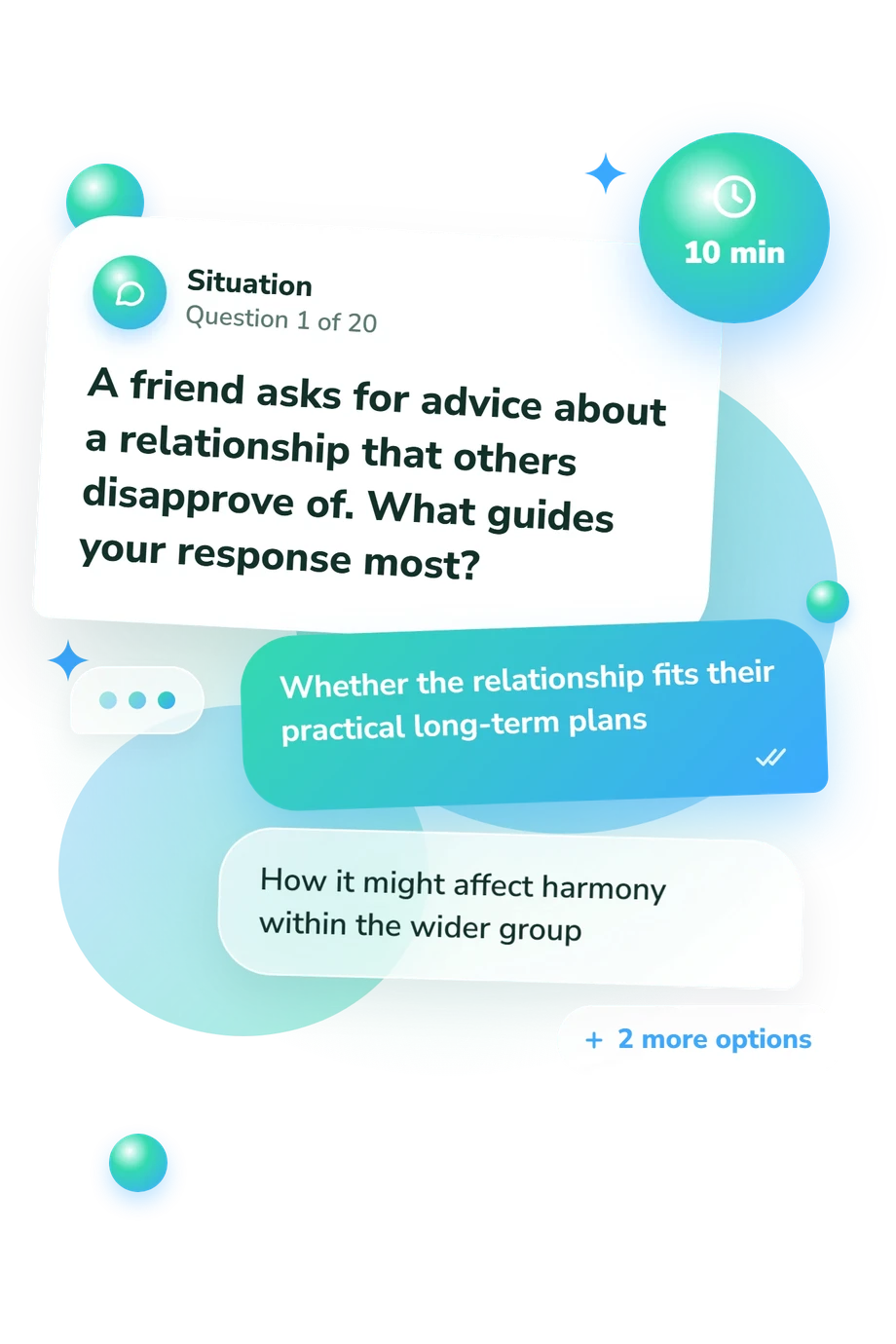
Each item presents a short situation with four response options. The choices contrast practical judgment, group sensitivity, creativity, emotional openness, loyalty, social impact, and analysis, so the respondent selects the response that feels most characteristic rather than rating isolated adjectives. The What PLL Character Are You Quiz format uses behavior in context.
Scoring compares totals across the five profiles. The highest total is the strongest affinity, and any scale within one point of it forms a blended result. This produces a comparative profile rather than a single categorical type.
Rarity et al. (2022) reports an association between fictional-character identification and shared personality traits. Hoffner and Buchanan (2005) connect wishful identification with perceived similarity and character attributes, while Hoorn and Konijn (2003) explain viewers’ experience of fictional characters. Jorgenson (2020) documents a statistical approach to character-matching assessments. These sources support the framework conceptually; this questionnaire is not presented as their adaptation.
The result answers the Which PLL Character Am I Quiz question by showing which affinity is strongest. As a self-report format without stated normative standardization, it is sensitive to mood and self-perception, and its bands are descriptive rather than clinical thresholds.
- Rarity, Erica C., Matthew R. Leitao, and Abraham M. Rutchick. (2022). Identification With Characters in Parasocial Relationships Predicts Sharing Their Personality Traits. Psychology of Popular Media, 11(2), 111-116. 10.1037/ppm0000389
- Jorgenson, Eric. (2020). Development of the Statistical “Which Character” Personality Quiz. Open-Source Psychometrics Project.
- Hoffner, C., and Buchanan, M. (2005). Young Adults’ Wishful Identification With Television Characters: The Role of Perceived Similarity and Character Attributes. Media Psychology, 7(4), 325-351. 10.1207/S1532785XMEP0704_2
- Hoorn, J. F., and Konijn, E. A. (2003). Perceiving and Experiencing Fictional Characters: An Integrative Account. Japanese Psychological Research, 45(4), 250-268. 10.1111/1468-5884.00225
Updated: