
3rd Grade Science Quiz
How the Scales are Structured
Who Usually Takes This Test?
See How You Compare
Below is a preview of how scores are typically distributed across each scale.
Example Questions From the Test
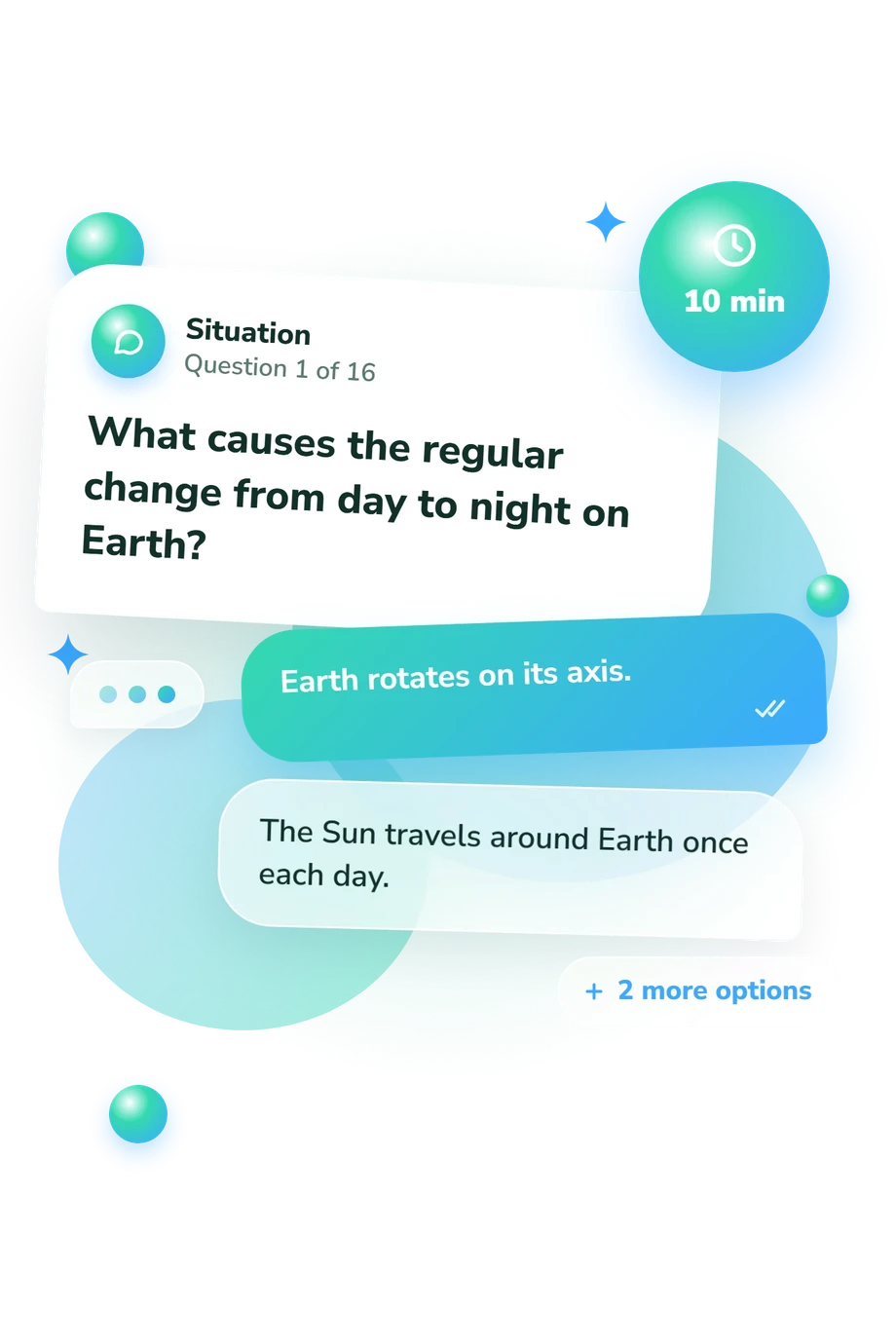
- Earth rotates on its axis.
- The Sun travels around Earth once each day.
- Clouds block all sunlight every evening.
- Earth moves closer to and farther from the Sun each day.
- Planting vegetation whose roots hold the soil
- Covering the hill with loose sand
- Removing the remaining grass
- Pouring more water down the hill
- A wooden craft stick
- A plastic bottle cap
- An iron paper clip
- A rubber band
3rd Grade Science Quiz - Description and methodology of the test
Teachers, parents, and students who want a focused check of foundational ideas can use this 3rd grade science quiz to get an overall indication of performance across the sampled science content. It suits classroom warm-ups, homework review, and independent practice. This online science quiz for class 3 presents familiar situations and asks learners to select the best scientific explanation.
What This Assessment Explores
These questions sample broad elementary science understanding. Learners connect observations with explanations and apply familiar ideas about change, systems, and tools. The intended audience is a young learner using this grade 3 science quiz to review classroom concepts.
The questions fall into three broad topic groups:
- Earth and life systems link daily patterns, habitats, food chains, life cycles, and organism needs.
- Matter and physical processes explain dissolving, melting, friction, shadows, sound, and simple machines.
- Investigation skills involve choosing tools and using evidence to select the best explanation.
The displayed scale is 3rd Grade Science Knowledge (0-16), with one point for each correct answer. Foundations to Build is 0-6, Developing Knowledge is 7-12, and Strong Knowledge is 13-16. These bands describe the concepts sampled, not every aspect of science learning.
Methodology and Scientific Basis
Each item uses a multiple-choice format with one best answer. Scenarios ask for cause-and-effect reasoning, classification, prediction, tool selection, or recognition of a scientific term. One point is awarded for each correct response, and the total determines the displayed result band; no additional weighting is indicated.
Question topics are conceptually consistent with the NGSS, the National Research Council framework, and Pellegrino and colleagues’ assessment work. The NGSS links elementary science learning with disciplinary core ideas, scientific practices, and crosscutting concepts. The National Research Council connects concepts with practices, while Pellegrino and colleagues explain how assessment tasks can represent such expectations. These sources provide curricular and assessment context, not validation studies for this quiz.
For a quick learning check, this third grade science test offers a focused result. Its band summarizes performance on the sampled questions and can be affected by reading comprehension, recent instruction, attention, and familiarity with examples. It may suggest whether broader review or hands-on practice is useful, while classroom work and teacher observation add context.
- NGSS Lead States. 2013. Next Generation Science Standards: For States, By States. Washington, DC: The National Academies Press. 10.17226/18290.
- National Research Council. 2012. A Framework for K-12 Science Education: Practices, Crosscutting Concepts, and Core Ideas. Washington, DC: The National Academies Press. 10.17226/13165.
- Pellegrino, James W., Mark R. Wilson, Judith A. Koenig, and Alexandra S. Beatty, editors. 2014. Developing Assessments for the Next Generation Science Standards. Washington, DC: The National Academies Press. 10.17226/18409.
Updated: