
Band Logo Quiz
How the Scales are Structured
Who Usually Takes This Test?
See How You Compare
Below is a preview of how scores are typically distributed across each scale.
Example Questions From the Test
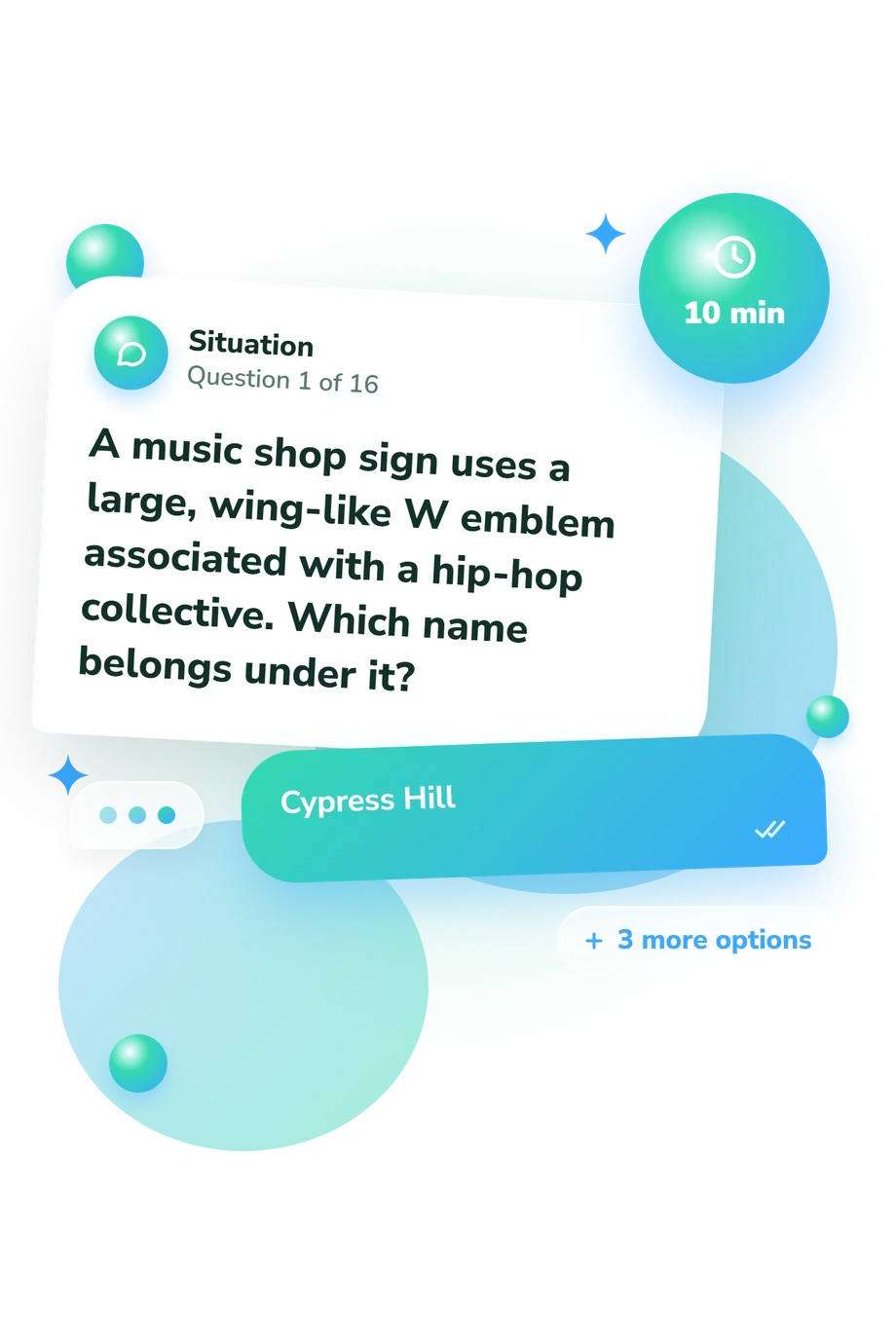
- Cypress Hill
- The Roots
- Bone Thugs-n-Harmony
- Wu-Tang Clan
- Journey
- Electric Light Orchestra
- Queen
- Yes
- The Jam
- Small Faces
- The Who
- The Kinks
Band Logo Quiz - Description and methodology of the test
People who enjoy identifying visual signatures in popular music can use this assessment to test recognition rather than lyrical or biographical knowledge. As a music logo quiz, it suits fans, collectors, designers, and curious listeners who want a focused challenge built around familiar cultural imagery. The band logo quiz produces a straightforward result tied to the logos included in the questionnaire and may prompt personal exploration of music’s visual culture.
What This Assessment Measures
The questions examine visual recognition of band identity through wordmarks, initials, crests, mascots, seals, letterforms, and standalone symbols. They span hip-hop, classic rock, punk, metal, and alternative music, asking you to connect a design cue with the correct act. Your performance on these choices reflects band logo recognition: correct identifications concern cultural imagery, not musical ability, listening skill, or band history.
The result uses one displayed scale:
- Band Logo Knowledge (0-16) counts correct identifications: Emerging Recognition (0-6) reflects recognition of some major music imagery; Developing Knowledge (7-12) indicates a solid range of famous logos with room to explore less familiar scenes or eras; Logo Authority (13-16) shows strong, wide-ranging recognition of iconic band symbols and wordmarks.
A lower band suggests opportunities for discovery rather than a fixed lack of knowledge, while a higher band indicates breadth across the examples represented.
Methodology and Scientific Basis
Each item presents a clue and four band names. Choosing one makes the task a forced-choice recognition exercise rather than free recall. The score is the number of correct responses, with bands translating that total into a description of recognition strength.
Mayas et al. (2024) offer the closest methodological comparison because its logo research separates recognition, recall, and naming. This questionnaire is conceptually consistent with that distinction, but it is not an adaptation or validation of the study. Blake et al. (2015) likewise shows why logo memory can be reconstructive: familiar marks may be remembered confidently while details are altered or overlooked.
Rijken et al. (2021) is relevant to the quiz’s typography because metal logos vary in legibility and semantic clarity. Difficulty may therefore reflect how stylized or culturally familiar a mark is. As a band logo test, the result is a snapshot of recognition for these examples, covering symbols, wordmarks, crests, and visual identities. Exposure, guessing, current attention, and personal memory can affect performance, so interpret it as recognition for this set rather than a complete measure of music knowledge.
- Mayas, Julia, Antonio Prieto, and Pedro R. Montoro. “Memory and metamemory in everyday settings: Assessing recall, recognition, and naming using car brand logos.” Applied Cognitive Psychology 38, no. 1 (2024): e4138. 10.1002/acp.4138
- Rijken, Gerrit J., Rene Cutura, Frank Heyen, Michael Sedlmair, Michael Correll, Jason Dykes, and Noeska Smit. “Illegible Semantics: Exploring the Design Space of Metal Logos.” arXiv preprint arXiv:2109.01688 (2021). 10.48550/arXiv.2109.01688
- Blake, Adam B., Meenely Nazarian, and Alan D. Castel. “The Apple of the mind’s eye: Everyday attention, metamemory, and reconstructive memory for the Apple logo.” Quarterly Journal of Experimental Psychology 68, no. 5 (2015): 858-865. 10.1080/17470218.2014.1002798
Updated: