
Candida Quiz
How the Scales are Structured
Who Usually Takes This Test?
See How You Compare
Below is a preview of how scores are typically distributed across each scale.
Example Questions From the Test
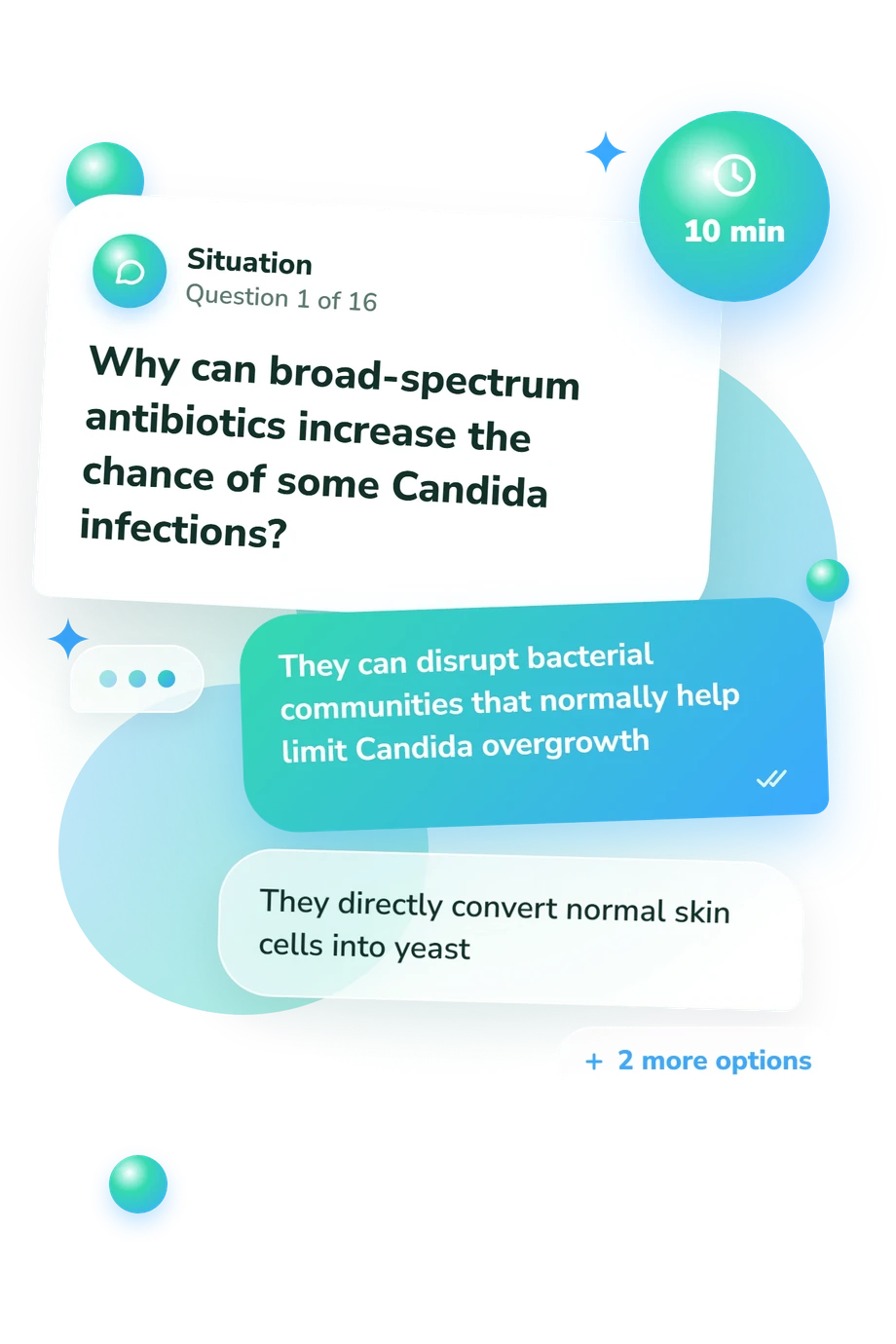
- They can disrupt bacterial communities that normally help limit Candida overgrowth
- They directly convert normal skin cells into yeast
- They permanently weaken every part of the immune system
- They make Candida spread through coughing and sneezing
- They reliably diagnose invasive candidiasis based on food cravings
- There is not robust evidence that highly restrictive cleanse diets diagnose or eradicate Candida infections
- They should replace prescribed antifungal treatment for confirmed infection
- They have been proven to remove Candida permanently from every healthy person
- A virus that primarily infects the respiratory tract
- A family of bacteria found only in contaminated food
- A group of yeasts that can normally live on or in the body but may sometimes cause infection
- A parasite transmitted exclusively through insect bites
Candida Quiz - Description and methodology of the test
For readers who want to understand Candida without jumping from a symptom to a conclusion, this Candida Quiz offers a compact knowledge check. Someone considering a quiz about whether they have Candida can use it to learn why symptoms alone are not enough. It is intended for general readers reviewing colonization, infection, risk factors, testing, and treatment principles, with the result directing attention toward secure knowledge and useful gaps.
What This Assessment Explores
It frames Candida as yeasts that may live on or in the body but can cause disease when barriers, competing microbes, or immune defenses change. Scenarios move from colonization to oral, vaginal, diaper-area, esophageal, and invasive infections.
Several items address Candida overgrowth, recurrent symptoms, risk factors, laboratory interpretation, and the difference between a possible condition and a confirmed cause.
The result is reported through Candida Knowledge (0-16): Foundation (0-6), Developing (7-12), and Strong (13-16). These educational bands describe breadth of understanding rather than infection status.
Together, the questions examine these areas:
- Risk factors and prevention show whether you can connect antibiotics, steroids, immune suppression, and intensive care with changing risk.
- Clinical patterns show whether you can distinguish oral, vaginal, diaper-area, and esophageal presentations from similar complaints.
- Testing and treatment show whether you understand examination, species identification, susceptibility results, colonization, and invasive disease.
Methodology and Scientific Basis
Each item offers four answer choices and asks for the response best supported by medical knowledge. The mix of direct facts and short clinical scenarios tests context rather than symptom matching alone. The format rewards recognizing when context changes the appropriate conclusion.
For general learning, it can function as an online quiz about Candida that reinforces distinctions between common presentations, risk profiles, clinical evaluation, and treatment principles.
Conceptually, the questionnaire is consistent with the knowledge focus in King et al. (2025), but it is not a reproduction, adaptation, or validation of that study’s instrument. Clinical distinctions and treatment principles align with Pappas et al. (2016), whose guideline addresses colonization, species, susceptibility, and invasive disease.
Performance is summarized across the items and placed in the displayed result range; the questionnaire itself is not a standardized clinical measure. Prior knowledge, attention, memory, and current concerns can affect answers. Since symptoms overlap, the result cannot confirm or exclude infection and is best used to identify topics for further learning or discussion.
- King EF, Amankwah PO, Bonsra EA, Adam A. Candidiasis knowledge, Self-Reported infection history, preventive practices, and associated factors among female tertiary students in Ghana. BMC Women's Health. 2025;25:476. 10.1186/s12905-025-04042-1
- Pappas PG, Kauffman CA, Andes DR, Clancy CJ, Marr KA, Ostrosky-Zeichner L, Reboli AC, Schuster MG, Vazquez JA, Walsh TJ, Zaoutis TE, Sobel JD. Clinical Practice Guideline for the Management of Candidiasis: 2016 Update by the Infectious Diseases Society of America. Clinical Infectious Diseases. 2016;62(4):e1-e50. 10.1093/cid/civ933
Updated: