
Blueprint Quiz
How the Scales are Structured
Who Usually Takes This Test?
See How You Compare
Below is a preview of how scores are typically distributed across each scale.
Example Questions From the Test
- I treat it as information and usually keep the decision open
- I tend to interpret it as a sign that I should not proceed
- I can acknowledge it without automatically changing course
- It often leads me to delay while I search for emotional certainty
- I follow its momentum and work out the purpose afterward
- I compare it with a defined priority before deciding
- I check whether it fits my values, although my endpoint is broad
- I weigh its pros and cons, but I lack a clear reference goal
- I usually reshape the choice until disapproval feels unlikely
- I seek perspective, then decide according to what matters to me
- I move ahead, though imagined reactions take up some attention
- I postpone the choice while trying to predict everyone’s response
Blueprint Quiz - Description and methodology of the test
People who want to understand why good intentions do not become consistent action may find the Blueprint Quiz useful. It frames follow-through as an interaction between conditions, direction, and emotional pressure rather than as a simple matter of willpower. As a goal-setting questionnaire, it helps identify which obstacle deserves attention first and which pattern to examine when choosing a next step.
What This Assessment Explores
Progress can stall through conditions, unclear priorities, or internal pressure. Scenarios cover interruptions, setup, overload, missed plans, feedback, opportunities, and unclear goals. As a follow-through assessment, it highlights friction, not discipline, ability, or worth.
The dimensions are:
- Action Friction Block (0-15) reflects practical obstacles to repeatable action. Supportive structure (0-5) means conditions help; Uneven structure (6-10) shows snags; Persistent friction (11-15) means disruption may separate intention from action.
- Direction Clarity Block (0-15) reflects uncertainty about priorities and outcomes. Defined direction (0-5) means destination is clear; Competing signals (6-10) need sorting; Direction fog (11-15) reflects unclear or shifting aims.
- Inner Resistance Block (0-15) reflects self-doubt, perfectionistic pressure, and discomfort with uncertainty. Workable discomfort (0-5) rarely controls choices; Noticeable resistance (6-10) sometimes delays action; Strong resistance (11-15) may interrupt progress.
Methodology and Scientific Basis
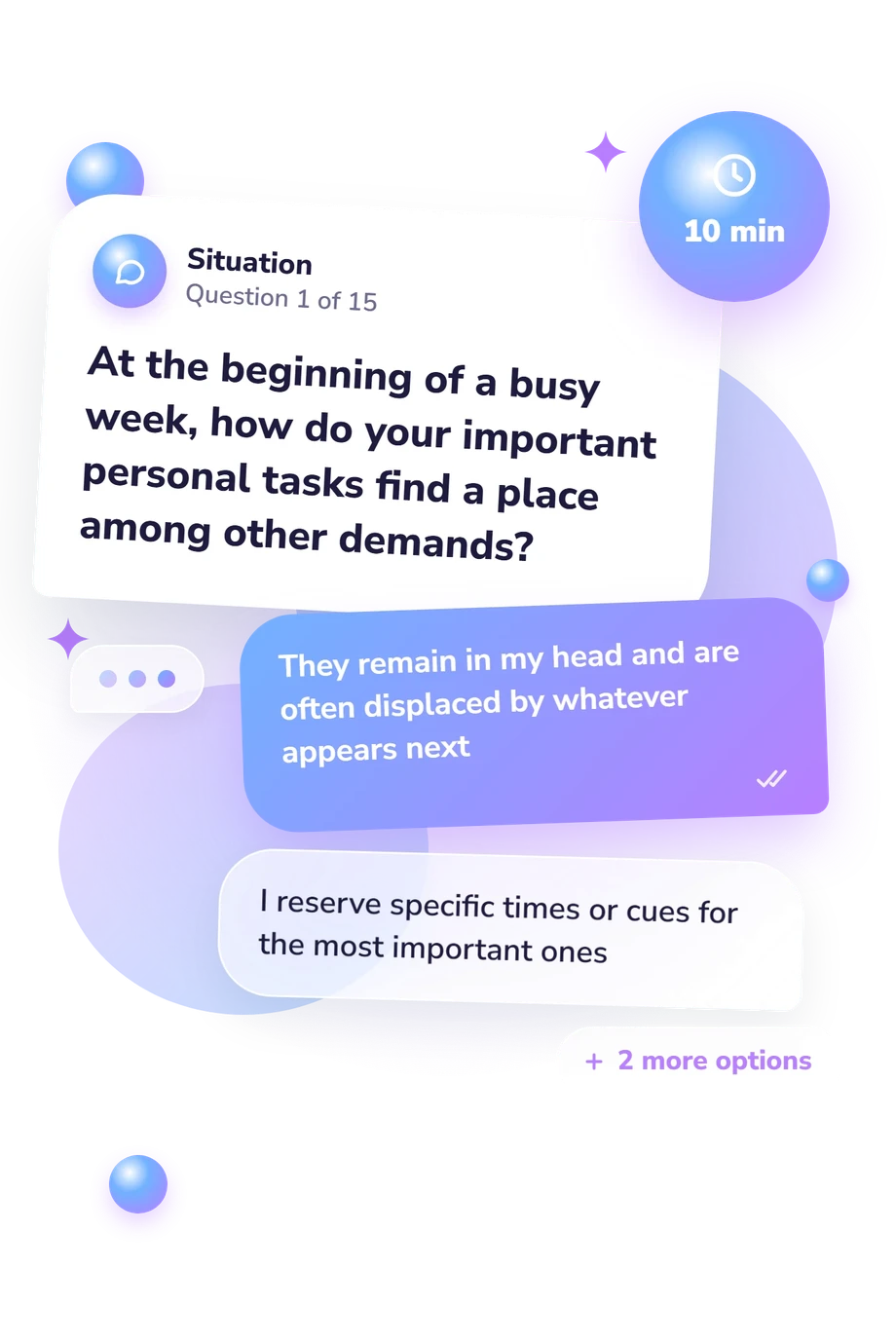
Each item presents a recognizable situation and four response options describing different ways of handling it. The choices address organizing action, interpreting emotion, responding to disruption, defining an endpoint, weighing outside reactions, and tolerating uncertainty. Each block is reported on a 0-15 range; the questionnaire does not state how individual response options are converted into points.
Conceptually, the structure is consistent with the Volitional Components Inventory (Kuhl & Fuhrmann, 1998), which separates self-regulatory processes involved in maintaining intentions and action. Blunt and Pychyl (1998) provide a related context on volitional action, inaction, state orientation, and procrastination, while Gollwitzer and Sheeran (2006) explain how concrete cues and planned next steps can support goal achievement. These sources offer context, not proof that this questionnaire reproduces their instruments.
For a self-regulation questionnaire, the bands are prompts for examining current patterns and the practical conditions, direction, and emotional pressure that shape follow-through, not clinical thresholds. Scores may shift with workload, mood, setbacks, and the situation imagined; self-report also depends on memory, self-awareness, and candid responding. Choose one small adjustment to test next.
- Kuhl, Julius, and Arno Fuhrmann. "Decomposing Self-Regulation and Self-Control: The Volitional Components Inventory." In Motivation and Self-Regulation across the Life Span, edited by Jutta Heckhausen and Carol S. Dweck, 15-49. Cambridge University Press, 1998. 10.1017/CBO9780511527869.003
- Blunt, Allan, and Timothy A. Pychyl. "Volitional Action and Inaction in the Lives of Undergraduate Students: State Orientation, Procrastination and Proneness to Boredom." Personality and Individual Differences 24, no. 6 (1998): 837-846. 10.1016/S0191-8869(98)00018-X
- Gollwitzer, Peter M., and Paschal Sheeran. "Implementation Intentions and Goal Achievement: A Meta-Analysis of Effects and Processes." Advances in Experimental Social Psychology 38 (2006): 69-119. 10.1016/S0065-2601(06)38002-1
Updated: