
Reality Check Quiz
How the Scales are Structured
Who Usually Takes This Test?
See How You Compare
Below is a preview of how scores are typically distributed across each scale.
Example Questions From the Test
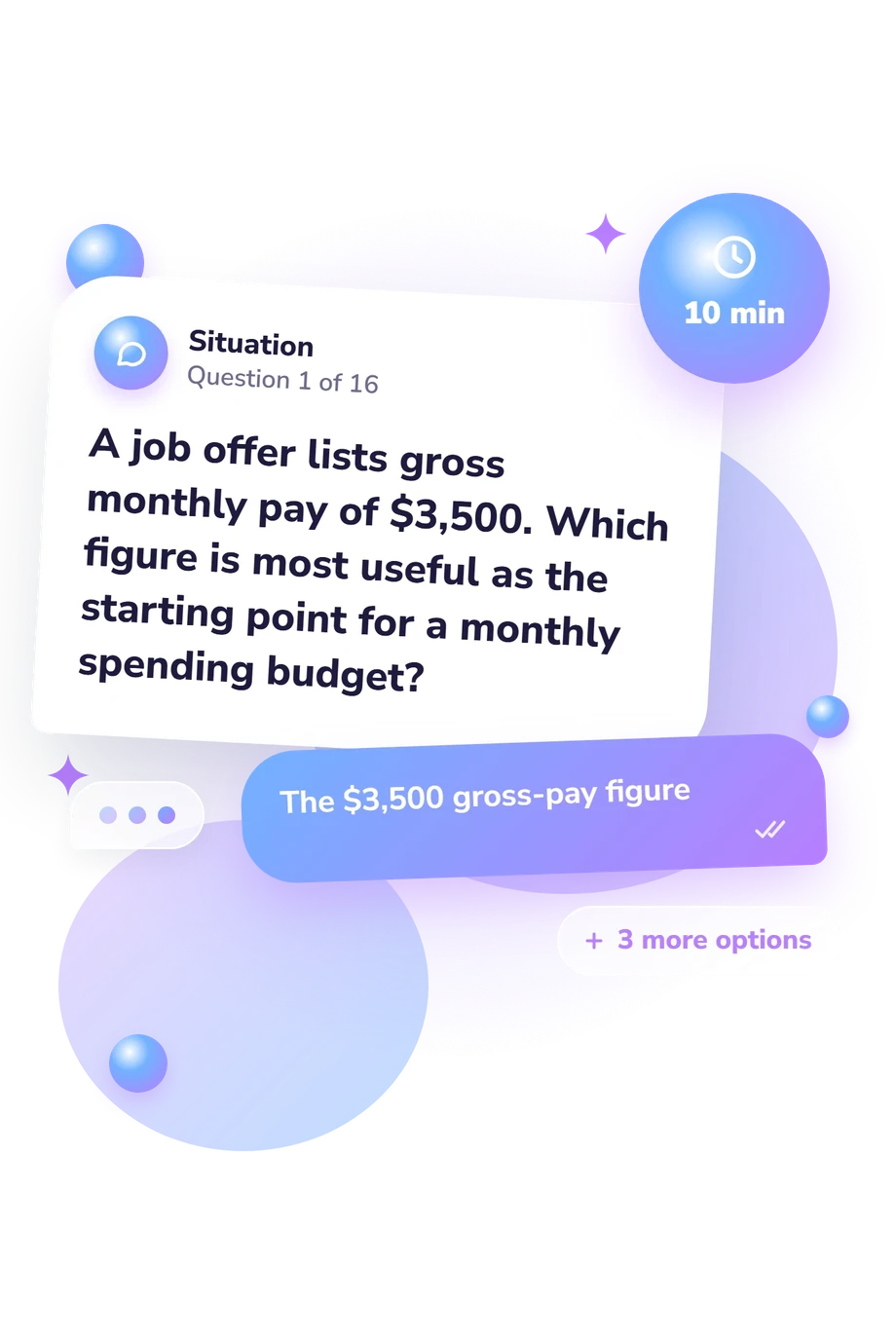
- The $3,500 gross-pay figure
- Expected take-home pay after deductions
- Gross pay plus available credit
- Annual gross pay divided by the number of workdays
- $40
- $50
- $60
- $72
- Public transportation fares
- The electricity bill
- Grocery spending
- The stated monthly rent
Reality Check Quiz - Description and methodology of the test
People who want a clearer picture of everyday money decisions can use this assessment to examine practical financial knowledge rather than personal income or spending style. The reality check quiz focuses on how well you recognize costs, compare options, and reason through common budgeting situations. Its scenario format is useful for giving you a reality check through a quiz before revisiting a household budget or planning a move.
What This Assessment Explores
The items test practical decisions about take-home pay, recurring and one-time costs, shared expenses, rent, unit prices, utilities, debt, insurance, purchasing power, and emergency funds. It suits anyone checking how confidently they understand living costs and budget trade-offs.
Taken as a living expenses quiz, it groups three reasoning areas:
- Income and obligations show how you separate take-home pay, required bills, and discretionary spending.
- Affordability and trade-offs show how you compare shared costs, unit prices, rent, savings, and total ownership expenses.
- Timing and resilience show whether you account for annual fees, changing bills, emergencies, insurance, and purchasing power.
These themes feed the Living Expenses Knowledge scale (0-16). Its bands are Foundations to build 0-6, Developing knowledge 7-12, and Strong knowledge 13-16, indicating increasing practical understanding of affordability and common budget trade-offs.
Methodology and Evidence Base
Each item presents a concrete scenario with four answer choices. The respondent selects the most accurate calculation, classification, or explanation, so the method tests applied recognition rather than opinions about money. Examples include using take-home pay, separating fixed from discretionary costs, and anticipating irregular or ownership expenses.
The result is one aggregate score. Since no differential item weights or separate subscale formula are stated, it summarizes performance across the displayed topics. The online version is not presented as a standardized administration with population norms.
Its conceptual reference point is the Financial knowledge scale (Vieira et al., 2020), which distinguishes items by difficulty and applies item-response methods. This questionnaire is conceptually consistent with that work, not an adaptation of it. OECD/INFE 2022 and Huston (2010) likewise support separating financial knowledge from broader financial behavior, attitudes, and circumstances.
Results are most useful for choosing topics to review, such as annual fees, purchasing power, or emergency reserves. This financial knowledge assessment can still be affected by wording, arithmetic slips, current stress, prior experience, and self-report limits, so use it as a learning-oriented snapshot of the topics covered.
- Vieira, Kelmara Mendes, Ani Caroline Grigion Potrich, and Aureliano Angel Bressan. “A proposal of a financial knowledge scale based on item response theory.” Journal of Behavioral and Experimental Finance 28 (2020): 100405. 10.1016/j.jbef.2020.100405
- OECD. OECD/INFE Toolkit for Measuring Financial Literacy and Financial Inclusion 2022. OECD Publishing, Paris, 2022. 10.1787/cbc4114f-en
- Huston, Sandra J. “Measuring Financial Literacy.” Journal of Consumer Affairs 44, no. 2 (2010): 296-316. 10.1111/j.1745-6606.2010.01170.x
Updated: