
What Type of Gamer Are You Quiz
How the Scales are Structured
Who Usually Takes This Test?
See How You Compare
Below is a preview of how scores are typically distributed across each scale.
Example Questions From the Test
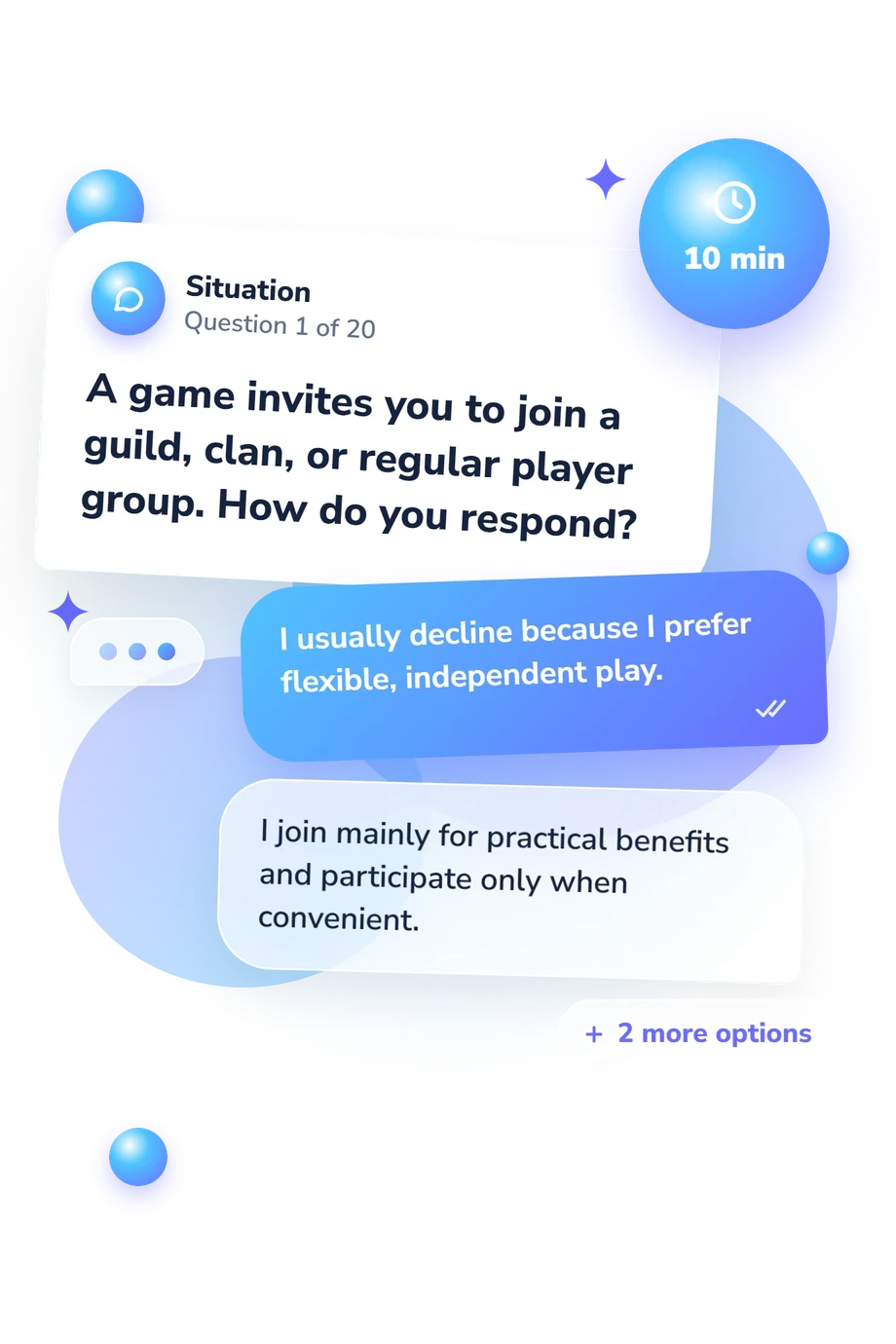
- I usually decline because I prefer flexible, independent play.
- I join mainly for practical benefits and participate only when convenient.
- I join if the group's atmosphere and schedule seem compatible with mine.
- I am enthusiastic about becoming part of an active group and contributing regularly.
- I would prefer the same game in a format with less emphasis on winning.
- I enjoy the occasion, though the pressure is not what draws me to the game.
- The stakes sharpen my focus and make the match more exciting.
- I like the added intensity when the teams feel reasonably balanced.
- It makes me want to refine my run and move above nearby players.
- I check my position out of curiosity, but rarely change how I play.
- It can motivate a few more attempts if improving my position feels achievable.
- I pay little attention because finishing the challenge was enough for me.
What Type of Gamer Are You Quiz - Description and methodology of the test
For players who want to understand their recurring play preferences, the What Type of Gamer Are You Quiz turns everyday choices into a profile showing the relative strength of separate motivations. It is useful for anyone curious about why particular features of play feel rewarding, including people whose preferences are focused or mixed. This gamer personality quiz clarifies how different motives contribute to enjoyment without assessing gaming ability or performance.
What This Assessment Explores
Your answers indicate how strongly separate motivations can make play satisfying; they describe preferences rather than gaming ability or performance. The profile shows how these motivations are distributed, including whether one is stronger or several are similarly strong. The profile from this what gamer are you quiz shows the relative strength of five dimensions affecting your enjoyment:
- Competitor (0-12) measures attraction to contests and rankings: Self-Paced Player (0-4), Selective Rival (5-8), Competitor (9-12).
- Explorer (0-12) measures discovery and experimentation: Guided Traveler (0-4), Curious Roamer (5-8), Dedicated Explorer (9-12).
- Mastery Chaser (0-12) measures improvement and system-solving: Comfort-First Player (0-4), Adaptive Improver (5-8), Mastery Chaser (9-12).
- Social Player (0-12) measures the value of shared play: Independent Player (0-4), Flexible Teammate (5-8), Social Player (9-12).
- Story Seeker (0-12) measures narrative engagement: Gameplay-Led Player (0-4), Engaged Viewer (5-8), Story Seeker (9-12).
Methodology and Scientific Basis
Each item in this gamer type quiz presents a gaming situation, such as joining a guild, facing a ranked match, finding an optional path, pursuing a difficult goal, making a story choice, or exploring a map. Four response options describe contrasting reactions, so you select the one closest to your usual way of playing.
Scoring is multidimensional: the result reports separate scores rather than forcing every player into one type. A mixed profile is therefore possible, such as strong exploration with modest interest in competition. The displayed bands give descriptive interpretations of each score; they are not a single overall rating.
Gaming Motivation Inventory (Király et al., 2022) is a relevant conceptual comparator because it organizes gaming motives within a motivational model. Yee (2006) and Bartle (1996) offer complementary perspectives on achievement, exploration, social interaction, and player orientations. This questionnaire is conceptually consistent with those works, but it is not presented as an adaptation or validation of them.
As a self-report questionnaire, it offers descriptive, non-norm-referenced scores; response bias, mood, current games, social setting, and self-awareness can influence responses.
- Király, O., Billieux, J., King, D. L., Urbán, R., Koncz, P., Polgár, E., & Demetrovics, Z. (2022). A comprehensive model to understand and assess the motivational background of video game use: The Gaming Motivation Inventory (GMI). Journal of Behavioral Addictions, 11(3), 796-819. 10.1556/2006.2022.00048
- Yee, N. (2006). Motivations for play in online games. CyberPsychology & Behavior, 9(6), 772-775. 10.1089/cpb.2006.9.772
- Bartle, R. (1996). Hearts, Clubs, Diamonds, Spades: Players Who Suit MUDs. Journal of MUD Research, 1(1).
Updated: