
Adding and Subtracting Decimals Quiz
How the Scales are Structured
Who Usually Takes This Test?
See How You Compare
Below is a preview of how scores are typically distributed across each scale.
Example Questions From the Test
- 83
- 23
- 95
- 03
- 55
- 118
- 18
- 88
- 55
- 55
- 45
- 45
Adding and Subtracting Decimals Quiz - Description and methodology of the test
For learners who want to check how confidently they handle decimal arithmetic, the adding and subtracting decimals quiz offers a focused achievement check. It is suitable for students, families, or educators who want a quick view of place-value and calculation skills. By completing an adding and subtracting decimals online quiz, learners can practise independently and see which performance band their answers reach.
What This Assessment Measures
The questions examine whether a respondent can align decimal places, add and subtract accurately, and apply procedures in practical situations. They include calculations, missing-number equations, equivalent expressions, error checking, and money or measurement contexts. As a decimal addition and subtraction quiz, it connects procedures with place-value reasoning.
The recurring skill areas below describe question content, not separate scores:
- Questions on place value and alignment ask whether digits are positioned correctly for an operation.
- Addition questions ask you to combine decimal quantities accurately.
- Subtraction questions involve differences, regrouping, and amounts remaining.
- Applied problems place these operations in money and measurement contexts.
The result reports Adding and Subtracting Decimals Knowledge (0-16). Foundations to strengthen (0-6) signals review of place value, alignment, and regrouping; Developing accuracy (7-12) reflects core understanding with checking still useful; Secure command (13-16) indicates consistent application across direct and practical problems.
Methodology and Evidence Base
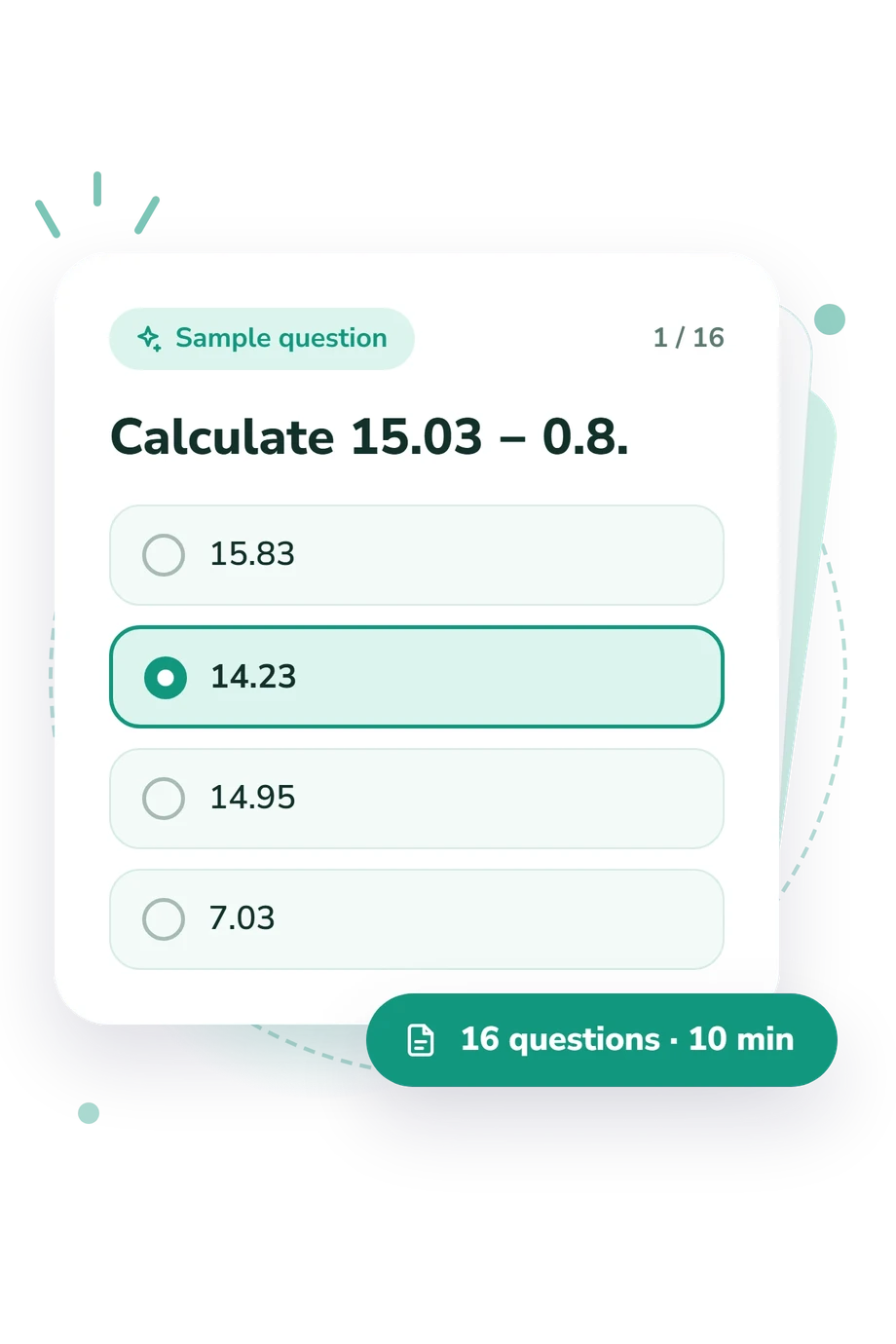
Each item presents four answer choices. The respondent selects the value that completes a calculation or solves a short practical problem, and the score is the number of correct answers. Direct computations are mixed with missing-number equations, equivalent expressions, error checking, and money or measurement situations.
The format is consistent with Rittle-Johnson et al. (2001), who link conceptual understanding and procedural skill. Its decimal focus is close to Durkin and Rittle-Johnson (2015), where errors reveal changing knowledge of decimal fractions. These sources support a conceptual connection, not an adaptation claim.
The addition and subtraction component of a 2010 Common Core standard for fluent multi-digit decimal operations provides a curricular reference. This decimal arithmetic quiz overlaps with that component; its questions do not represent the standard's full range of operations.
Interpret the band as feedback about performance on the tested questions. Attention, haste, and familiarity with decimal notation may affect performance, so use the result to choose methods and examples for review. It describes this task set, not mathematical ability in every context.
- Rittle-Johnson, B., Siegler, R. S., & Alibali, M. W. (2001). Developing conceptual understanding and procedural skill in mathematics: An iterative process. Journal of Educational Psychology, 93(2), 346-362. 10.1037/0022-0663.93.2.346
- Durkin, K., & Rittle-Johnson, B. (2015). Diagnosing misconceptions: Revealing changing decimal fraction knowledge. Learning and Instruction, 37, 21-29. 10.1016/j.learninstruc.2014.08.003
- Common Core State Standards Initiative. (2010). CCSS.Math.Content.6.NS.B.3: Fluently add, subtract, multiply, and divide multi-digit decimals using the standard algorithm for each operation. Common Core State Standards Initiative.
Updated: