
When Will I Fall in Love Quiz
How the Scales are Structured
Who Usually Takes This Test?
See How You Compare
Below is a preview of how scores are typically distributed across each scale.
Example Questions From the Test
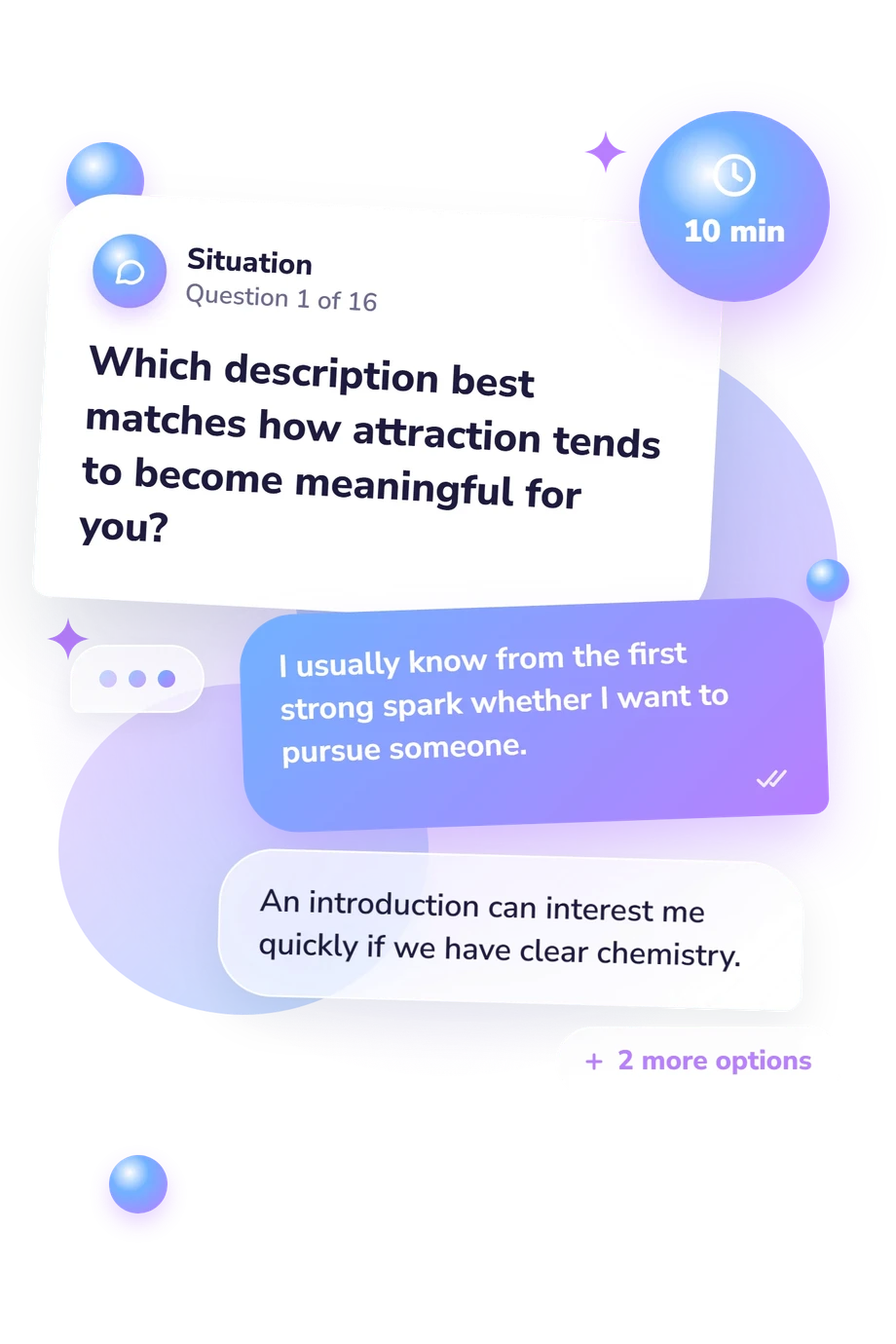
- I usually know from the first strong spark whether I want to pursue someone.
- An introduction can interest me quickly if we have clear chemistry.
- Several good conversations usually help attraction take shape.
- Interest often deepens after I have seen someone's character over time.
- With someone already central to my life or personal history.
- With an acquaintance I already see from time to time.
- Through a friend introducing me to someone unfamiliar.
- In a new environment, community, activity, or social circle.
- I noticed it but generally kept some distance.
- I responded when the other person made an opening.
- My attention was focused on parts of life other than romance.
- I initiated conversation or created a chance to meet again.
When Will I Fall in Love Quiz - Description and methodology of the test
People who feel curious about their romantic direction can use this assessment to examine the conditions surrounding connection rather than wait for a fixed prediction. The When Will I Fall in Love Quiz turns that question into a profile for reflecting on your current romantic direction. As a love timing quiz, it suits anyone whose readiness for love feels uneven across different parts of life.
What This Assessment Explores
Rather than naming a date, it examines attraction, availability, expanding routines and social circles, and whether restoration, closure, or other priorities need space. It suits a romantic readiness test when interest and capacity diverge.
The profile distinguishes these dimensions:
- A Slow-Burn Connection (0-12) measures trust-based attraction: Spark-Oriented (0-4), Familiarity Helps (5-8), or Slow-Burn Affinity (9-12).
- Love Through New Encounters (0-12) measures affinity for expanding routines, activities, and social circles as a route toward romance; it does not predict a meeting: Familiar Ground (0-4), Selective Expansion (5-8), or New-Horizon Affinity (9-12).
- Open to Love Now (0-12) measures present capacity and willingness: Other Priorities (0-4), Opening Up (5-8), or Ready to Engage (9-12).
- Space Before the Next Chapter (0-12) measures whether restoration, closure, or other priorities need room: Available for a Chapter (0-4), Pace Matters (5-8), or Space Has Priority (9-12).
Methodology and Scientific Basis
Each item offers four choices tied to a situation, preference, or likely reaction. The themes include first-spark chemistry, repeated contact, emotional residue, new social settings, boundaries, and room for a relationship. Choosing the closest response keeps the result anchored in current experience.
Displayed scoring combines responses into four profile scores. The highest score indicates the strongest affinity, while profiles within one point may blend. Its ranges and bands are descriptive categories: the online profile has no published validation or population norms.
Readiness themes are conceptually consistent with the Commitment Readiness Scale (Hadden et al., 2018), which addresses willingness and capacity to form a relationship, but this questionnaire is not an adaptation of it. Reis et al. (2011) supports the relevance of familiarity, while Relationship Receptivity Theory (Agnew et al., 2020) frames receptivity as sensitive to timing and circumstances.
As a relationship readiness quiz, it is an online self-report profile with descriptive, non-standardized bands; mood, recent experiences, social context, and self-awareness can shift responses, so read the result as a present snapshot rather than a forecast or diagnosis.
- Hadden, B. W., Agnew, C. R., & Tan, K. (2018). Commitment Readiness and Relationship Formation. Personality and Social Psychology Bulletin, 44(8), 1242-1257. 10.1177/0146167218764668
- Reis, H. T., Maniaci, M. R., Caprariello, P. A., Eastwick, P. W., & Finkel, E. J. (2011). Familiarity Does Indeed Promote Attraction in Live Interaction. Journal of Personality and Social Psychology, 101(3), 557-570. 10.1037/a0022885
- Agnew, C. R., Hadden, B. W., & Tan, K. (2020). Relationship Receptivity Theory: Timing and Interdependent Relationships. In L. V. Machia, C. R. Agnew, & X. B. Arriaga (Eds.), Interdependence, Interaction, and Close Relationships (pp. 269-292). Cambridge University Press. 10.1017/9781108645836.014
Updated: