
Am I Awesome Quiz
How the Scales are Structured
Who Usually Takes This Test?
See How You Compare
Below is a preview of how scores are typically distributed across each scale.
Example Questions From the Test
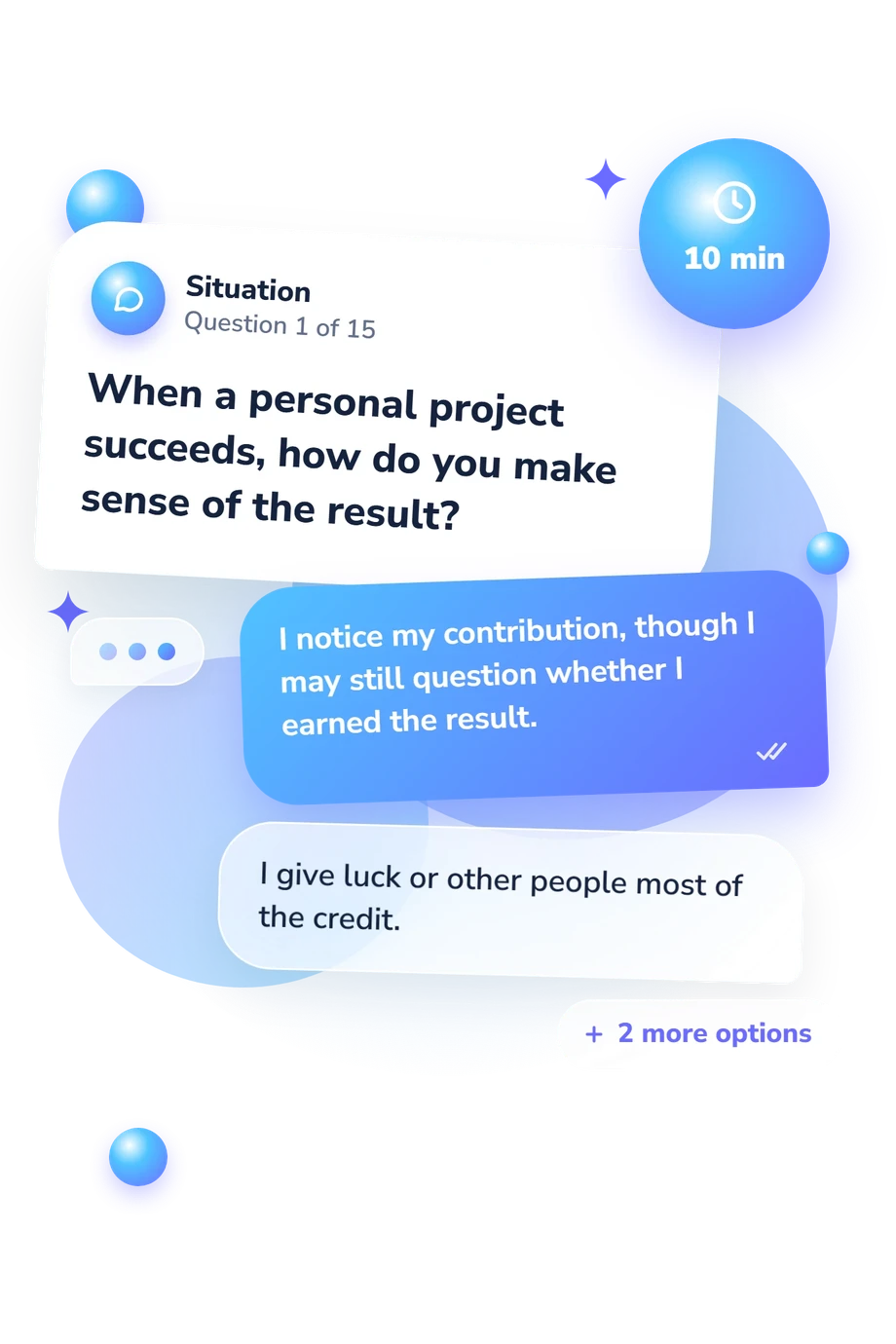
- I notice my contribution, though I may still question whether I earned the result.
- I give luck or other people most of the credit.
- I recognize my ability while also crediting help and circumstances.
- I feel proud once I can identify the choices that helped.
- Keep my view to myself so the conversation stays easy.
- State my view clearly and stay curious about their reasoning.
- Offer part of my perspective but avoid pushing the point.
- Explain my reasoning while adjusting my tone to the group.
- Thank them and openly enjoy the recognition.
- Thank them, then quickly shift attention elsewhere.
- Accept it while mentioning the effort or learning behind it.
- Downplay it because praise makes me uncomfortable.
Am I Awesome Quiz - Description and methodology of the test
Anyone curious about how they show up in ordinary situations can use the Am I Awesome Quiz to turn a broad question about personal qualities into more specific self-observations. The result helps you consider recurring choices, reactions, and interpersonal habits rather than treating the profile as a fixed label. As a personal strengths quiz, it organizes those observations into a clear structure for reflection.
What This Assessment Explores
Here, awesome means qualities rather than a social impression. The items examine how you claim credit, voice disagreement, accept praise, handle mistakes, explore change, and support others. Viewed as a self-confidence quiz, the assessment connects self-recognition with curiosity, flexibility, and consideration.
The three dimensions are:
- Authentic Self-Confidence (0-15) measures self-trust, expression, and self-acknowledgment without domination; Quiet Self-Trust (0-5) is cautious, Emerging Assurance (6-10) is developing, and Grounded Confidence (11-15) owns strengths while staying open.
- Curious Growth (0-15) measures responses to novelty, setbacks, and learning; Familiar-Path Explorer (0-5) favors stability, Adaptive Learner (6-10) balances challenge, and Energetic Experimenter (11-15) tests possibilities.
- Positive Human Impact (0-15) reflects attention, encouragement, fairness, and warmth in relationships; Selective Contributor (0-5) concentrates support, Responsive Supporter (6-10) responds constructively, and Active Uplifter (11-15) encourages while respecting agency.
These bands describe patterns, not worth, intelligence, or potential.
Methodology and Scientific Basis
Each item presents an everyday situation with four choices. You select the option matching your usual reaction, revealing patterns in self-recognition, disagreement, flexibility, persistence, initiative, appreciation, and support.
Responses produce three scores from 0 to 15. The bands are reflective summaries, not statistical cutoffs; read the profile across dimensions, noting strengths and questions for reflection. A higher score indicates more of the tendency, not greater human value.
As a self-reflection questionnaire, this assessment can be compared conceptually with the VIA Classification; authenticity, curiosity, kindness, fairness, and contribution are practical themes here, not claimed VIA categories. Wood and colleagues’ Authenticity Scale, the Curiosity and Exploration Inventory-II, and Caprara and colleagues’ Prosocialness scale offer comparisons for self-expression, exploration, and interpersonal support. These sources provide conceptual comparisons, not psychometric evidence for this questionnaire: it is neither an adaptation of them nor a standardized administration, and they do not validate it.
Because self-report answers reflect current context, self-awareness, and the wish to present yourself favorably, they can shape the profile. Read the profile as a snapshot and prompt to examine patterns, not a fixed verdict.
- Peterson, Christopher, and Martin E. P. Seligman. Character Strengths and Virtues: A Handbook and Classification. Washington, DC: American Psychological Association; New York: Oxford University Press, 2004.
- Wood, Alex M., P. Alex Linley, John Maltby, Michael Baliousis, and Stephen Joseph. "The Authentic Personality: A Theoretical and Empirical Conceptualization and the Development of the Authenticity Scale." Journal of Counseling Psychology 55, no. 3 (2008): 385-399. 10.1037/0022-0167.55.3.385.
- Kashdan, Todd B., Matthew W. Gallagher, Paul J. Silvia, Beate P. Winterstein, William E. Breen, Daniel Terhar, and Michael F. Steger. "The Curiosity and Exploration Inventory-II: Development, Factor Structure, and Psychometrics." Journal of Research in Personality 43, no. 6 (2009): 987-998. 10.1016/j.jrp.2009.04.011.
- Caprara, Gian Vittorio, Patrizia Steca, Arnaldo Zelli, and Cristina Capanna. "A New Scale for Measuring Adults’ Prosocialness." European Journal of Psychological Assessment 21, no. 2 (2005): 77-89. 10.1027/1015-5759.21.2.77.
Updated: