
60s Quiz
How the Scales are Structured
Who Usually Takes This Test?
See How You Compare
Below is a preview of how scores are typically distributed across each scale.
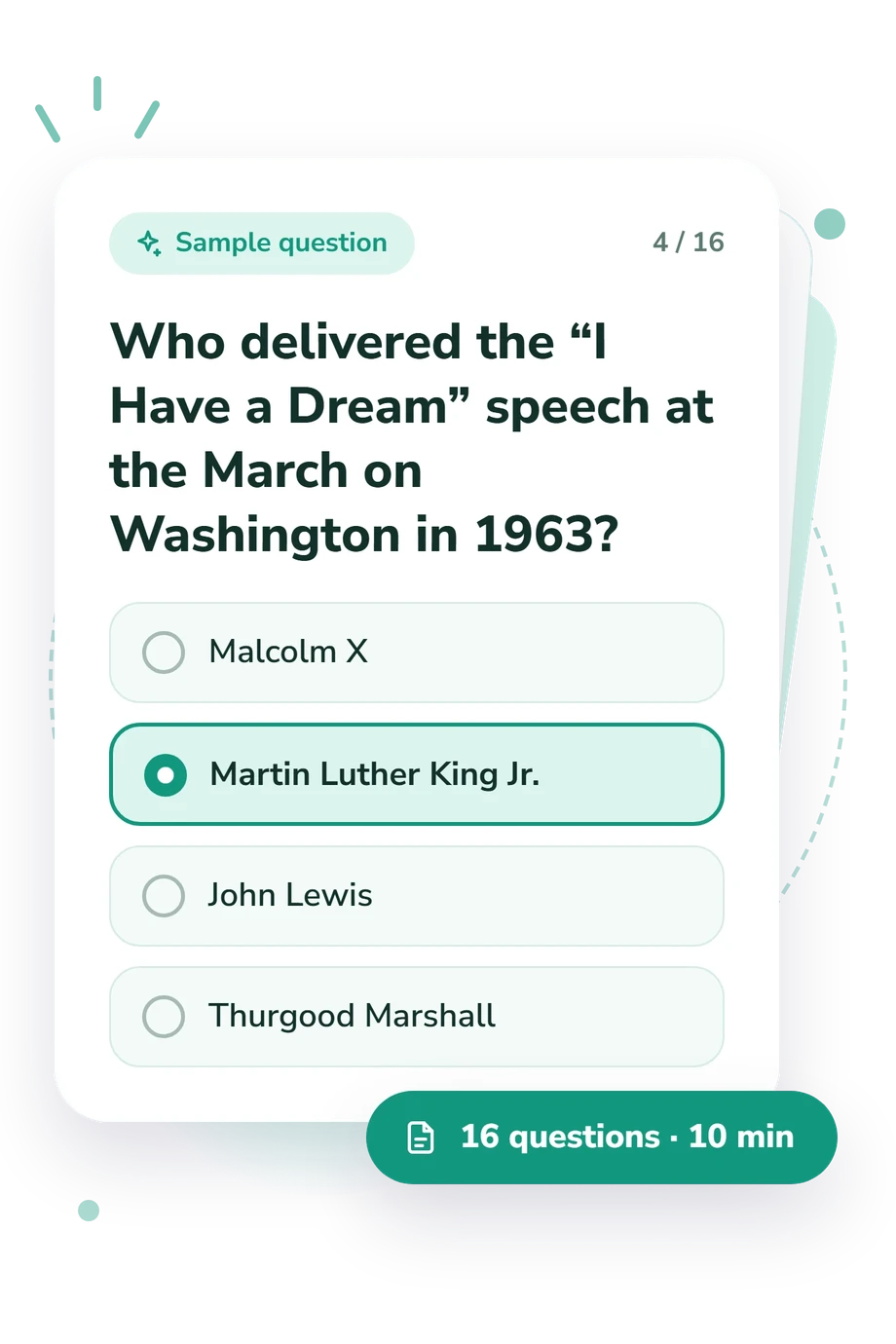
Example Questions From the Test
- The Tonight Show
- American Bandstand
- The Ed Sullivan Show
- The Smothers Brothers Comedy Hour
- The first crewed landing on the Moon
- The first spacewalk
- The first human orbit of Earth
- The first flight of a reusable spacecraft
- The Berlin Blockade
- The Bay of Pigs invasion
- The Cuban Missile Crisis
- The Gulf of Tonkin incident
60s Quiz - Description and methodology of the test
Readers looking to revisit the decade through a 1960s history quiz can use this assessment to review familiar names, events, and cultural landmarks in context. People curious about the decade can use the 60s quiz questions and answers to test their recall of its major names, events, and cultural landmarks. The result can also point toward topics that deserve further reading.
What This Assessment Explores
The questionnaire measures recognition of political events, social movements, international conflict, science, technology, and popular culture associated with the 1960s. Its result is a single score, reflecting performance across the sampled topics rather than a separate profile for each subject.
These are the main thematic groups represented by the items:
- Political and social change covers civil-rights leadership, presidential policy, decolonization, and the Berlin Wall.
- International affairs connects the Cuban Missile Crisis, the Prague Spring, independence, and Cold War tensions.
- Culture and media examines television, Motown, film, literature, environmental writing, youth fashion, and Woodstock.
- Science, technology, and sport bring together Apollo 11, ARPANET, and the 1966 FIFA World Cup.
As a 1960s trivia quiz, it suits people exploring the period through memorable examples. A strong result indicates broad familiarity with the selected material; a lower result highlights topics for review, not a lack of general intelligence or historical ability.
Methodology and Evidence Base
Each item uses a four-option multiple-choice format. Prompts ask respondents to identify a person, event, achievement, place, or historical significance; choosing the best answer makes recognition central, while guessing and prior exposure can affect performance.
The displayed 1960s Knowledge scale runs from 0 to 16. Emerging recall (0-6) reflects recognition of some decade features with room to revisit major people, events, and cultural shifts. Developing knowledge (7-12) reflects a solid foundation with gaps across the sampled topics. Strong knowledge (13-16) reflects broad, accurate familiarity with key 1960s history and culture.
The selection is conceptually consistent with Columbia Guide (Farber & Bailey, 2003), which connects political, social, international, and cultural developments across the decade. Ward (2009) and Self (2016) provide documentary and interpretive context. The questionnaire is not an adaptation of these works, and its score has no stated population norms or independent validation. Education, cultural familiarity, current interests, and guessing may influence the result. These questions and answers about the 1960s are best read as a focused self-check of the material represented here, not a complete measure of historical knowledge.
- Farber, David, and Beth Bailey. The Columbia Guide to America in the 1960s. Columbia University Press, 2003.
- Ward, Brian, ed. The 1960s: A Documentary Reader. Wiley-Blackwell, 2009.
- Self, Robert O. “The 1960s.” Oxford Research Encyclopedia of American History, 2016. 10.1093/acrefore/9780199329175.013.278
Updated: