
Lay vs Lie Quiz
How the Scales are Structured
Who Usually Takes This Test?
See How You Compare
Below is a preview of how scores are typically distributed across each scale.
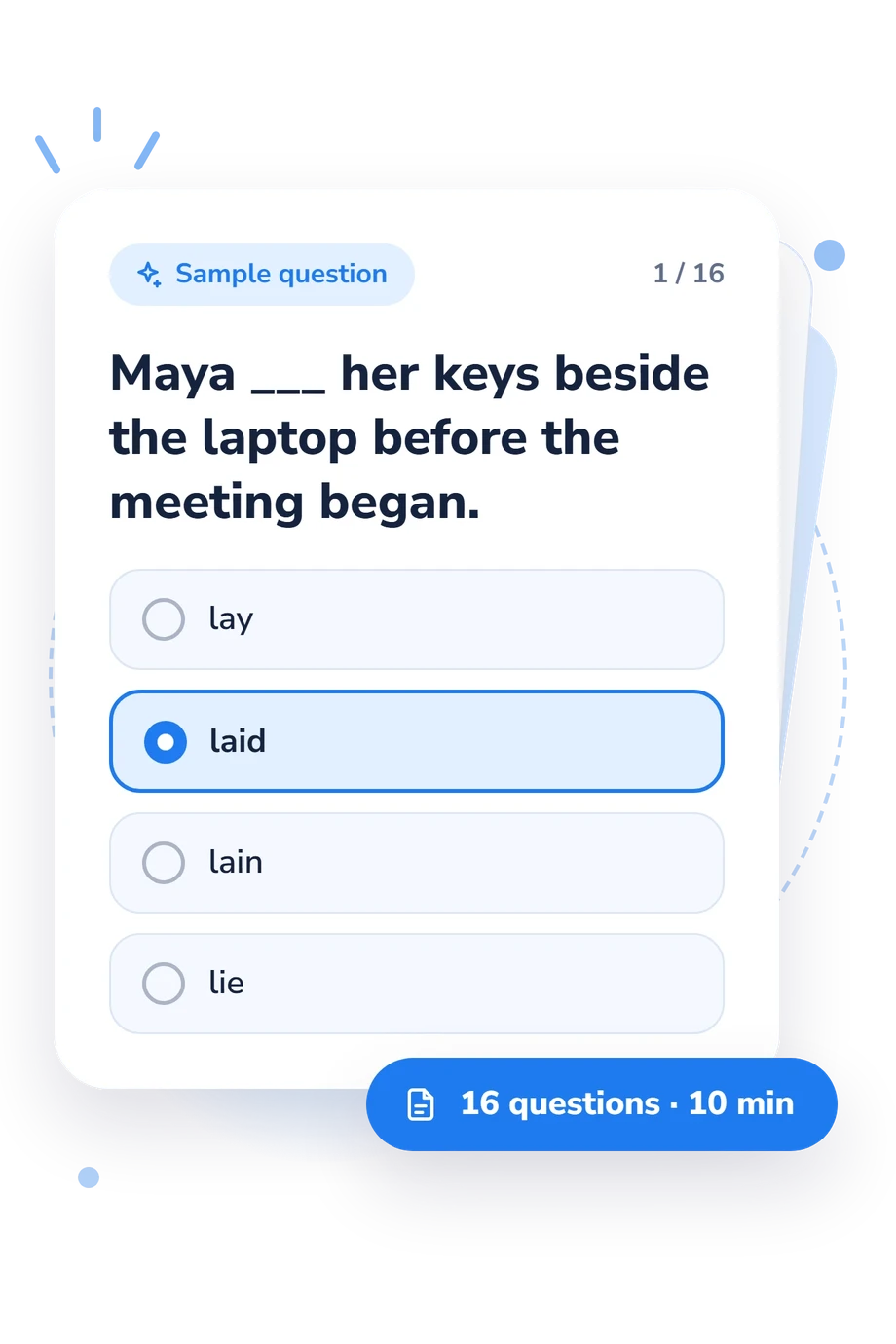
Example Questions From the Test
- lay
- laid
- lain
- lie
- lie
- lain
- laid
- lay
- lain
- laid
- lay
- lying
Lay vs Lie Quiz - Description and methodology of the test
Readers who want to use lay and lie accurately in writing can take the Lay vs Lie Quiz to examine how well they apply the verbs in context. It works as a practical lay vs lie grammar test, focusing on meaning, grammatical role, and changing forms rather than memorized slogans. The result gives a focused picture of where answers are strong and where review may help.
What This Assessment Explores
The questionnaire examines the choice between lay, which normally takes an object, and lie, which can mean to recline, while testing the forms that cause confusion in real sentences. It suits learners, writers, editors, and anyone seeking a more reliable command of standard usage.
As a quiz on the lay-and-lie distinction, it reports one scale: Lay vs Lie Knowledge (0-16). The result bands are Foundations to build (0-6), Developing control (7-12), and Strong command (13-16). They indicate how consistently a respondent matches verb form, grammatical role, and sentence meaning.
The main areas covered are:
- Object placement shows whether you recognize when lay introduces something being put somewhere.
- Reclining usage shows whether lie and its forms fit a subject that is resting or positioned.
- Tense, participle, and context choices show whether you can apply the distinction beyond a memorized rule.
Methodology and Scientific Basis
Each item presents a sentence or short usage question with answer choices. The alternatives test direct-object behavior, verb forms, progressive and perfect constructions, and contextual meaning. For questions about lie and lay, the respondent chooses a completion or correction; one point is awarded for each correct answer, yielding the displayed score.
Lay/lie usage (Lee, 2018) provides the closest subject-specific evidence, examining corpus patterns for how lay and lie function in English. The lie lay quiz applies grammatical distinctions discussed in the works of Huddleston and Pullum and in the usage-pattern research of Newman and Rice. Together, these sources describe the object requirement of lay, the reclining meaning of lie, and the past and participial forms that the questions ask respondents to select.
Interpret the result as performance on this set of questions, not a fixed measure of overall writing ability. Wording familiarity, attention, education, and current language habits can affect responses. The result uses three score bands, so its practical value is identifying specific verb forms and contexts that merit further practice.
- Lee, Yunhyun. (2018). The Intransitive Usage of the English Verb Lay in COCA and BNC. Modern English Education, 19(2), 56-62. 10.18095/meeso.2018.19.2.06
- Huddleston, Rodney, and Geoffrey K. Pullum. (2002). The Cambridge Grammar of the English Language. Cambridge University Press. 10.1017/9781316423530
- Newman, John, and Sally Rice. (2004). Patterns of usage for english SIT, STAND, and LIE: a cognitively inspired exploration in corpus linguistics. Cognitive Linguistics, 15(3), 351-396. 10.1515/cogl.2004.013
Updated: