
Construction Safety Quiz
How the Scales are Structured
Who Usually Takes This Test?
See How You Compare
Below is a preview of how scores are typically distributed across each scale.
Example Questions From the Test
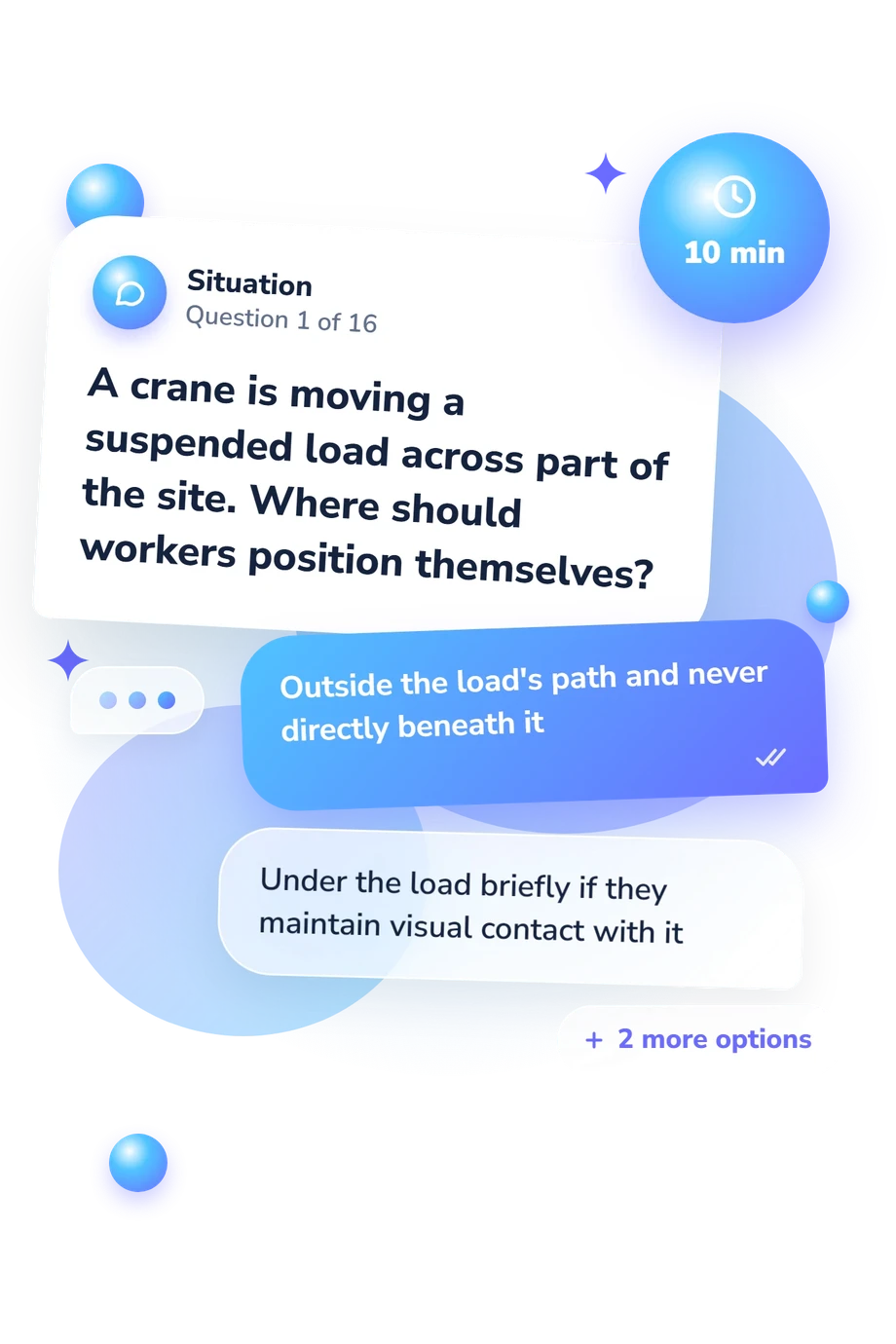
- Outside the load's path and never directly beneath it
- Under the load briefly if they maintain visual contact with it
- Close to the load so they can steady it by hand if it swings
- Anywhere outside the crane operator's cab-side blind spot
- Carry light tools in one hand and grip the ladder with the other
- Lean sideways rather than climb down to reposition the ladder
- Face the ladder and maintain three points of contact
- Climb facing outward when descending for a clearer view below
- Wrap the damaged area with ordinary tape and finish the task
- Move the damaged section away from wet or high-traffic areas
- Use it only for tools that draw relatively little power
- Remove it from service, identify it as defective, and report it
Construction Safety Quiz - Description and methodology of the test
Workers, trainees, and supervisors who want a focused check of practical safety knowledge can use this construction safety quiz to examine decisions around common site hazards. It is intended for foundational learning, refresher study, and conversations about topics that may need supervised practice. A quiz with answers about construction safety can make the reasoning behind safer choices easier to review, while the result highlights areas for further learning.
What This Assessment Measures
The assessment asks whether a respondent can recognize hazards and choose controls before an incident. Scenarios in this construction site safety quiz cover suspended loads, energy isolation, access, excavations, damaged equipment, silica, confined spaces, chemicals, falls, lifting, and electricity. It suits foundational learning and refreshers, not physical skill or employer authorization.
The result profile groups decisions into dimensions:
- Hazard recognition shows whether you identify conditions that may cause injury or exposure.
- Control selection indicates whether you favor risk reduction before personal protective equipment.
- Emergency judgment reflects how you protect yourself and others during a dangerous event.
- Work planning shows whether you consider routes, access, equipment, loads, and changing conditions.
Construction Safety Knowledge (0-16) places results in Foundation to build (0-6), Developing knowledge (7-12), or Strong foundational knowledge (13-16). These labels describe the understanding shown by selected responses, not real-workplace performance.
Methodology and Evidence Base
Each item presents a jobsite situation with four answer choices. The preferred response is the action that most directly controls the stated hazard, so this scenario-based self-report tests applied recognition and judgment rather than technical vocabulary. Results are reported as a total; no item-weighting rule is stated, so a more detailed formula should not be inferred.
Nielsen et al. (2023) is the closest source for construction safety training and connects training outcomes with transfer to work. OSHA guidance supplies practical hazard-control context, NIOSH’s Hierarchy of Controls supports prioritizing elimination before administrative measures or PPE, and Ho and Dzeng (2010) adds evidence on online safety learning and user satisfaction. In this construction safety knowledge test, these sources provide a conceptual evidence base; the questionnaire is not an adaptation of them.
No population norms or standardization are stated, so the bands are descriptive rather than diagnostic. Results may reflect guessing, attention, self-awareness, current experience, and familiarity with local procedures. Strong foundational knowledge indicates understanding of the tested principles, not practical competence, workplace conditions, site-specific training, supervision, risk assessment, or compliance with local requirements.
- Nielsen, Karina, Kara Ng, Michela Vignoli, Laura Lorente, and José María Peiró. “A mixed methods study of the training transfer and outcomes of safety training for low-skilled workers in construction.” Work & Stress 37, no. 2 (2023): 127-147. 10.1080/02678373.2022.2086646
- Occupational Safety and Health Administration. Construction Industry Digest. OSHA Publication 2202-09R 2015. U.S. Department of Labor, 2015.
- National Institute for Occupational Safety and Health. Hierarchy of Controls. Centers for Disease Control and Prevention, 2024.
- Ho, Chun-Ling, and Ren-Jye Dzeng. “Construction safety training via e-Learning: Learning effectiveness and user satisfaction.” Computers & Education 55, no. 2 (2010): 858-867. 10.1016/j.compedu.2010.03.017
Updated: