
Copyright Quiz
How the Scales are Structured
Who Usually Takes This Test?
See How You Compare
Below is a preview of how scores are typically distributed across each scale.
Example Questions From the Test
- The general premise is not usually protected by itself, but each writer’s particular expression may be
- The first writer owns every later story involving magic and a school
- Neither story can receive copyright because they share a premise
- Only character names can be protected; prose and scenes cannot be
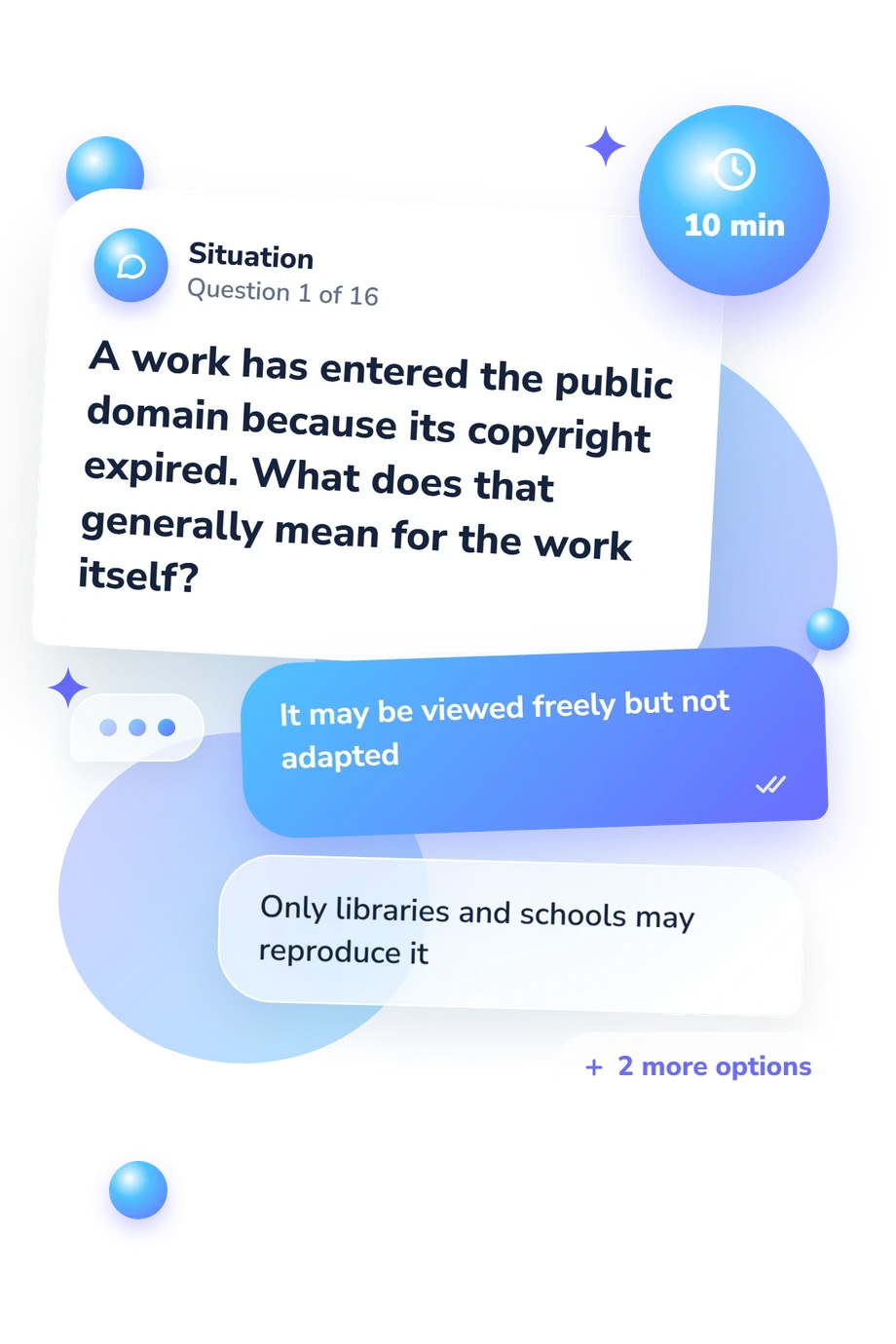
- It may be viewed freely but not adapted
- Only libraries and schools may reproduce it
- Anyone may use it without obtaining copyright permission
- Ownership automatically passes to the government
- The final owner must choose a new copyright holder
- The copyright renews automatically forever
- The work becomes protected only by trademark law
- The work enters the public domain
Copyright Quiz - Description and methodology of the test
Creators, students, educators, and internet users can use this assessment to examine how they reason about everyday creative-work decisions. This copyright quiz focuses on distinctions that shape choices about making, sharing, and reusing material. Its scenarios connect abstract rules with practical decisions. In classroom use, this copyright knowledge quiz for students can support review before an assignment. The result shows how confidently the respondent applies core principles.
What This Assessment Measures
The questions examine copyright literacy. They distinguish expression from ideas, copyright from patents and trademarks, and physical ownership from rights to reproduce or share. Public domain, attribution, Creative Commons, license scope, and exceptions also appear. As a copyright knowledge test, it suits people who create, teach, post, or reuse material.
The result uses one scale: Copyright Knowledge, 0-16. Foundations to build (0-6) marks uncertain core concepts; Developing knowledge (7-12) shows many rules understood with room to improve application; Strong foundation (13-16) reflects consistent recognition of major principles and related rights. These bands do not resolve a dispute or jurisdiction-specific question.
Main groups:
- Ownership shows whether the result separates expression from ideas and copies from rights.
- Reuse shows whether it applies public-domain, attribution, Creative Commons, and license-scope rules.
- Exceptions show how it handles fair use or fair dealing, parody, and similarity.
Methodology and Evidence Base
Each item presents a practical situation with four answer choices. The respondent selects the best answer, and the total score summarizes performance across the scenarios. Reviewing answers to copyright questions can help identify whether difficulty concerns ownership, permission, license scope, or an exception.
The method is conceptually consistent with the Copyright Literacy Survey (Saunders & Estell, 2019), which addresses practical copyright understanding. WIPO guidance and the United States Copyright Office support distinctions involving expression, public domain, permission, attribution, related rights, and exceptions. This relationship is conceptual, not a claim that the online questionnaire is an adaptation or restandardized edition of those sources.
Interpretation should stay tied to the situations presented. A higher score indicates stronger recognition of tested principles, while a lower score identifies topics for study; neither result decides whether a particular use is lawful. The questionnaire has no stated population norms, reliability estimates, or jurisdiction-specific calibration, so performance may reflect prior learning, attention, and self-report. Because copyright exceptions and formal requirements vary by country, local law and exact facts matter when applying an answer to real work.
- Laura Saunders and Allison N. Estell, "Copyright Literacy of Library and Information Science Students in the United States," Journal of Education for Library and Information Science 60, no. 4 (2019): 329-353. 10.3138/jelis.2018-0059
- World Intellectual Property Organization, Understanding Copyright and Related Rights, WIPO Publication No. 909E (2016). 10.34667/tind.28946
- United States Copyright Office, Copyright Basics, Circular 1, revised September 2021.
Updated: