
2021 Quiz
How the Scales are Structured
Who Usually Takes This Test?
See How You Compare
Below is a preview of how scores are typically distributed across each scale.
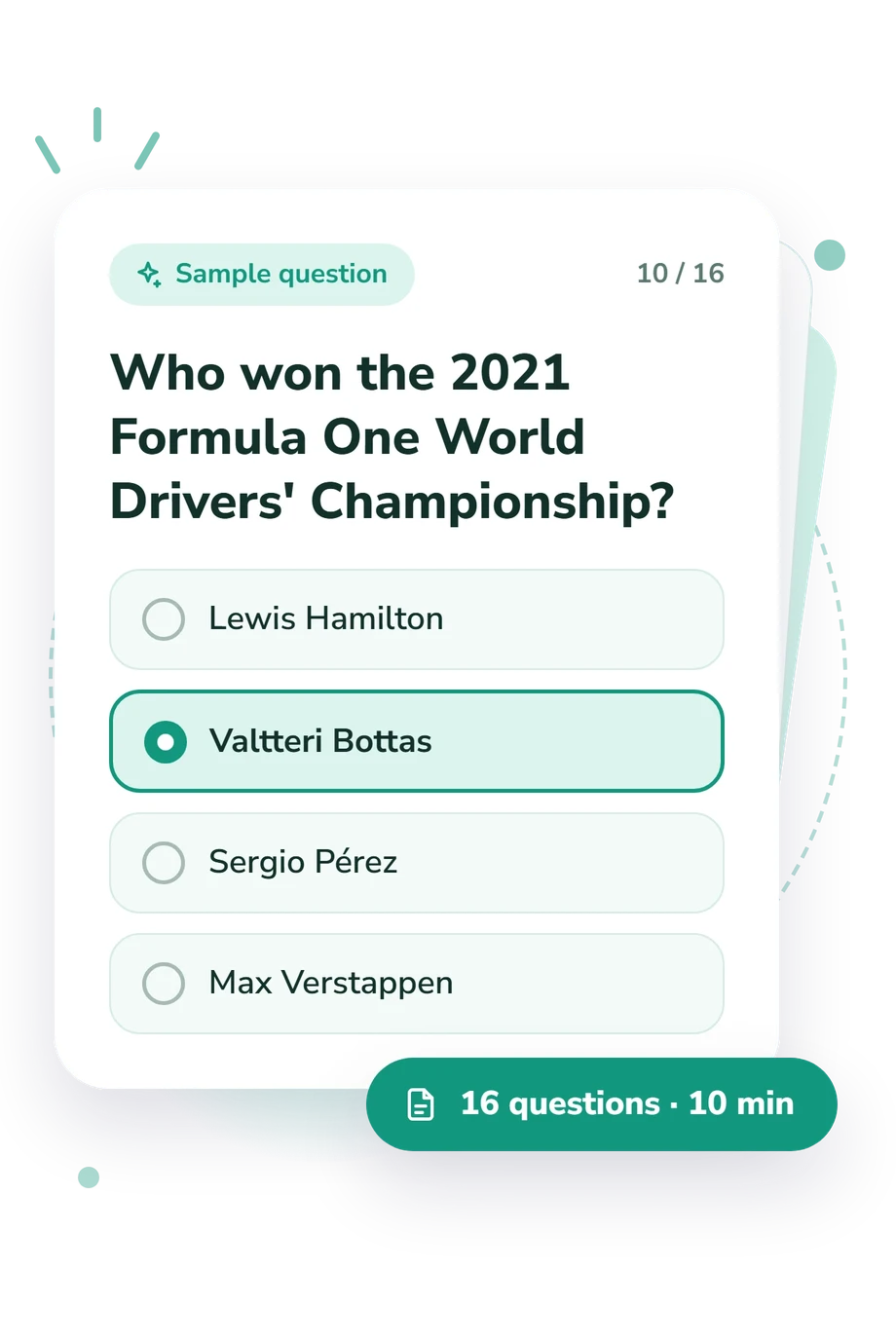
Example Questions From the Test
- Spain
- Italy
- Portugal
- Greece
- Panama Canal
- Kiel Canal
- Suez Canal
- Corinth Canal
- Japan
- Thailand
- South Korea
- Singapore
2021 Quiz - Description and methodology of the test
People who want to revisit a fast-moving public year can use the 2021 quiz to test factual knowledge of events and developments from that year. Anyone who enjoys checking knowledge with this 2021 trivia quiz can use it as a compact recall exercise, without specialist training. The result offers an overall indication of how well the year is remembered, helping readers reflect on details that deserve a fresh look.
What This Assessment Explores
The questionnaire treats 2021 as a broad public-information landscape rather than a single subject. The quiz questions about 2021 cover geography, government, journalism, entertainment, sport, health, climate, technology, space, and natural events. It suits people testing general recall of widely reported developments, without specialist training.
The themes are:
- World affairs and civic life show recognition of countries, institutions, leaders, and constitutional events.
- Culture, media, and sport show familiarity with programs, music, journalism, tournaments, and champions.
- Science, health, environment, and exploration show recall of vaccines, climate action, missions, and natural phenomena.
One scale reports the result: 2021 Knowledge (0-16). Foundation Builder (0-6) indicates partial recognition with major gaps; Informed Recall (7-12) indicates solid coverage with some finer gaps; and 2021 Expert (13-16) indicates broad, accurate recall in context. It describes knowledge of the year, not intelligence or personal values.
Methodology and Evidence Base
Each item presents a brief event-based prompt followed by four answer choices. The options ask the respondent to identify a place, person, institution, event, achievement, or scientific development, so the method emphasizes recognition and factual recall. It does not test essay-style explanation, source evaluation, or sustained reasoning.
As a quiz about what happened in 2021, the questionnaire uses a current-events knowledge approach. Beier and Ackerman's 2001 discussion of current-events knowledge provides conceptual context for treating public-event knowledge as a distinct area while recognizing influences beyond general ability. Nelson and Narens's 1980 work offers a related general-information framework involving recall accuracy and feeling of knowing. These studies provide conceptual context for the questionnaire, not evidence that this question set has been validated, standardized, or normed.
The displayed result uses that scale with one named band; no separate topic scores are shown. Results can be affected by news exposure, education, language, guessing, memory, and current context, so one score cannot fully distinguish durable knowledge from recent exposure or show depth of understanding.
- Beier, Margaret E., and Phillip L. Ackerman. "Current-Events Knowledge in Adults: An Investigation of Age, Intelligence, and Nonability Determinants." Psychology and Aging 16, no. 4 (2001): 615-628. 10.1037/0882-7974.16.4.615
- Nelson, Thomas O., and Louis Narens. "Norms of 300 General-Information Questions: Accuracy of Recall, Latency of Recall, and Feeling-of-Knowing Ratings." Journal of Verbal Learning and Verbal Behavior 19, no. 3 (1980): 338-368. 10.1016/S0022-5371(80)90266-2
Updated: