
Reflexive Verb Quiz
How the Scales are Structured
Who Usually Takes This Test?
See How You Compare
Below is a preview of how scores are typically distributed across each scale.
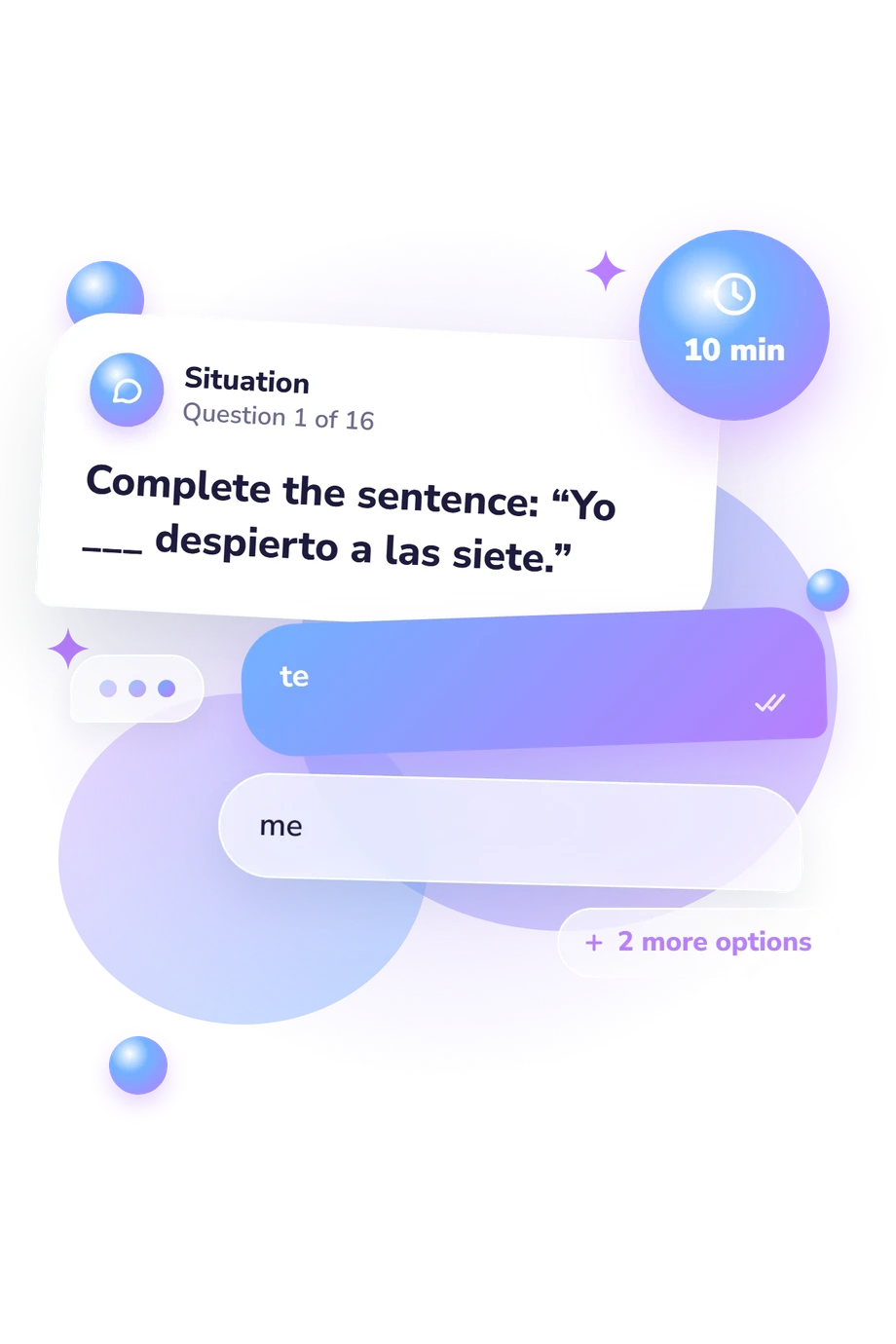
Example Questions From the Test
- te
- me
- se
- nos
- Lucía se peina antes de salir.
- Los amigos se abrazan al llegar.
- Nosotros nos vestimos rápidamente.
- La puerta se abre a las ocho.
- Someone else writes for María and José.
- María and José write to each other.
- María and José write only about themselves.
- María writes while José reads.
Reflexive Verb Quiz - Description and methodology of the test
Spanish learners who struggle with choosing pronouns, matching verb forms, or interpreting se can use this assessment to examine those decisions in meaningful sentences. The reflexive verb quiz focuses on everyday Spanish and helps learners decide whether its question types match the grammar they want to practise. Its sentence-based format makes it a practical quiz on Spanish reflexive verbs, with choices that reveal where a learner may hesitate.
What This Assessment Explores
Rather than testing vocabulary in isolation, this assessment checks whether a learner can link a subject, a reflexive pronoun, and the verb's intended meaning. It covers self-directed and reciprocal actions, non-reflexive and accidental uses of se, plus pronoun placement in commands, infinitives, and everyday routines.
Several items quiz Spanish reflexive pronouns by asking the respondent to match me, te, se, nos, or os with the subject and verb. The result is reported on Spanish Reflexive Verb Knowledge (0-16), with Foundation (0-6), Developing (7-12), and Strong (13-16). This result describes control of these constructions, not general fluency.
The question themes are:
- Reflexive and reciprocal readings show whether actions return to the subject or another person.
- Pronoun agreement and placement show whether forms fit subjects, commands, and infinitives.
- Uses of se show whether meanings are ordinary, non-reflexive, or accidental.
Methodology and Scientific Basis
Each multiple-choice item presents a Spanish sentence, a meaning distinction, or a short completion task with answer options. The respondent selects the option that best fits the subject, pronoun, verb form, or interpretation, so the format tests recognition and application rather than open-ended explanation.
Answers are summarized as one knowledge score, while the displayed level indicates how securely the tested patterns were handled. This makes it a useful reflexive verb test for targeted practice, but not a measure of speaking, listening, vocabulary, or overall Spanish proficiency. Similar exercises and uncertain context can affect performance.
González (2022) describes Spanish se-constructions through reflexive, reciprocal, non-agentive, and accidental interpretations; this questionnaire is conceptually consistent with that work, not an adaptation of it. Butt, Benjamin, and Moreira Rodríguez provide guidance on pronoun forms, agreement, placement, commands, and infinitives. These works describe the grammatical distinctions used here; they do not provide psychometric validation for this questionnaire. Displayed bands label performance on this question set rather than compare it with population norms. Use the result to choose what to practise next and check points in context.
- González, Luis H. Understanding and Teaching Reflexive Sentences in Spanish. New York: Routledge, 2022. 10.4324/9781003214090
- Butt, John, Carmen Benjamin, and Antonia Moreira Rodríguez. A New Reference Grammar of Modern Spanish. 6th ed. Routledge, 2019.
Updated: