
Kwami Quiz
How the Scales are Structured
Who Usually Takes This Test?
See How You Compare
Below is a preview of how scores are typically distributed across each scale.
Example Questions From the Test
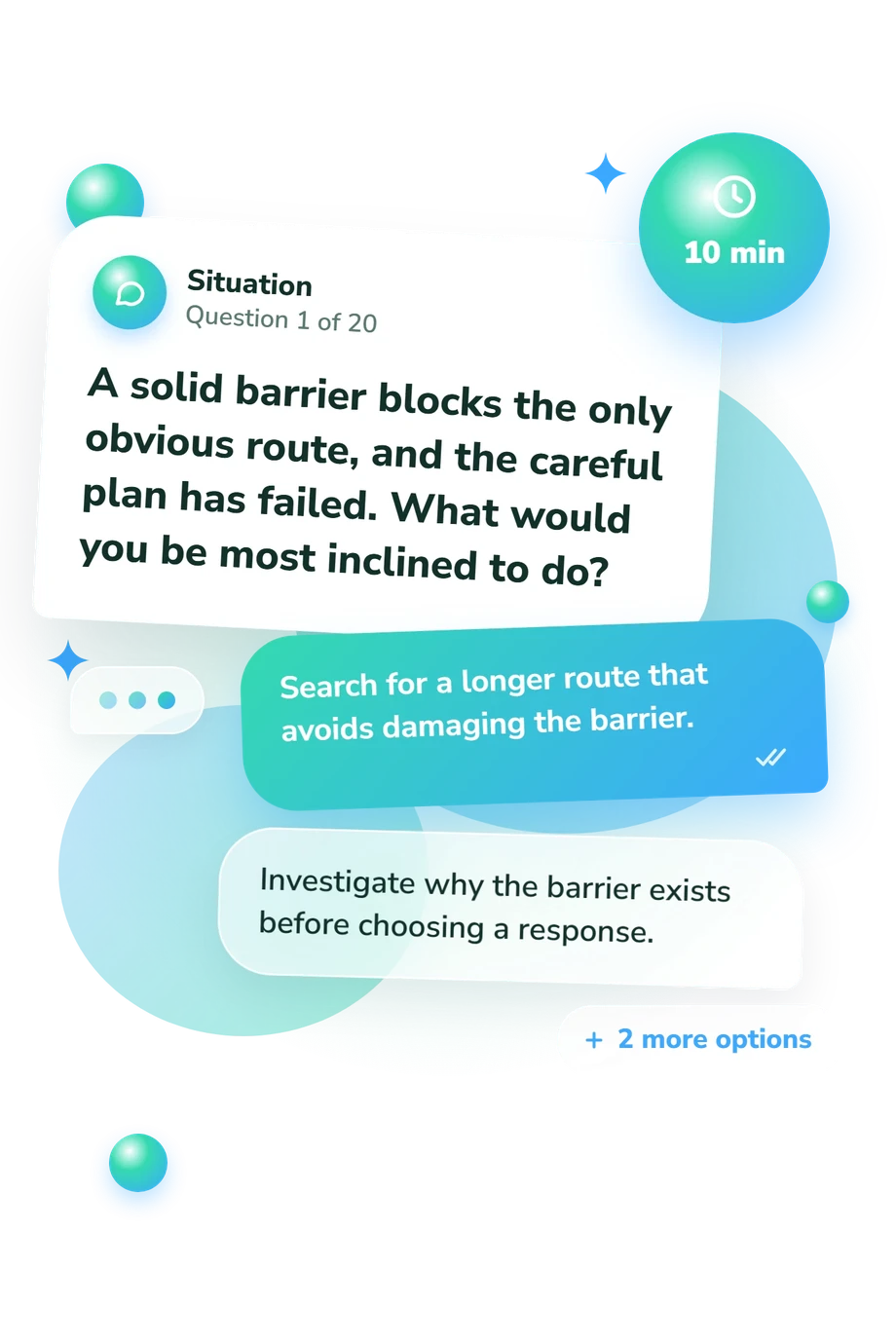
- Search for a longer route that avoids damaging the barrier.
- Investigate why the barrier exists before choosing a response.
- Wait for the right opening, then remove the obstacle decisively.
- Use controlled force to clear the essential path now.
- I would rather act immediately and adjust afterward.
- I test a small move early to learn how the situation responds.
- I monitor changes and quietly prepare a fallback.
- I stay patient and conserve my effort until the moment is right.
- Hold position until the guards leave on their own.
- Ask teammates to create a clear, coordinated route inside.
- Study the guards' patterns and slip through an overlooked gap.
- Stage a believable distraction that sends the guards elsewhere.
Kwami Quiz - Description and methodology of the test
Fans who want to connect Miraculous characters with their own habits can use this profile to explore preferred ways of acting, coordinating, and responding under pressure. The Kwami Quiz turns fictional powers into a reflective comparison rather than a fixed identity. If you are considering what your kwami result says, focus on the style that feels most natural across situations.
What This Assessment Explores
Five affinity scales turn fictional powers into themes of timing, obstacles, authority, imagination, repair, and protection. To consider which kwami my profile resembles, compare the tendencies rather than adopt a fixed identity. These are the dimensions shown:
- Bee Miraculous - Pollen Affinity (0-12) measures precision, confidence, timing, and focused action; Emerging 0-4, Mixed 5-8, Strong 9-12.
- Cat Miraculous - Plagg Affinity (0-12) measures independence, playful disruption, confidence, and decisive action; Emerging 0-4, Mixed 5-8, Strong 9-12.
- Fox Miraculous - Trixx Affinity (0-12) measures imagination, observation, misdirection, and strategic storytelling; Emerging connection 0-4, Mixed connection 5-8, Strong connection 9-12.
- Ladybug Miraculous - Tikki Affinity (0-12) measures resourcefulness, restoration, coordination, and creative problem-solving; Emerging connection 0-4, Mixed connection 5-8, Strong connection 9-12.
- Turtle Miraculous - Wayzz Affinity (0-12) measures patience, protection, resilience, and dependable support; Emerging connection 0-4, Mixed connection 5-8, Strong connection 9-12.
Methodology and Evidence Base
Each prompt presents a short scenario with four response choices. Situations cover timing, obstacles, authority, teamwork, risk, imagination, repair, and support, so the questionnaire compares approaches rather than factual knowledge. The pattern across choices matters more than any single answer.
The thematic framework is Miraculous series (Astruc et al., 2015), together with official Miraculous Corp profiles for Ladybug, Cat Noir, Carapace, Rena Rouge, and Vesperia. The questionnaire is conceptually consistent with those portrayals, not a standardized adaptation of them.
Cheetham et al. (2014) supplies a lens on identification with fictional characters and fantasy; it does not validate this questionnaire’s scoring. That perspective helps explain why who your kwami match might be can feel personally meaningful without making the result a fixed identity.
Results compare scores: the highest marks the strongest affinity, while scores within one point form a blended result. What your kwami alignment means depends on the situations you recognize in your answers. There are no stated population norms, reliability estimates, or clinical validation, and self-report may shift with mood, context, self-awareness, or familiarity with the characters.
- Astruc, Thomas; Bronn, Nathanaël; and Zag, Jeremy. Miraculous: Tales of Ladybug & Cat Noir. Animated television series, 2015-present.
- Miraculous Corp. “Ladybug,” “Cat Noir,” “Carapace,” and “Rena Rouge.” Official character profiles, accessed September 22, 2026.
- Miraculous Corp. “Vesperia.” Official character profile, accessed September 22, 2026.
- Cheetham, Marcus; Hänggi, Jürgen; and Jäncke, Lutz. “Identifying with fictive characters: structural brain correlates of the personality trait ‘fantasy’.” Social Cognitive and Affective Neuroscience 9, no. 11 (2014): 1836-1844. 10.1093/scan/nst179
Updated: