
What Guys Do I Attract Quiz
How the Scales are Structured
Who Usually Takes This Test?
See How You Compare
Below is a preview of how scores are typically distributed across each scale.
Example Questions From the Test
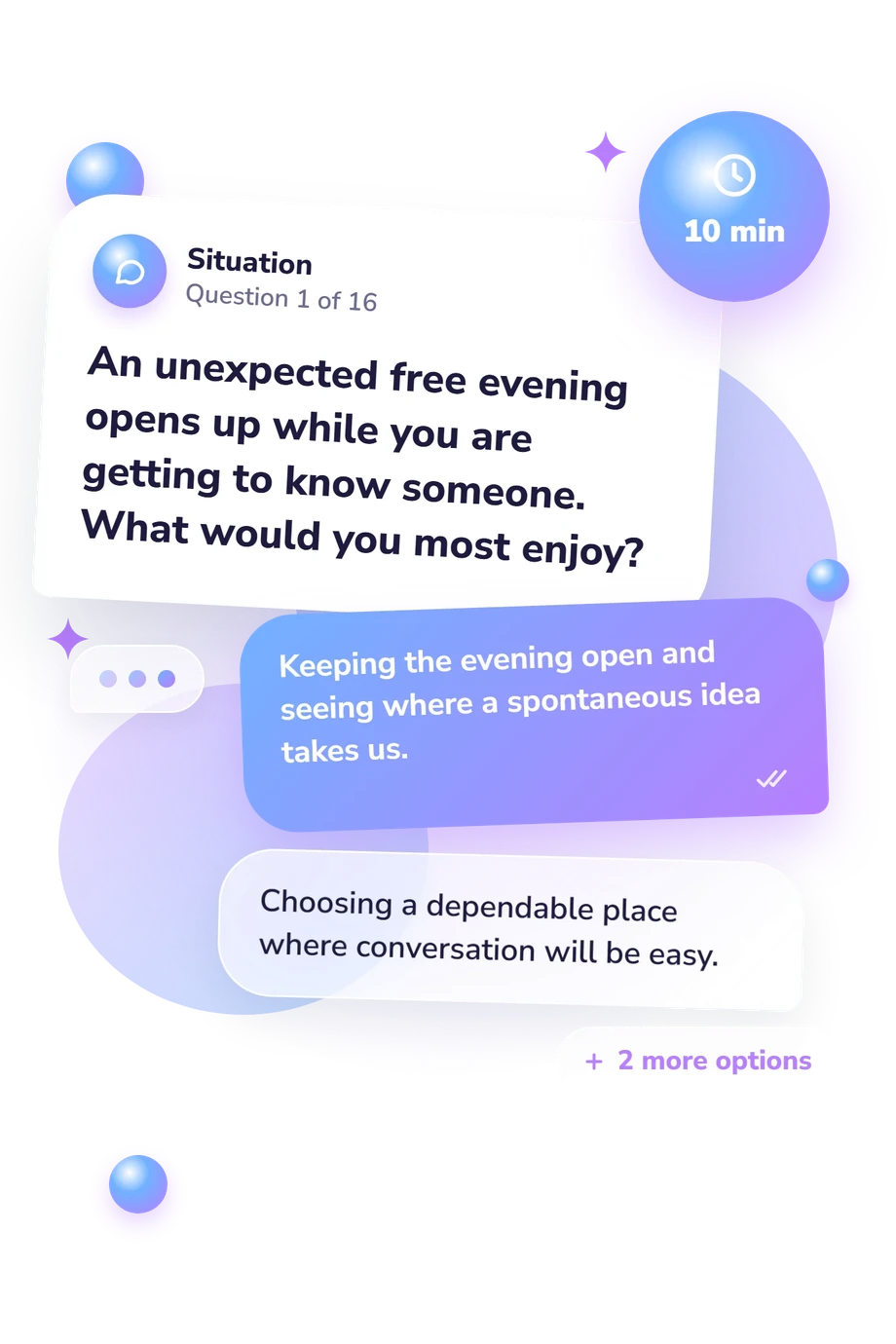
- Keeping the evening open and seeing where a spontaneous idea takes us.
- Choosing a dependable place where conversation will be easy.
- Using the time for an event connected to one of our goals or interests.
- Making a loose plan but leaving room to change it together.
- Playful challenges, quick banter, and unexpected invitations.
- Consistent messages and clear signs that I can be counted on.
- Confident praise for his ideas, drive, or accomplishments.
- A mix of teasing energy and curiosity about trying something new.
- A last-minute outing with several possible stops.
- An activity that feels useful or helps us accomplish something.
- A relaxed meal followed by a familiar, low-pressure activity.
- A comfortable plan with one small element of surprise.
What Guys Do I Attract Quiz - Description and methodology of the test
People curious about the romantic energy they communicate can use the What Guys Do I Attract Quiz as a focused self-reflection exercise. The result compares your relative affinity across four partner profiles, making the who do i attract quiz question more nuanced than a single label. It suits anyone exploring dating preferences and reflecting on the forms of connection their behavior may invite.
What This Assessment Explores
Rather than assigning one fixed type, the questionnaire reads dating choices around novelty, ambition, dependability, emotional attention, support, and repair. It gives a practical vocabulary for considering the result of this what type of guys do you attract quiz and which partner styles may respond to it. The four displayed dimensions are:
- Bold, Spontaneous Guys (0-12) reflects appeal through novelty and flexible plans: Subtle signal 0-4, Mixed signal 5-8, Strong signal 9-12.
- Driven, Goal-Focused Guys (0-12) reflects appeal through progress, competence, and long-term aims: Subtle signal 0-4, Mixed signal 5-8, Strong signal 9-12.
- Steady, Caring Guys (0-12) reflects appeal through reliability, warmth, and calm partnership: Subtle signal 0-4, Mixed signal 5-8, Strong signal 9-12.
- Thoughtful, Emotionally Attuned Guys (0-12) reflects appeal through nuance, reflection, and meaningful conversation: Subtle signal 0-4, Mixed signal 5-8, Strong signal 9-12.
Methodology and Scientific Basis
Each item presents a dating situation with four response options. The alternatives emphasize spontaneity, achievement, steadiness, and emotional depth, producing totals across four profiles. Your highest total is the strongest affinity; scores within one point form a blended result.
The totals make this do i attract guys quiz result a comparison of novelty, achievement, steadiness, and emotional depth.
The questionnaire is conceptually consistent with Luo and Zhang's speed-dating research on security and romantic attraction. Tidwell, Eastwick, and Finkel's study found perceived similarity predicted attraction more reliably than actual similarity in a romantic setting. Figueredo, Sefcek, and Jones examined desired partner personality traits.
These studies provide conceptual context; the online self-report questionnaire is not an adaptation of their instruments. Its response patterns produce descriptive profile totals rather than validated clinical scores; with no stated norms or clinical standardization, results remain sensitive to mood, experience, self-awareness, and self-presentation and indicate which qualities may draw partner styles rather than proving compatibility or another person's motives.
- Luo, Shanhong, and Guangjian Zhang. (2009). What Leads to Romantic Attraction: Similarity, Reciprocity, Security, or Beauty? Evidence From a Speed-Dating Study. Journal of Personality, 77(4), 933-964. 10.1111/j.1467-6494.2009.00570.x
- Tidwell, Natasha D., Paul W. Eastwick, and Eli J. Finkel. (2013). Perceived, not actual, similarity predicts initial attraction in a live romantic context: Evidence from the speed-dating paradigm. Personal Relationships, 20(2), 199-215. 10.1111/j.1475-6811.2012.01405.x
- Figueredo, Aurelio José, Jon Adam Sefcek, and Daniel Nelson Jones. (2006). The ideal romantic partner personality. Personality and Individual Differences, 41(3), 431-441. 10.1016/j.paid.2006.02.004
Updated: