
Am I Greyromantic Quiz
How the Scales are Structured
Who Usually Takes This Test?
See How You Compare
Below is a preview of how scores are typically distributed across each scale.
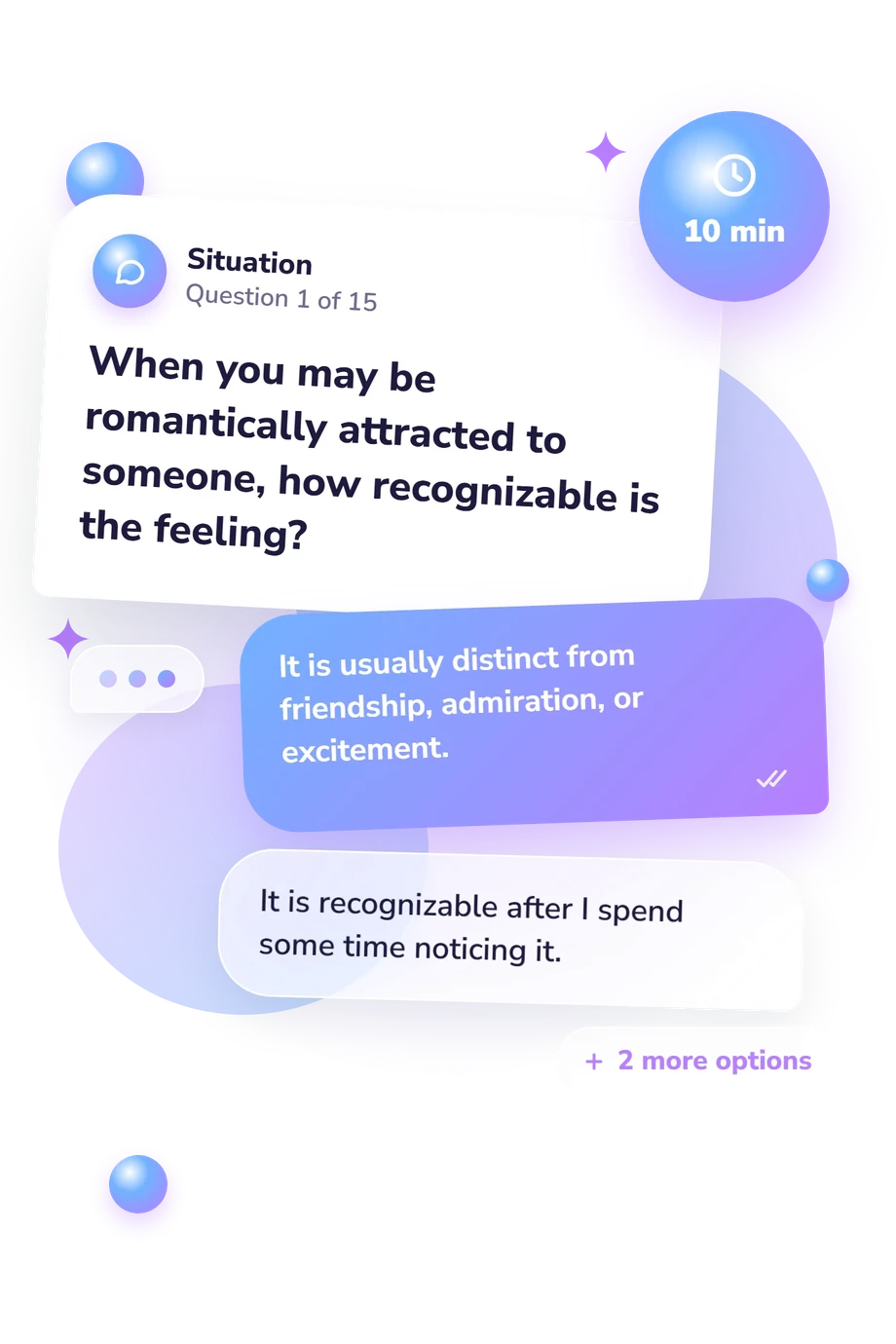
Example Questions From the Test
- It is usually distinct from friendship, admiration, or excitement.
- It is recognizable after I spend some time noticing it.
- It remains subtle enough that I often question what it is.
- I rarely know whether anything I feel qualifies as romantic attraction.
- It has happened regularly enough to feel like a familiar experience.
- It has happened occasionally, with noticeable gaps between experiences.
- It has happened only a small number of times.
- I cannot identify a clear instance, or perhaps only one uncertain instance.
- I can usually think of a current or fairly recent crush.
- I sometimes have an answer, but not consistently.
- I usually have to think back a long way to find an example.
- The question rarely fits because recognizable crushes are absent or exceptionally rare for me.
Am I Greyromantic Quiz - Description and methodology of the test
People unsure whether their romantic experiences fit familiar expectations can use the Am I Greyromantic Quiz to compare three aspects of attraction. It is intended for readers whose attraction may feel infrequent, difficult to identify, or dependent on specific or uncommon conditions. As a quiz about greyromantic experiences, it distinguishes clarity and intensity, rarity, and specificity, showing how these dimensions may combine.
What This Assessment Explores
Clarity and intensity, rarity, and specificity are the three dimensions. Questions in this grey romantic quiz examine how they vary across experiences. The three dimensions are:
- Clarity and Intensity of Romantic Attraction (0-15) reflects how recognizable and substantial attraction feels: Clear signal (0-5), Variable signal (6-10), or Faint or uncertain signal (11-15).
- Rarity of Romantic Attraction (0-15) reflects how often attraction occurs: Familiar occurrence (0-5), Occasional pattern (6-10), or Strong rarity pattern (11-15).
- Specificity of Romantic Attraction (0-15) reflects whether attraction is broad, selective, or exceptional: Broad possibility (0-5), Selective pattern (6-10), or Exceptional pattern (11-15).
Together, the profile shows whether attraction feels clear or faint, familiar or rare, and broad or specific. Results can differ across dimensions, so the profile is descriptive rather than an identity verdict.
Methodology and Evidence Base
Each question presents a situation involving a possible crush, recognition over time, emotional closeness, or the role of context. Four response options move from clearer or more recurring attraction toward subtler, rarer, or more conditional experiences. The responses produce the three displayed scale results, which should be read through the displayed bands.
Fowler's qualitative study of aromantic community experiences offers conceptual context for feelings that may be difficult to name or infrequent. Antonsen's work helps distinguish romantic attraction from asexual identity, while Scherrer's study examines identity and desire. These related studies do not validate this questionnaire or establish its three scales; the questionnaire is conceptually consistent with their themes, not a direct adaptation of them.
The greyromantic test is an online self-report profile with descriptive bands. Answers can be influenced by memory, self-awareness, and current context, so the profile may not represent every experience.
- Fowler, James A., Marini Mendis, Alex Crook, UnYoung Chavez-Baldini, Tabitha Baca, and Judith A. Dean. “Exploring Aromanticism Through an Online Qualitative Investigation With the Aromantic Community: ‘Freeing, Alienating, and Utterly Fantastic.’” International Journal of Sexual Health, 36(1), 126-143, 2024. 10.1080/19317611.2024.2311158
- Antonsen, Amy N., Bozena Zdaniuk, Morag Yule, and Lori A. Brotto. “Ace and Aro: Understanding Differences in Romantic Attractions Among Persons Identifying as Asexual.” Archives of Sexual Behavior, 49(5), 1615-1630, 2020. 10.1007/s10508-019-01600-1
- Scherrer, Kristin S. “Coming to an Asexual Identity: Negotiating Identity, Negotiating Desire.” Sexualities, 11(5), 621-641, 2008. 10.1177/1363460708094269
Updated: