
Does My Crush Hate Me Quiz
How the Scales are Structured
Who Usually Takes This Test?
See How You Compare
Below is a preview of how scores are typically distributed across each scale.
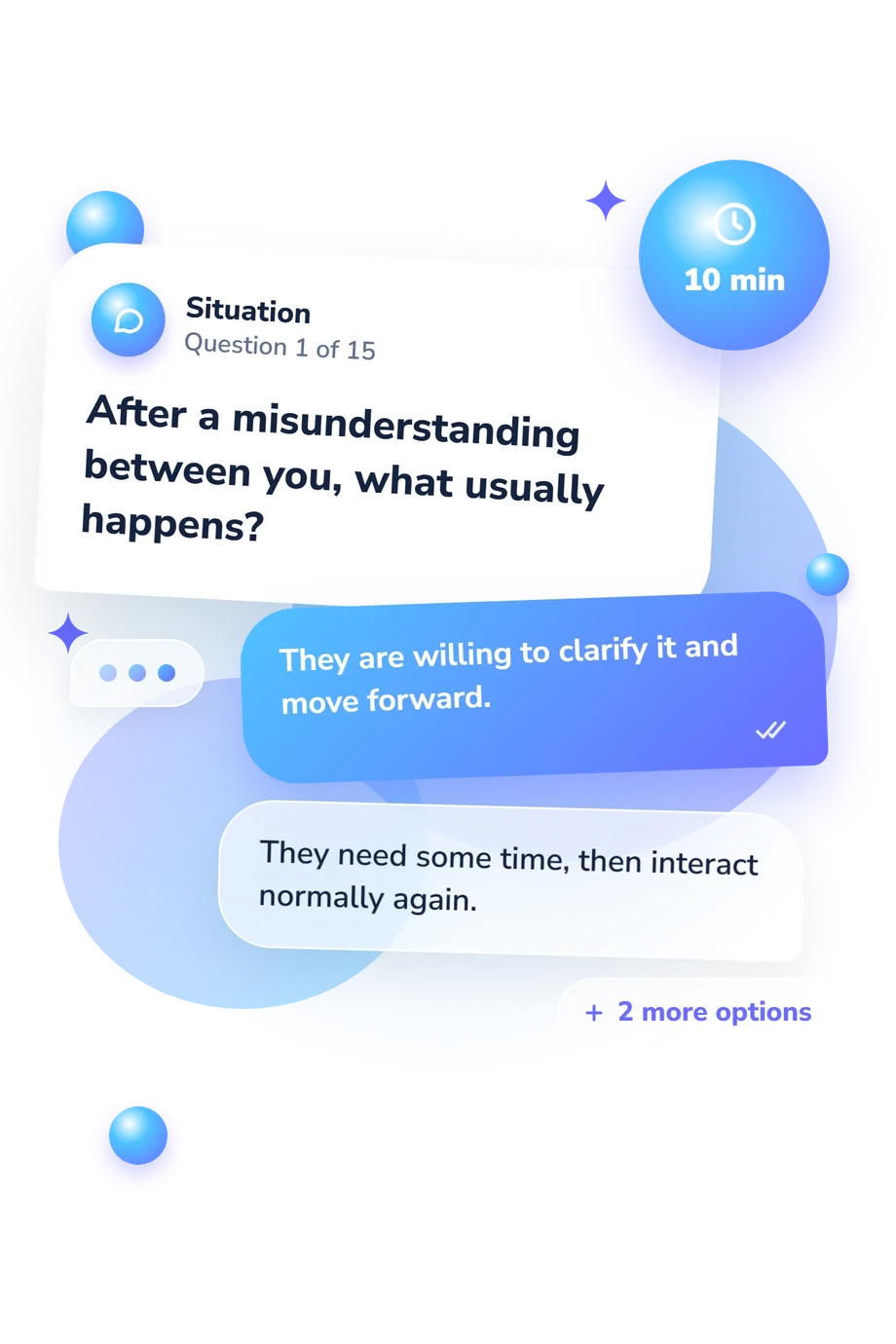
Example Questions From the Test
- They are willing to clarify it and move forward.
- They need some time, then interact normally again.
- They remain distant and avoid discussing what happened.
- They repeatedly use the incident to insult me or justify cutting off contact.
- They actively include me or check whether the plan works for me.
- They appear comfortable with my inclusion but do not take the lead.
- They seem hesitant once my participation is mentioned.
- They explicitly try to exclude me without offering a neutral reason.
- They often restart it or send me something relevant.
- Either of us might restart it, depending on the week.
- I usually restart it, but they respond with some interest.
- Nothing resumes unless I make repeated attempts.
Does My Crush Hate Me Quiz - Description and methodology of the test
People who feel uncertain about a crush’s reactions can use the Does My Crush Hate Me Quiz to organize recurring interpersonal signals rather than judge one delayed message or awkward encounter. It is intended for anyone reviewing a confusing connection. As a quiz about signs your crush doesn't like you, it offers separate profiles of distance signals, engagement and reciprocity, and warmth or comfort, each with its own result bands.
What This Assessment Explores
Rather than claiming access to private feelings, the questionnaire organizes interactions into three dimensions. It helps someone review whether a crush’s behavior reflects explicit distance signals, engagement and reciprocity, or observable warmth and comfort. This quiz about whether my crush hates me turns concern about rejection into observations of repeated behavior.
The scales capture three dimensions:
- Direct Distance Signals (0-15) reflects explicit words and repeated actions indicating romantic disinterest, requests for space, or interpersonal conflict; bands: Little explicit distance (0-5), Meaningful boundaries (6-10), Strong distance signal (11-15).
- Engagement and Reciprocity (0-15) reflects how evenly attention, conversation, and plans are maintained; bands: Mutual momentum (0-5), Uneven momentum (6-10), Limited reciprocity (11-15).
- Warmth and Comfort (0-15) considers observable ease, kindness, and inclusion; bands: Comfortable tone (0-5), Mixed tone (6-10), Consistent coolness (11-15).
Together, they help organize what to notice across interactions.
Methodology and Scientific Basis
Each item describes a recognizable interaction and offers four choices, moving from engagement toward avoidance, explicit distance, or hostility. Choose the option matching repeated firsthand experience, not the most alarming interpretation. The question behind a does your crush hate you quiz is handled as a behavioral pattern, not a binary verdict.
Responses are grouped by dimension, keeping boundaries, reciprocity, and warmth distinct. The questionnaire states each scale's range and result bands but not how individual choices add points; interpret scores through the displayed bands and definitions rather than infer a formula. A higher result indicates more of the named pattern, not certainty about another person’s feelings.
The dimensions are conceptually consistent with the Romantic Disengagement Scale (Barry et al., 2008). Young et al. (2008) add a communication perspective on distancing in unrequited situations, and Downey and Feldman (1996) explain how rejection concerns can amplify ambiguous cues. The questionnaire is conceptually consistent with this work, not an adaptation of these instruments.
These online scores have no established normative interpretation; mood, memory, self-awareness, and context can shape answers. Respect requests for space regardless of the total; threatening conduct warrants disengagement and support.
- Barry, Robin A., Erika Lawrence, and Amie Langer. (2008). Conceptualization and assessment of disengagement in romantic relationships. Personal Relationships, 15(3), 297-315. 10.1111/j.1475-6811.2008.00200.x
- Young, Stacy L., Christina G. Paxman, Christine L. E. Koehring, and Courtney A. Anderson. (2008). The Application of a Face Work Model of Disengagement to Unrequited Love. Communication Research Reports, 25(1), 56-66. 10.1080/08824090701831800
- Downey, Geraldine, and Scott I. Feldman. (1996). Implications of Rejection Sensitivity for Intimate Relationships. Journal of Personality and Social Psychology, 70(6), 1327-1343. 10.1037//0022-3514.70.6.1327
Updated: