
3 Word Style Quiz
How the Scales are Structured
Who Usually Takes This Test?
See How You Compare
Below is a preview of how scores are typically distributed across each scale.
Example Questions From the Test
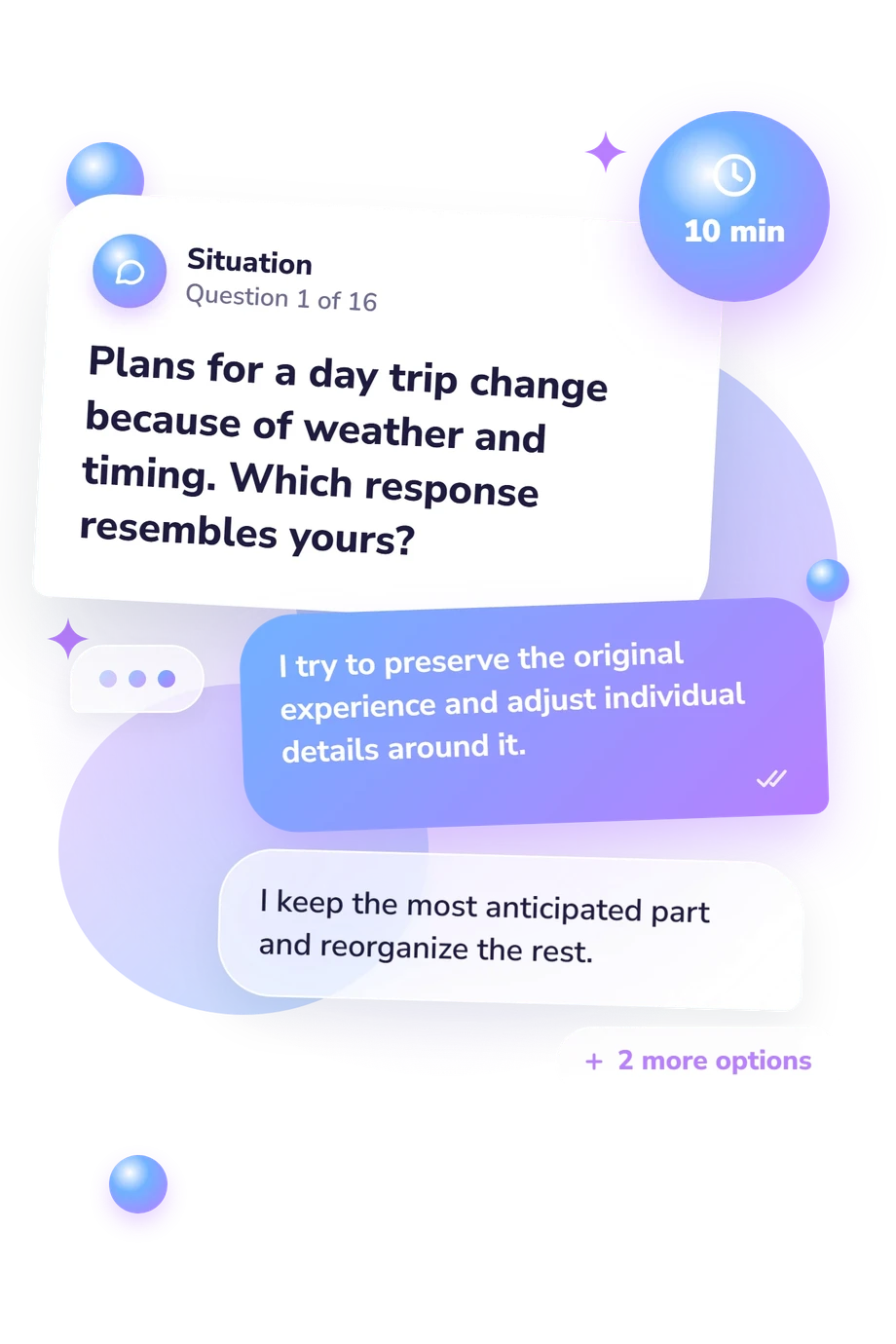
- I try to preserve the original experience and adjust individual details around it.
- I keep the most anticipated part and reorganize the rest.
- I simplify the plan and focus on what remains convenient and enjoyable.
- I switch directions easily and choose whatever works best with the conditions now.
- I choose according to my mood and adjust as the day unfolds.
- I start with one suitable item and build a workable outfit around it.
- I coordinate the main pieces so the outfit feels appropriate and cohesive.
- I plan the full combination, including small details, for a deliberate finish.
- It creates a strong visual or emotional impression, even if it needs special handling.
- It has a distinctive quality that makes occasional inconvenience worthwhile.
- It works reliably and also fits naturally with my preferences.
- It is comfortable, durable, uncomplicated, and useful in several situations.
3 Word Style Quiz - Description and methodology of the test
For readers who want to understand the priorities behind their everyday choices, the 3 word style quiz offers a guided profile of how originality, polish, usefulness, and personal meaning may shape decisions. It suits anyone exploring a personal style quiz through ordinary situations rather than appearance alone, with results framed as reflective affinities instead of fixed labels.
What This Assessment Explores
Rather than ranking taste, the assessment reads style as preferences expressed in ordinary situations. The style words quiz covers plans, clothing, objects, spaces, creative work, gifts, and relationship-shaped choices. Together, these scenarios show whether visibility, refinement, practical ease, or personal meaning most often guides a choice.
The four displayed dimensions are:
- Bold Expressive Original (0-12) measures affinity for visibility and distinctive experimentation: Quiet Individuality (0-4), Expressive Spark (5-8), Signature Energy (9-12).
- Polished Purposeful Precise (0-12) measures structure and refinement: Flexible Finish (0-4), Selective Precision (5-8), Intentional Polish (9-12).
- Relaxed Practical Grounded (0-12) measures comfort, usefulness, and adaptation: Designed Structure (0-4), Practical Balance (5-8), Grounded Ease (9-12).
- Warm Thoughtful Connected (0-12) measures warmth and relationship-shaped meaning: Independent Lens (0-4), Personal Warmth (5-8), Meaningful Connection (9-12).
The highest scale is the strongest affinity; scores within one point form a blended result, not a fixed label.
Methodology and Evidence Base
Methodologically, it is a self-report questionnaire: each prompt in this 3 word style test presents a familiar situation with four response options, and each option emphasizes expression, refinement, ease, or relational meaning. There are no right answers; selections indicate preference, not performance.
Scoring is dimensional rather than pass-fail. Responses form four profile totals; the strongest identifies the clearest affinity, while close totals produce a blended result instead of a single category.
Its closest conceptual anchor is Clothing Style Confidence (Joyner Armstrong et al., 2018), a multidimensional treatment of style-related confidence that supports examining several priorities at once. Themes also align with Tiggemann and Lacey (2009) on clothing functions and appearance investment, and Sontag and Lee (2004) on clothing, identity, and personal meaning. This questionnaire is conceptually consistent with those works, not an adaptation or standardized administration of them.
The result is a snapshot of stated preferences. This questionnaire has no published norms, and mood, context, self-awareness, or socially desirable responding may affect answers. It is not a diagnosis or a measure of creativity, confidence, kindness, or social ability.
- Joyner Armstrong, Cosette M., Jiyun Kang, and Chunmin Lang. (2018). Clothing style confidence: The development and validation of a multidimensional scale to explore product longevity. Journal of Consumer Behaviour, 17(6), 553-568. 10.1002/cb.1739
- Tiggemann, Marika, and Catherine Lacey. (2009). Shopping for clothes: Body satisfaction, appearance investment, and functions of clothing among female shoppers. Body Image, 6(4), 285-291. 10.1016/j.bodyim.2009.07.002
- Sontag, M. Suzanne, and Jongnam Lee. (2004). Proximity of Clothing to Self Scale. Clothing and Textiles Research Journal, 22(4), 161-177. 10.1177/0887302X0402200402
Updated: