
What Kind of Guy Will I Marry Quiz
How the Scales are Structured
Who Usually Takes This Test?
See How You Compare
Below is a preview of how scores are typically distributed across each scale.
Example Questions From the Test
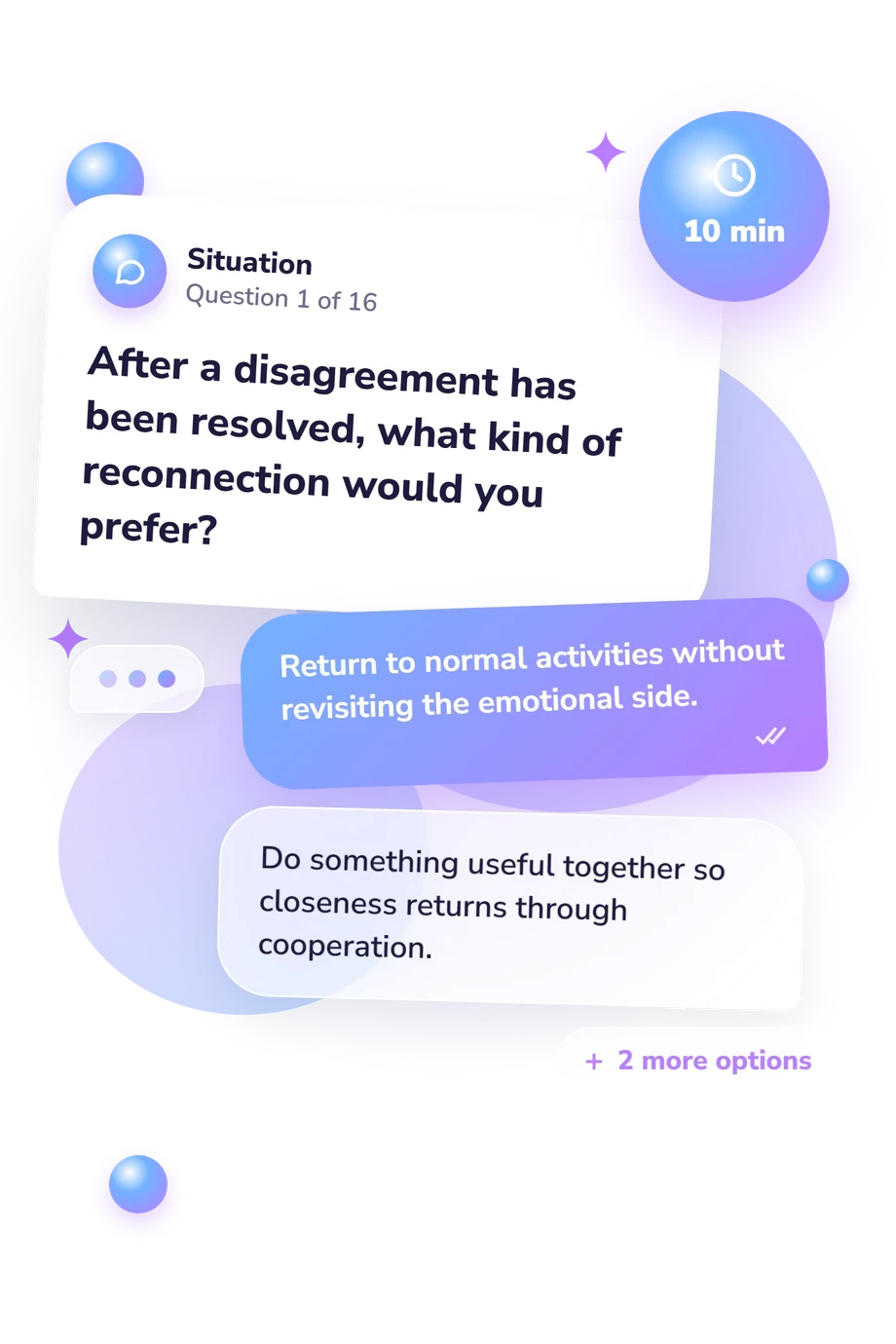
- Return to normal activities without revisiting the emotional side.
- Do something useful together so closeness returns through cooperation.
- Share affection and briefly acknowledge what we learned from the disagreement.
- Have an open conversation about how each of us felt, followed by an intentional moment of closeness.
- I would encourage him to pursue it independently while I keep my own routine.
- I would try it once if we planned ahead and knew what to expect.
- I would rather invest our shared time in interests we already know we enjoy.
- I would be eager to learn alongside him, even if we might be terrible at first.
- We would examine the trade-offs and create a plan that supports both of our goals.
- He would decide independently, since personal ambitions should remain separate.
- I would offer encouragement while avoiding detailed involvement in the decision.
- We would discuss how it fits our life, but keep the plan adjustable as circumstances change.
What Kind of Guy Will I Marry Quiz - Description and methodology of the test
People who want to clarify the partner qualities they value can use the What Kind of Guy Will I Marry Quiz as a guided reflection on relationship ideals. It suits someone who is dating, single, or reflecting on the qualities they want in a long-term partner. Rather than predicting a spouse, the questionnaire creates a relationship preference profile from everyday choices.
What This Assessment Explores
The questionnaire focuses on partner qualities that respondents may value in a relationship, not on naming a future spouse. Its scenarios cover emotional repair, novelty, ambition, routines, money, travel, affection, and practical care. The scenarios help respondents identify their preferred partner qualities and relationship dynamics.
These profiles show the result's dimensions:
- Adventurous Optimist (0-12) reflects attraction to curious, energetic partners and shared novelty: Familiar Ground (0-4), Selective Explorer (5-8), or Strong Adventurous Optimist Affinity (9-12).
- Ambitious Builder (0-12) reflects shared goals and collaborative progress: Present-Focused (0-4), Balanced Builder (5-8), or Strong Affinity (9-12).
- Steady Supporter (0-12) reflects dependable care and stable teamwork: Independence First (0-4), Stability Appreciated (5-8), or Strong Steady Supporter Affinity (9-12).
- Thoughtful Romantic (0-12) reflects emotional expression and personal attention: Subtle Connection (0-4), Warm but Grounded (5-8), or Strong Romantic Affinity (9-12).
Methodology and Scientific Basis
Each item presents a relationship situation with four response options. The scenarios sample conflict repair, independence, shared planning, novelty, ambition, stability, affection, and practical care. Choosing the most appealing pattern makes the output a profile of stated ideals rather than observed behavior.
Four profile scores turn these choices into a picture of the qualities the respondent prefers in a long-term partner. The highest shows strongest affinity; any profile within one point of it contributes to a blended result. The point assigned to each option is not specified, so no additional scoring rule should be inferred.
Partner-preference themes are conceptually consistent with the Ideal Standards Model, which treats partner ideals as standards for evaluating close relationships. Campbell et al. describe flexible ideals, while Eastwick et al. report limited but meaningful links with relationship outcomes. The questionnaire is conceptually consistent with these works, not an adaptation of them.
Reflection with this profile helps a reader consider ideal relationship qualities rather than assess a specific relationship or predict a future spouse. Mood, relationship history, and self-awareness can affect self-report results.
- Fletcher, Garth J. O., Jeffry A. Simpson, Geoff Thomas, and Louise Giles. "Ideals in Intimate Relationships." Journal of Personality and Social Psychology 76, no. 1 (1999): 72-89. 10.1037/0022-3514.76.1.72
- Campbell, Lorne, Jeffry A. Simpson, Deborah A. Kashy, and Garth J. O. Fletcher. "Ideal Standards, the Self, and Flexibility of Ideals in Close Relationships." Personality and Social Psychology Bulletin 27, no. 4 (2001): 447-462. 10.1177/0146167201274006
- Eastwick, Paul W., Laura B. Luchies, Eli J. Finkel, and Lucy L. Hunt. "The Predictive Validity of Ideal Partner Preferences: A Review and Meta-Analysis." Psychological Bulletin 140, no. 3 (2014): 623-665. 10.1037/a0032432
Updated: