
Mutations Quiz
How the Scales are Structured
Who Usually Takes This Test?
See How You Compare
Below is a preview of how scores are typically distributed across each scale.
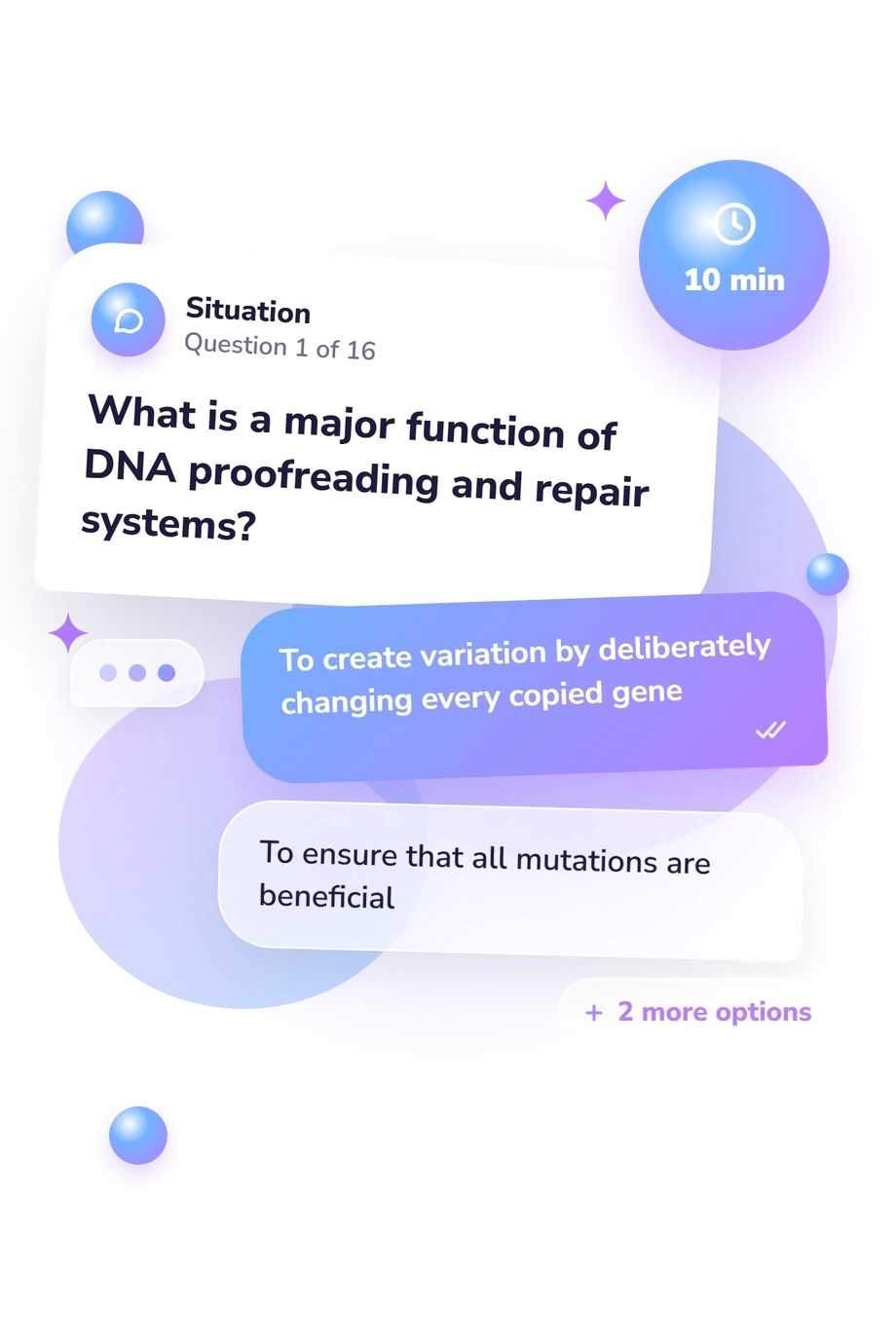
Example Questions From the Test
- To create variation by deliberately changing every copied gene
- To ensure that all mutations are beneficial
- To detect and correct many copying errors or damaged DNA sites
- To translate altered genes into proteins before cell division
- Insertion
- Translocation
- Duplication
- Substitution
- The chromosome number in every cell
- The amino acid meanings assigned to all codons
- The identity of every protein made by the cell
- When, where, or how much the gene is expressed
Mutations Quiz - Description and methodology of the test
For learners checking core genetics knowledge, this DNA mutation quiz offers a focused way to organize revision and study planning. Taking the mutations quiz gives learners a structured checkpoint before further study. It suits classroom revision, independent study, or anyone seeking a clear way to work through foundational mutation biology.
What This Assessment Explores
The assessment measures conceptual understanding rather than personal genetic risk. Items ask you to identify mutation types, connect DNA changes with reading frames and protein products, and judge effects that depend on location or context. They also touch on repair, regulatory regions, chromosome rearrangements, reproductive cells, and selection.
Across these mutation quiz questions, application matters as much as recall. Results use one displayed scale, Mutations Knowledge (0-16), with three result bands:
- Building Foundations (0-6) shows that core biological mutation and inheritance concepts need review.
- Developing Knowledge (7-12) shows growing understanding, with some central distinctions still needing practice.
- Strong Knowledge (13-16) shows solid application of major mutation concepts without interpreting personal genetic data.
Methodology and Evidence Base
Each item presents a biological situation or definition with four answer choices. The set moves from mutation definitions, spontaneous change, and DNA repair to applications involving sequence changes, including substitutions, insertions, deletions, reading-frame effects, regulatory regions, chromosome rearrangements, inheritance, and selection.
The displayed score summarizes correct answers across the full quiz. It is an educational knowledge tally, and guessing or familiarity with terminology can affect the result.
The approach is conceptually consistent with MuCRA (Wasendorf et al., 2024), a mutation-focused criterion-referenced assessment, and with the Genetics Concept Assessment (Smith et al., 2008), a genetics concept inventory. These sources support the emphasis on applying mechanisms and distinguishing common misconceptions, but they do not establish that this online questionnaire is an adaptation, validated copy, or standardized instrument.
As a mutation knowledge quiz, it offers a focused snapshot rather than a complete measure of genetics expertise. Current study context can influence performance, so use the result to target review rather than infer disease status, personal genetic findings, or laboratory competence.
- Chloe Wasendorf, Joshua W. Reid, Rebecca Seipelt-Thiemann, Z. T. Grimes, Brock Couch, Nick T. Peters, Julia Massimelli Sewall, Audrey L. McCombs, Patrick I. Armstrong, and Nancy Boury (2024). The development and validation of the Mutation Criterion Referenced Assessment (MuCRA). Journal of Biological Education, 58(3), 651-665. 10.1080/00219266.2022.2100451
- Michelle K. Smith, William B. Wood, and Jennifer K. Knight (2008). The Genetics Concept Assessment: A New Concept Inventory for Gauging Student Understanding of Genetics. CBE-Life Sciences Education, 7(4), 422-430. 10.1187/cbe.08-08-0045
Updated: