
Is She My Best Friend Quiz
How the Scales are Structured
Who Usually Takes This Test?
See How You Compare
Below is a preview of how scores are typically distributed across each scale.
Example Questions From the Test
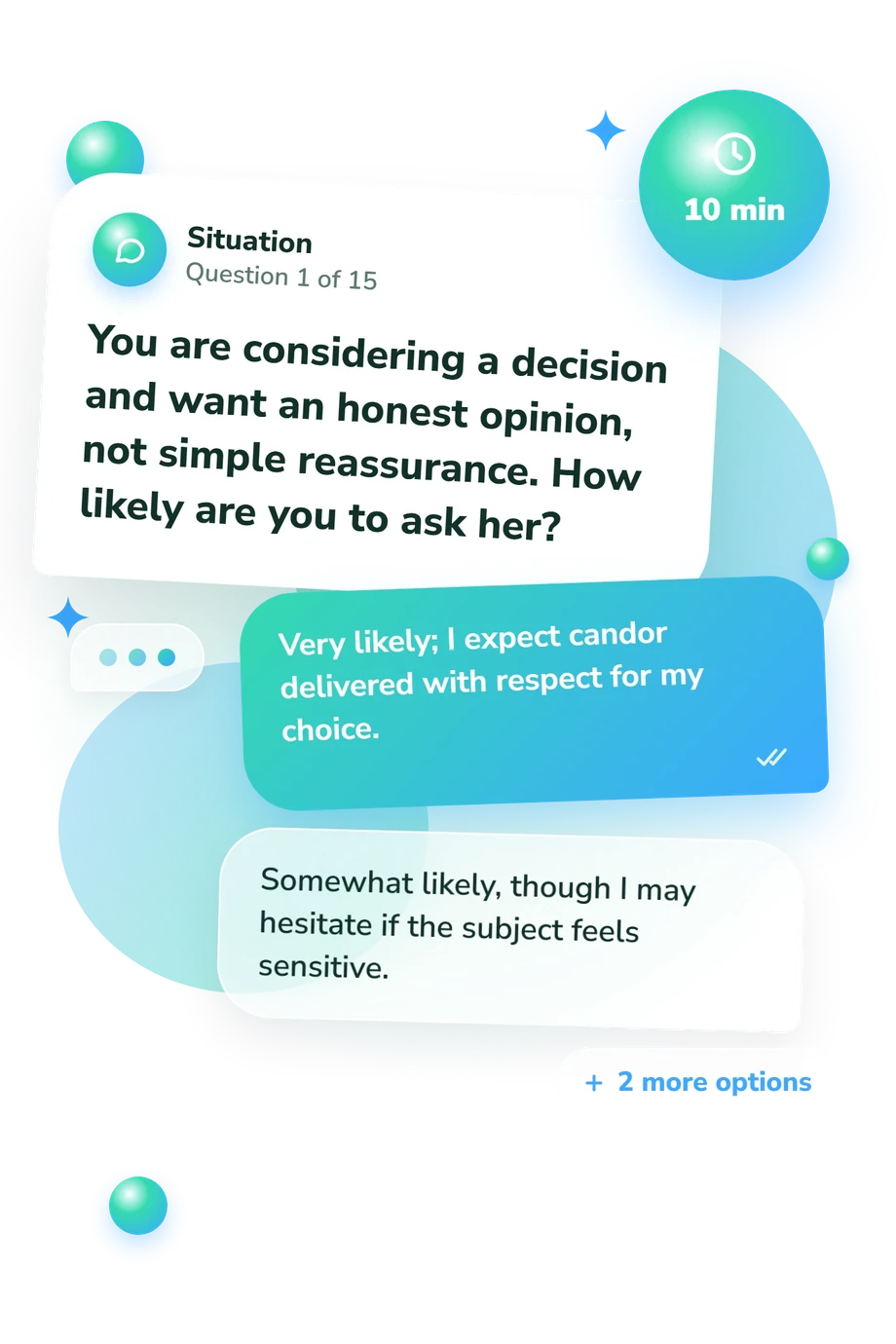
- Very likely; I expect candor delivered with respect for my choice.
- Somewhat likely, though I may hesitate if the subject feels sensitive.
- I would probably choose someone whose perspective I trust more for that decision.
- I might ask if the decision is fairly low-stakes.
- She might come to mind if our schedules and interests happen to align.
- She is one of my most natural choices, even without a special plan.
- I would be more likely to use the time alone or contact someone else.
- I might invite her if there were a particular activity to do together.
- She is usually one of the first people I want to contact.
- I may tell her after I have processed it or spoken to someone else.
- I generally share only the practical outline with her.
- She is rarely someone I think of telling personally.
Is She My Best Friend Quiz - Description and methodology of the test
People wondering whether a close friendship feels mutual can use the Is She My Best Friend Quiz to examine its everyday pattern instead of forcing a simple label. It suits someone reflecting on one important friendship, especially when warmth and history are real but the current balance feels unclear. This true best friend quiz can turn that uncertainty into observations about support, closeness, and trust.
What This Assessment Explores
These questions cover advice, contact, support, disagreement, social settings, daily familiarity, and future plans. They suit someone examining one bond when a label feels less useful than its pattern. Results describe support, connection, and openness.
Treat the questionnaire as a best friend compatibility assessment, not a verdict about either person’s worth; it offers a snapshot of current functioning. These are the three dimensions:
- Reciprocity and Reliability (0-15) shows whether attention, effort, encouragement, and practical support move both ways: Uneven rhythm (0-5), Meaningful give-and-take (6-10), or Strong reciprocity (11-15).
- Shared Connection (0-15) shows how naturally the friendship fits daily life, enjoyment, social settings, and future plans: Limited shared place (0-5), Established connection (6-10), or Central connection (11-15).
- Trust and Openness (0-15) shows comfort with authenticity, personal sharing, disagreement, and vulnerable information: Guarded connection (0-5), Growing trust (6-10), or Deep openness (11-15).
Methodology and Scientific Basis
Methodologically, it is a self-report questionnaire: each item offers four response descriptions rather than yes-or-no choices. Items cover advice, contact, private sharing, disagreement, planning, good news, and future expectations. Choose the response closest to the usual pattern, not an ideal version. The result describes the bond from your side, not her private view, so it cannot settle what she thinks of the friendship.
The questionnaire is conceptually consistent with the McGill Friendship Questionnaires, a friendship-quality framework. Its themes also align with the Friendship Qualities Scale developed by Bukowski, Hoza, and Boivin and with Langheit and Poulin’s study of friendship quality. The displayed scores are descriptive rather than norm-based.
Responses are summarized across the three dimensions; the displayed result organizes them, while no item-by-item weighting formula is specified. Here, friendship familiarity means relational familiarity rather than trivia: the items ask where she fits in routines, plans, conversations, and vulnerable moments. Self-report can be shaped by current conflict, distance, memory, or a desire to present the relationship favorably.
- Morton J. Mendelson and Frances E. Aboud (1999). Measuring Friendship Quality in Late Adolescents and Young Adults: McGill Friendship Questionnaires. Canadian Journal of Behavioural Science/Revue canadienne des sciences du comportement, 31(2), 130-132. 10.1037/h0087080
- Stéphanie Langheit and François Poulin (2022). Developmental changes in best friendship quality during emerging adulthood. Journal of Social and Personal Relationships, 39(11), 3373-3393. 10.1177/02654075221097993
- William M. Bukowski, Betsy Hoza, and Michel Boivin (1994). Measuring Friendship Quality During Pre- and Early Adolescence: The Development and Psychometric Properties of the Friendship Qualities Scale. Journal of Social and Personal Relationships, 11(3), 471-484. 10.1177/0265407594113011
Updated: