
What Guitar Am I Quiz
How the Scales are Structured
Who Usually Takes This Test?
See How You Compare
Below is a preview of how scores are typically distributed across each scale.
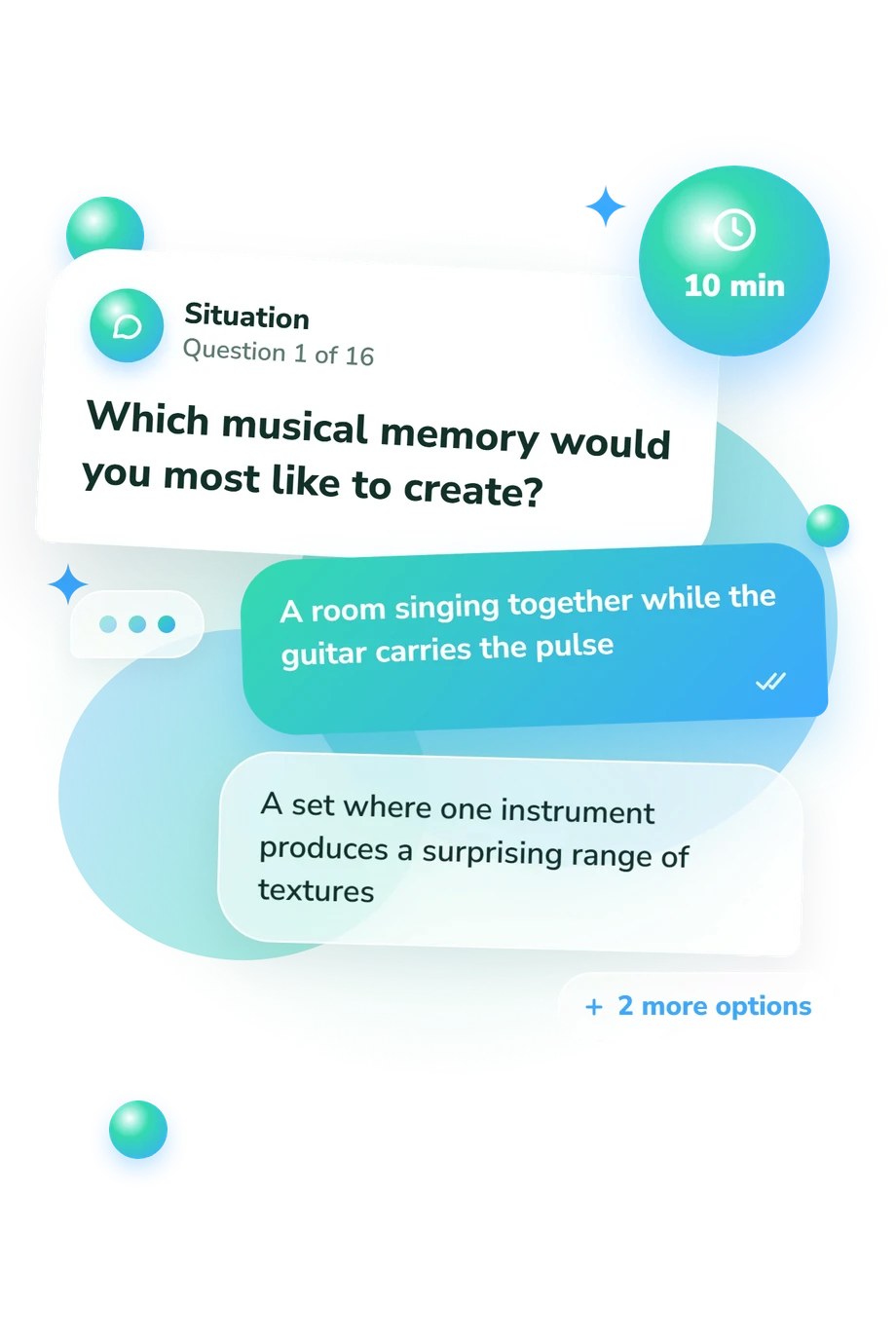
Example Questions From the Test
- Replace it with a softer, more atmospheric layer
- Reduce it to a sharp rhythmic figure with plenty of space
- Save one sustained phrase for the end of each vocal line
- Move to straightforward chords that support the melody
- “You always find an interesting color for each section.”
- “Your notes have real weight and authority.”
- “You make the whole room want to sing along.”
- “Every note lands clearly and exactly where it belongs.”
- Choose a crisp tone and play a lean part that cuts through
- Add a broad, layered texture that changes across the section
- Use a firm, sustained phrase at a few dramatic moments
- Simplify to open chords and let the vocal remain central
What Guitar Am I Quiz - Description and methodology of the test
Players curious about how musical instincts translate into instrument preferences can use the What Guitar Am I Quiz as a guided profile. It is intended for anyone who wants language for the tone, presence, flexibility, or shared musical role that feels most natural. This assessment works as a what guitar are you quiz, showing which style feels most compatible rather than ranking instruments.
What This Assessment Explores
Items contrast tone, rhythm, resonance, and flexibility across imagined musical situations. The test describes guitar style preferences for curious listeners and players without technical training.
The result reports four separate affinities:
- Powerful Single-Cut Electric (0-12) reflects affinity for rich sustain, grounded presence, deliberate expression, and tonal weight: Lighter Approach (0-4), Solid Pull (5-8), or Sustained Presence (9-12).
- Punchy T-Style Electric (0-12) reflects affinity for clarity, economy, rhythmic precision, and a direct voice: Broader Palette (0-4), Clear-Cut Pull (5-8), or Direct Spark (9-12).
- Resonant Dreadnought Acoustic (0-12) reflects affinity for natural resonance, storytelling, portability, and shared musical moments: Electric Leaning (0-4), Acoustic Current (5-8), or Resonant Storyteller (9-12).
- Versatile S-Style Electric (0-12) reflects affinity for adaptable tones, fluid role changes, and expressive experimentation: Focused Signature (0-4), Flexible Streak (5-8), or Versatile Colorist (9-12).
Together, they describe preference, not ability.
Methodology and Evidence Base
Each question presents a musical situation or preference with four contrasting options. This forced-choice self-report format captures what the respondent would do, value, or find satisfying rather than technical skill. Scenarios cover tone, stage presence, arrangement decisions, creative constraints, equipment context, and band role.
Scores appear separately for four outcomes. The highest score indicates strongest affinity; another within one point indicates a blended profile. The questionnaire does not specify how individual answers contribute to each score, so the result should be interpreted comparatively rather than through an inferred scoring formula.
Herbst (2019) provides the closest context by linking guitar equipment attitudes and distortion preferences with musical orientations. Mateos-Moreno and Hoglert (2024) treat instrument choice as motivational, while Waterman and Funder (2021) examine associations between instrument preference and personality traits. This questionnaire is conceptually consistent with those works, not an adaptation.
Current mood, experience, familiarity with guitar sounds, and self-presentation may shape how this guitar style quiz groups your affinities. Its bands are comparative result categories for tone, expression, resonance, and adaptability; the result is not a clinical classification.
- Herbst, Jan-Peter. “Empirical Explorations of Guitar Players’ Attitudes Towards Their Equipment and the Role of Distortion in Rock Music.” Current Musicology, no. 105, 2019, pp. 75-106. 10.7916/cm.v0i105.5404
- Mateos-Moreno, Daniel, and Anders Hoglert. “Why did you (not) choose your main musical instrument? Exploring the motivation behind the choice.” British Journal of Music Education, vol. 41, no. 1, 2024, pp. 74-85. 10.1017/S0265051723000025
- Waterman, Morgan J., and David Funder. “What Does Your Musical Instrument Say About You: Analyzing Musical Instrument Preference and the Big 5 Personality Traits.” UC Riverside Undergraduate Research Journal, vol. 15, no. 1, 2021. 10.5070/RJ515355198
Updated: