
Kids Movie Quiz
How the Scales are Structured
Who Usually Takes This Test?
See How You Compare
Below is a preview of how scores are typically distributed across each scale.
Example Questions From the Test
- Puss in Boots
- Donkey
- Gingy
- Pinocchio
- Maui's fishhook
- A crown from Lalotai
- A shell from Motunui
- The heart of Te Fiti
- Anna
- Olaf
- Kristoff
- Hans
Kids Movie Quiz - Description and methodology of the test
For families, teachers, and film fans who want a lively way to revisit familiar stories, the kids movie quiz turns recognition into a focused self-check. The format also works well as a children's movie quiz for anyone curious about characters, settings, objects, and plot details from well-known animated and family-friendly films. Its result gives a concise picture of recall across varied movie adventures.
What This Assessment Explores
This assessment measures recognition of film facts rather than taste or emotional reactions. The items sample several kinds of recall: identifying characters, matching films to settings, remembering a central object or ability, and connecting a memorable event with the correct title. Together, these tasks show how readily a respondent retrieves details from familiar children’s cinema, making the format suitable as a film quiz for kids.
On the result screen, Kids Movie Knowledge (0-16) describes the breadth and accuracy of that recall. The three bands give the result its practical meaning:
- Foundation-building (0-6) shows that major touchstones are beginning to register, while many stories remain to explore.
- Developing (7-12) reflects broad knowledge and connections among characters, settings, and plot clues.
- Standout (13-16) indicates impressive accuracy across different studios and eras.
Methodology and Evidence Base
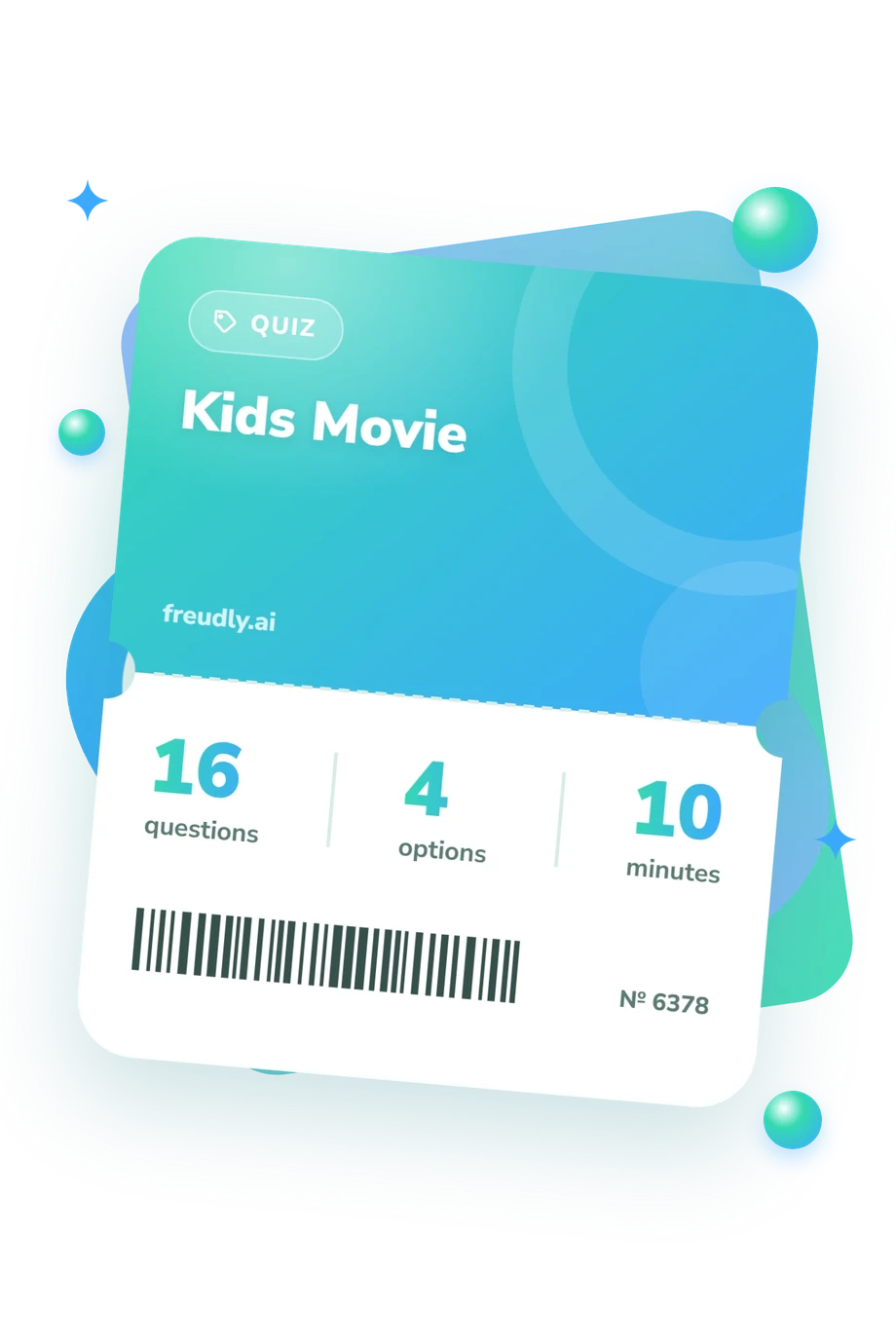
The questionnaire uses 16 multiple-choice prompts with four answer options each. Items ask the respondent to select the character, country, creature, object, ability, celebration, or film title that best completes a familiar story detail. Responses are aggregated into a single displayed knowledge score.
Furman et al. (2007) found that information from a long audiovisual story can remain available for later recognition. MovieQA connects question-answering with story understanding, while Michel and colleagues highlight active engagement with film content. The questionnaire is conceptually consistent with these lines of work. It has no documented standardization or norms, and its displayed bands are descriptive rather than population-based.
The questionnaire provides a light movie-trivia check as a kids film quiz; its score reflects overall movie knowledge and may prompt a general review of familiar films. It is not a measure of general memory, learning level, or psychological traits. Viewing history, cultural exposure, guessing, current attention, and familiarity with the titles can affect performance, so the score is best read as a snapshot of movie knowledge.
- Furman, Orit, Nimrod Dorfman, Uri Hasson, Lila Davachi, and Yadin Dudai. “They saw a movie: Long-term memory for an extended audiovisual narrative.” Learning & Memory, 14(6), 457-467, 2007. 10.1101/lm.550407
- Tapaswi, Makarand, Yukun Zhu, Rainer Stiefelhagen, Antonio Torralba, Raquel Urtasun, and Sanja Fidler. “MovieQA: Understanding Stories in Movies Through Question-Answering.” Proceedings of the IEEE Conference on Computer Vision and Pattern Recognition, 4631-4640, 2016. 10.1109/CVPR.2016.501
- Michel, E., Claudia M. Roebers, and Walter Schneider. “Educational films in the classroom: Increasing the benefit.” Learning and Instruction, 17(2), 172-183, 2007. 10.1016/j.learninstruc.2007.01.005
Updated: