
Ideal Woman Quiz
How the Scales are Structured
Who Usually Takes This Test?
See How You Compare
Below is a preview of how scores are typically distributed across each scale.
Example Questions From the Test
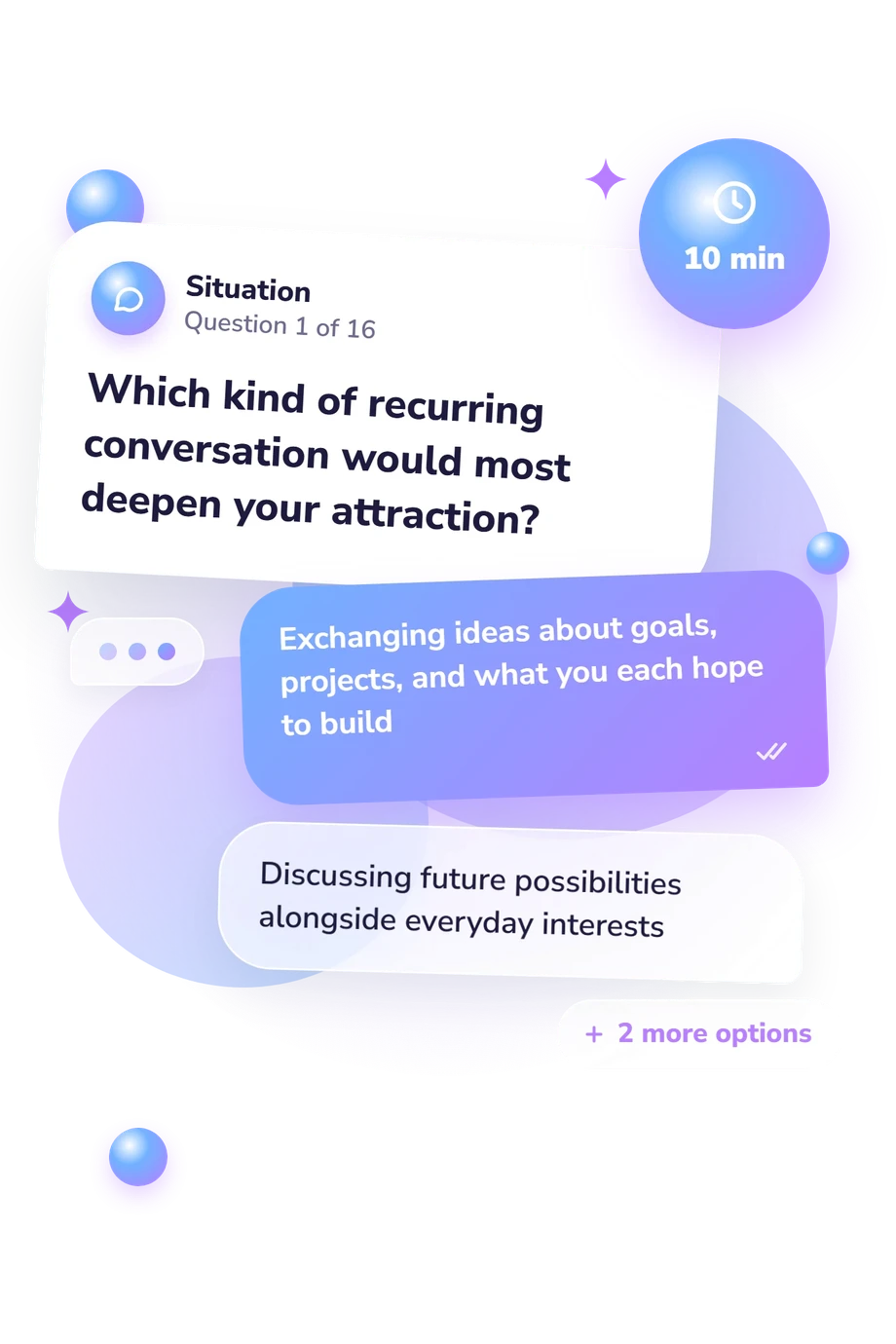
- Exchanging ideas about goals, projects, and what you each hope to build
- Discussing future possibilities alongside everyday interests
- Focusing mainly on present experiences and letting the future unfold
- Keeping plans light and avoiding pressure to turn interests into achievements
- Giving me uninterrupted time to reset on my own
- Offering practical help, then letting me choose whether to talk
- Checking in gently and listening if I want to share
- Sitting close, inviting me to open up, and showing clear affection
- Mostly through loyalty and being present when it counts
- Through frequent kind words, touch, and thoughtful check-ins
- Through occasional meaningful gestures rather than daily displays
- By respecting my space without needing much visible affection
Ideal Woman Quiz - Description and methodology of the test
People exploring the qualities they want in a woman as a partner can use the Ideal Woman Quiz to organize preferences rather than judge a particular person. Reflecting on your ideal-woman preferences can help compare valued relationship qualities without treating any single trait as decisive. As an ideal woman test, it offers a structured prompt for considering which relationship dynamic feels appealing when several qualities matter at once.
What This Assessment Explores
Four orientations organize the result. Scenarios cover goals, freedom, routines, cooperation, conflict, affection, and contact, revealing recurring priorities. The perfect woman quiz profile is a pattern, not a fixed standard.
The result groups your preferences into these dimensions:
- Driven Builder (0-12) reflects preference for present contentment (Present-Focused, 0-4), balanced goals (Purpose with Balance, 5-8), or purposeful growth (Driven Builder Affinity, 9-12).
- Independent Explorer (0-12) reflects preference for shared routines (Together-Oriented, 0-4), autonomy with connection (Grounded Explorer, 5-8), or freedom and novelty (Independent Explorer Affinity, 9-12).
- Steady Teammate (0-12) reflects flexible responsibility (Flexible Partnership, 0-4), reliable cooperation with room to adapt (Balanced Teammate, 5-8), or consistent teamwork (Steady Teammate Affinity, 9-12).
- Warm Connector (0-12) reflects emotional space (Reserved Connection, 0-4), selective openness (Selective Warmth, 5-8), or expressive closeness (Warm Connector Affinity, 9-12).
Methodology and Scientific Basis
Each item presents a relationship situation with four response options. The alternatives contrast approaches to goals, solitude, plans, household duties, disagreement, affection, and contact. Concrete choices make the questionnaire practical for examining partner preferences rather than abstract personality labels.
The structure uses a preference-mapping approach consistent with the Ideal Standards Model (Fletcher et al., 1999). Fletcher and Simpson's 2000 work presents relationship ideals as organized dimensions for evaluating close relationships, while Buss's 1989 cross-cultural study adds context for recurring mate-preference themes. Together, these sources support the conceptual frame; this questionnaire is not an adaptation of their instruments.
Scores within one point of the highest form a blended preference, so this relationship preference test places your perfect-woman preferences in context rather than producing a single winner. The bands describe stated preferences, not a population ranking.
Because this is self-report, mood, current relationship experiences, and self-awareness can influence responses. This online questionnaire has no reported norms, reliability or validity estimates, or clinical cutoffs; interpret its profile as structured reflection on preferences rather than a standardized assessment.
- Fletcher, Garth J. O., Geoff Thomas, Louise Giles, and Jeffry A. Simpson (1999). "Ideals in intimate relationships." Journal of Personality and Social Psychology, 76(1), 72-89. 10.1037/0022-3514.76.1.72
- Fletcher, Garth J. O., and Jeffry A. Simpson (2000). "Ideal Standards in Close Relationships: Their Structure and Functions." Current Directions in Psychological Science, 9(3), 102-105. 10.1111/1467-8721.00070
- Buss, David M. (1989). "Sex differences in human mate preferences: Evolutionary hypotheses tested in 37 cultures." Behavioral and Brain Sciences, 12(1), 1-49. 10.1017/S0140525X00023992
Updated: