
7 Heavenly Virtues Quiz
How the Scales are Structured
Who Usually Takes This Test?
See How You Compare
Below is a preview of how scores are typically distributed across each scale.
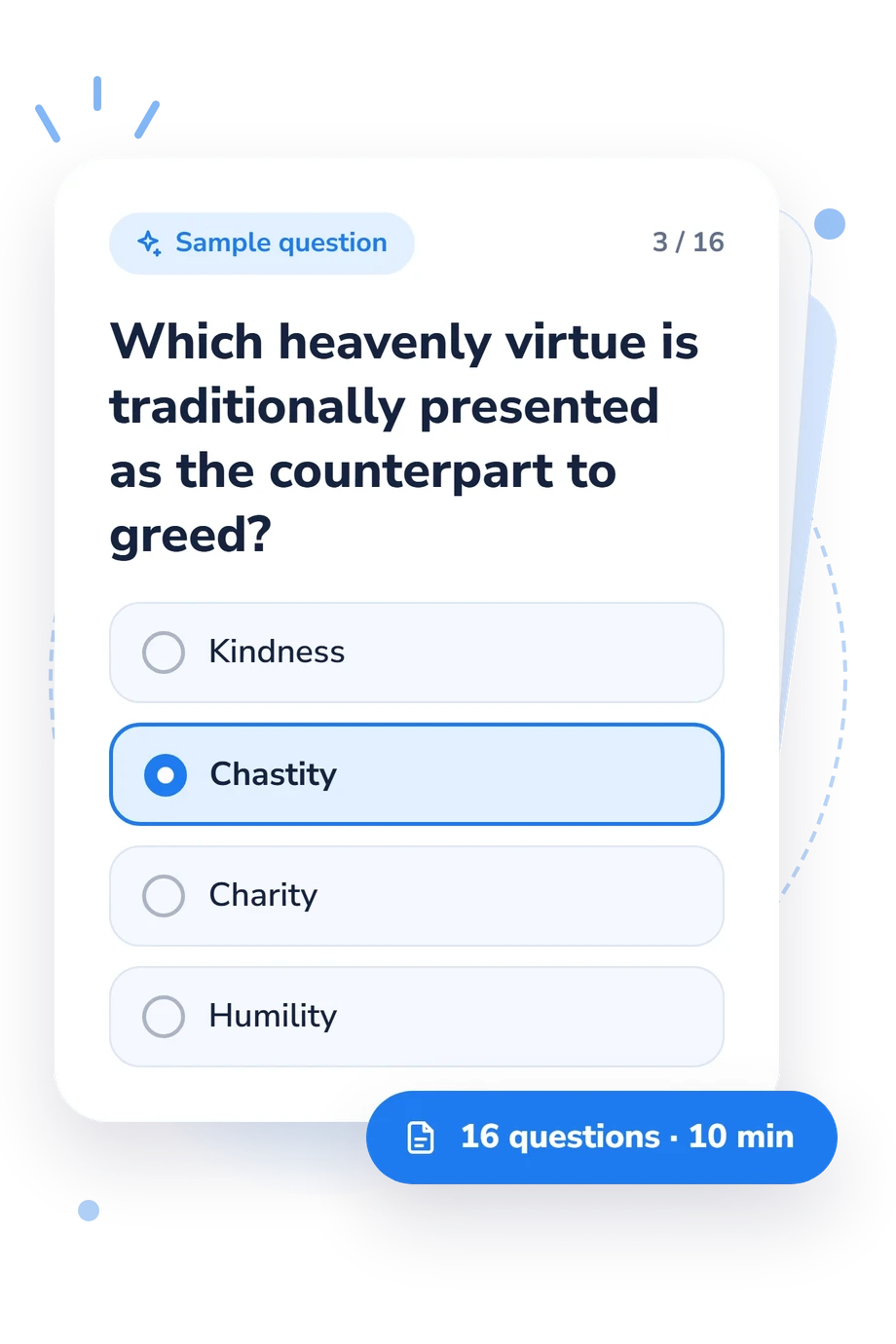
Example Questions From the Test
- Temperance
- Patience
- Humility
- Diligence
- Kindness
- Chastity
- Charity
- Humility
- Kindness
- Courage
- Humility
- Patience
7 Heavenly Virtues Quiz - Description and methodology of the test
People deciding whether to take this 7 heavenly virtues quiz may benefit if they are studying moral vocabulary or checking recall of a shared framework. Readers asking what is your virtue quiz can use the overall band to judge whether a broad refresher or further study would be useful. It is designed for learners who want a clear starting point for review, not a judgment of character.
What This Assessment Explores
This assessment checks whether you can identify the virtue-and-vice pairings used here within the common modern seven-heavenly-virtues framework and apply those distinctions to short situations. It suits readers studying the framework, revisiting moral vocabulary, or checking recall. This seven virtues quiz can show how well you know the framework without treating that knowledge as evidence of personal virtue.
One catalogue scale defines the result. It covers:
- Framework knowledge appears as 7 Heavenly Virtues Knowledge, ranging from 0-16. Foundation (0-6) signals partial recognition, Developing (7-12) broader understanding, and Strong (13-16) clear command of the names, paired vices, and examples; the scale measures knowledge, not moral worth.
- Virtue-vice recognition shows whether you can distinguish pairings such as humility against pride, charity against greed, and diligence against sloth.
- Situational application shows whether patience, temperance, chastity, and kindness fit everyday choices and reactions.
Methodology and Evidence Base
Questions use four-option multiple choice, combining direct identification with brief scenarios. Some ask for a paired virtue; others test whether patience, restraint, goodwill, or responsible boundaries fit a described response. Answers are summarized as one knowledge result, not a personality profile.
Vices and Virtues Scales (VAVS; Veselka et al., 2014) offers adjacent conceptual background: it is a published measure linking the seven deadly sins with personality-related constructs. This questionnaire is conceptually consistent with that work, not an adaptation of it, and VAVS findings do not validate this online knowledge check.
Prudentius' Psychomachia supplies historical context for conflicts between virtues and vices, while Timpe and Boyd provide a modern philosophical treatment of virtue theory. These sources clarify the framework without making the quiz a test of religious commitment.
For learners, this questionnaire works as a seven heavenly virtues test and a structured learning and self-reflection exercise. Interpretation follows its displayed bands: they indicate familiarity with the framework, not moral standing; results can also reflect memory, wording interpretation, current attention, and prior exposure to the terms.
- Veselka, Livia, Erica A. Giammarco, and Philip A. Vernon. "The Dark Triad and the seven deadly sins." Personality and Individual Differences 67 (2014): 75-80. 10.1016/j.paid.2014.01.055
- Prudentius, Aurelius Clemens. Prudentius, Volume I. Translated by H. J. Thomson. Loeb Classical Library 387. Cambridge, MA: Harvard University Press; London: William Heinemann, 1949. Psychomachia, pages 274-343.
- Timpe, Kevin, and Craig A. Boyd, eds. Virtues and Their Vices. Oxford: Oxford University Press, 2014. 10.1093/acprof:oso/9780199645541.001.0001
Updated: