
Time Management and Health Math Quiz
How the Scales are Structured
Who Usually Takes This Test?
See How You Compare
Below is a preview of how scores are typically distributed across each scale.
Example Questions From the Test
- 360 calories
- 450 calories
- 480 calories
- 540 calories
- 2 bottles
- 3 bottles
- 5 bottles
- 4 bottles
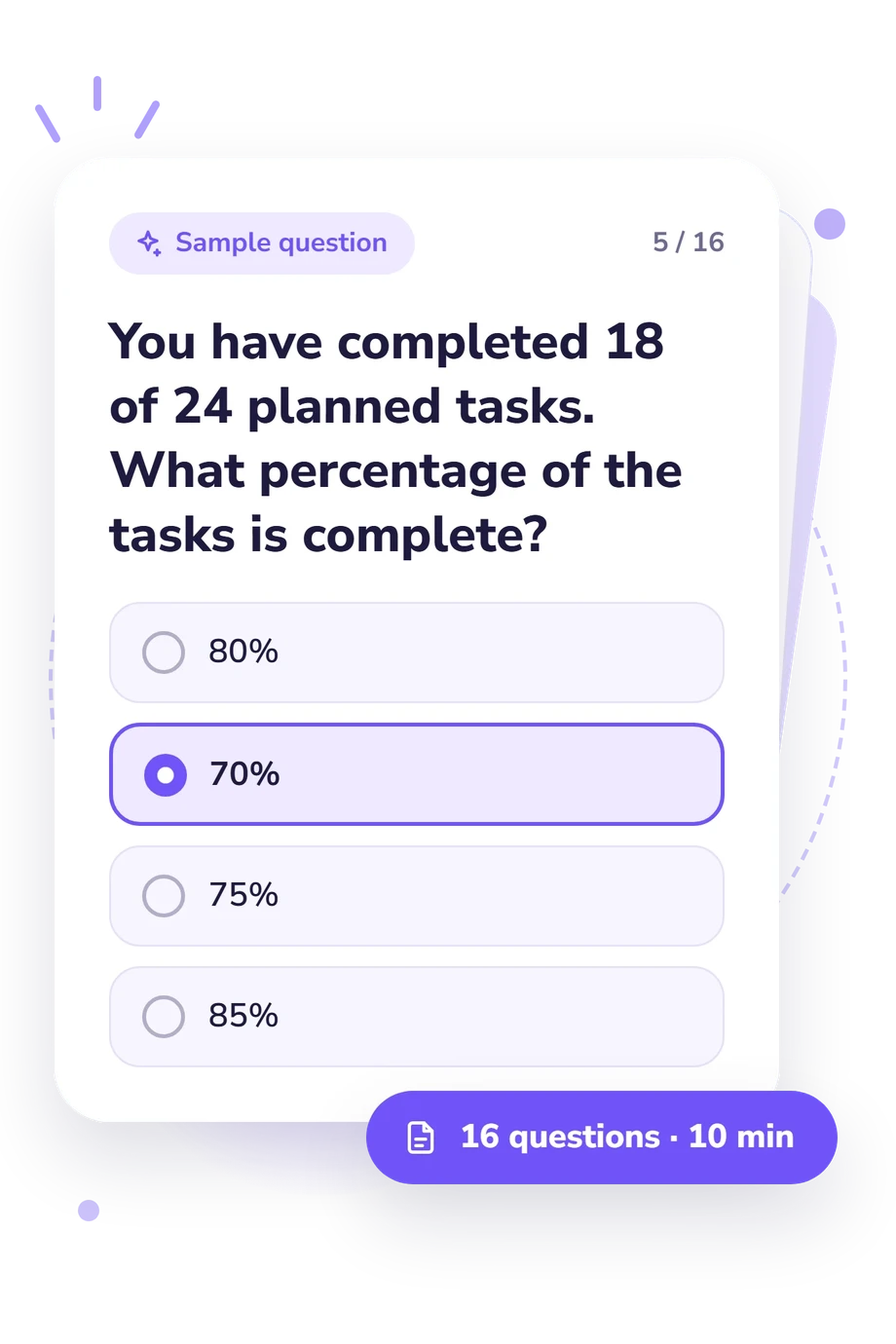
- 80%
- 70%
- 75%
- 85%
Time Management and Health Math Quiz - Description and methodology of the test
Anyone checking everyday planning and health-related calculation skills can use this assessment as a focused learning snapshot. The time management and health math quiz links scheduling with quantities from routines, labels, and medication instructions. It suits learners deciding whether their everyday calculations are secure enough to guide routine planning. Careful reading of health labels, instructions, and units forms part of the time management skills assessed here.
What This Assessment Measures
At its core, the questionnaire turns ordinary planning and health situations into numerical decisions. Items cover elapsed time, rates, percentages, averages, and health math questions involving food, activity, sleep, pulse, and medication. This assessment offers a broad knowledge result across these themes.
The items form three thematic groups, content areas rather than separately scored scales:
- Planning and prioritization show how you compare deadlines, durations, buffers, breaks, and available time.
- Elapsed time and rates show whether you calculate periods, paces, and scaled quantities correctly.
- Health-related units, percentages, and averages show how you interpret servings, milliliters, grams, minutes, and summaries.
The catalogue reports Time Management and Health Math Knowledge on a 0-16 scale: Foundations to build (0-6), Developing knowledge (7-12), or Strong knowledge (13-16). This combined score summarizes knowledge across the quiz as an educational score, not a validated medical measure.
Methodology and Evidence Base
Each item presents a short scenario followed by four answer choices. Solving requires attention to units, time frame, rate, or condition, so the format tests interpretation as well as arithmetic. The time-management and health-math quiz answers are scored together, so the displayed result is one combined total rather than separate category scores.
The content is conceptually consistent with the Knowledge Matters Time Management and Health lesson. Its numeracy emphasis aligns with the Diabetes Numeracy Test (DNT) described by Huizinga and colleagues (2008), while Ancker and Kaufman (2007) explain health numeracy as using numerical information in context. Together, these sources provide context for the subject matter and health numeracy; they do not validate this questionnaire, its combined scoring, or its displayed result bands, or make it an adaptation of either published instrument.
The displayed score is educational rather than a validated medical measure, and performance can vary with attention, arithmetic slips, current context, and familiarity with examples. For medication or other health decisions, use the label and qualified professional guidance alongside the score.
- Knowledge Matters. PERSONAL FINANCE (LEGACY) Lesson Plans: Time Management and Health. Knowledge Matters, n.d.
- Huizinga MM, Elasy TA, Wallston KA, Cavanaugh K, Davis D, Gregory RP, Fuchs LS, Malone R, Cherrington A, Dewalt DA, Buse J, Pignone M, Rothman RL. Development and validation of the Diabetes Numeracy Test (DNT). BMC Health Services Research. 2008;8:96. 10.1186/1472-6963-8-96
- Ancker JS, Kaufman D. Rethinking health numeracy: A multidisciplinary literature review. Journal of the American Medical Informatics Association. 2007;14(6):713-721. 10.1197/jamia.M2464
Updated: