
Sword Quiz
How the Scales are Structured
Who Usually Takes This Test?
See How You Compare
Below is a preview of how scores are typically distributed across each scale.
Example Questions From the Test
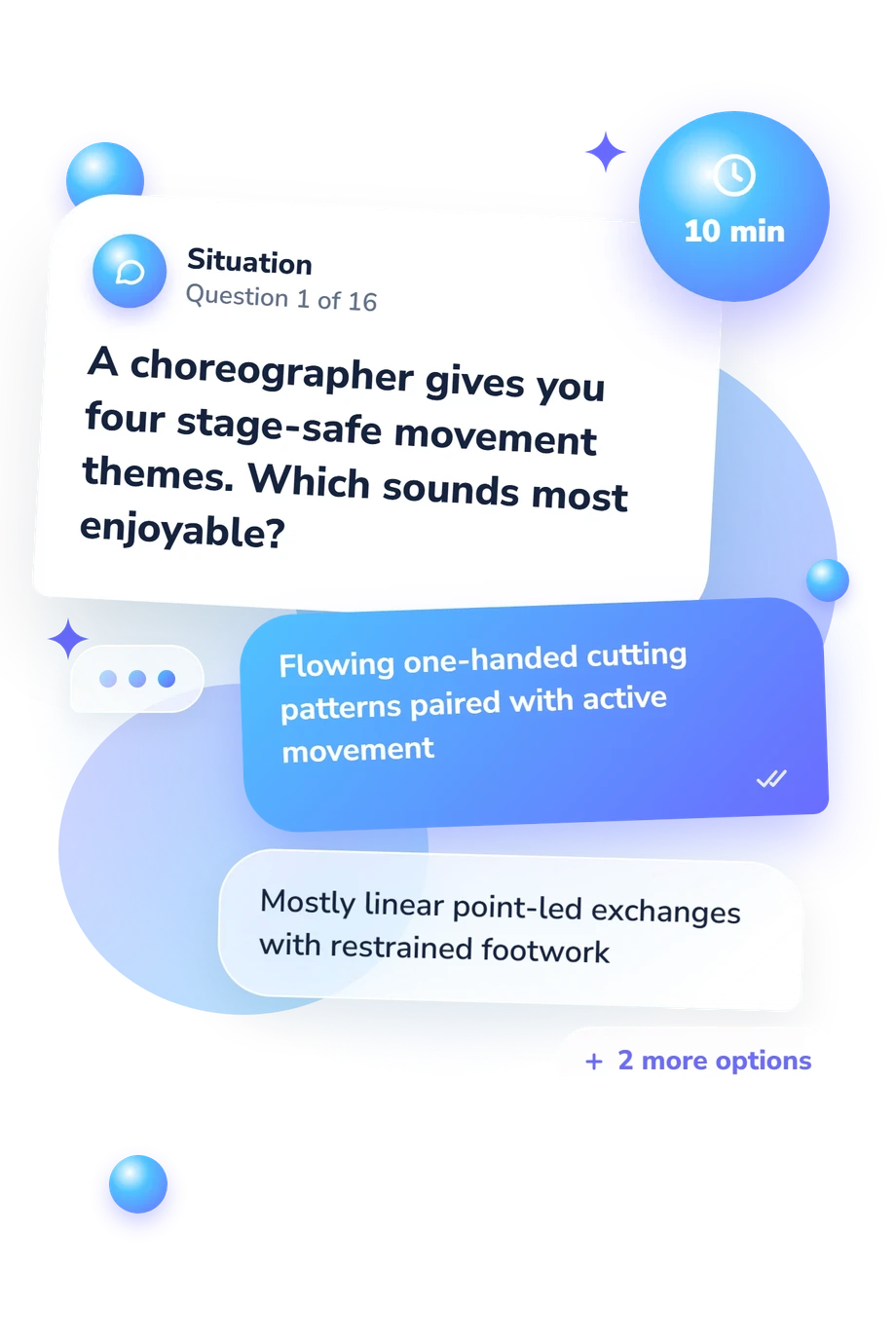
- Flowing one-handed cutting patterns paired with active movement
- Mostly linear point-led exchanges with restrained footwork
- A mobile mixture in which one-handed cuts play a noticeable role
- General fantasy actions with only an occasional sabre-like flourish
- Renaissance civilian fashion and formal dueling culture
- Medieval two-handed combat traditions and armored imagery
- Military sabres, cavalry associations, and the later tradition of sport fencing
- Nineteenth-century military history interests me, alongside several other periods
- Compact one-handed actions that keep my other hand free
- Mostly one-handed movement with an occasional two-handed moment
- Measured two-handed sequences, balanced with simpler movements
- Two-handed guard changes that use reach and leverage throughout
Sword Quiz - Description and methodology of the test
Curious readers can use this sword quiz to turn visual, historical, and movement preferences into a structured profile. As a quiz about what kind of sword you would use, it suits people comparing styles encountered through fiction, museums, choreography, or supervised study. The imagined choices compare preference rather than ability.
What This Assessment Explores
Imagined scenes, choreography, training, and museum interests reveal preferences for movement, precision, reach, cultural identity, and history. As a quiz about what kind of sword you are, it lets readers compare styles without equating preference with expertise.
These scales describe the result:
- Katana (0-12) reflects attraction to a curved, single-edged, two-handed form, Japanese sword traditions, cultural history, visual simplicity, deliberate movement, and disciplined aesthetics; Limited pull 0-4, Considered connection 5-8, and Strong affinity 9-12.
- Longsword (0-12) reflects reach, leverage, adaptable guards, and medieval character; Distant admirer 0-4, Versatile contender 5-8, and Strong affinity 9-12.
- Rapier (0-12) reflects interest in linear precision, timing, distance, and elegant one-handed handling; Different direction 0-4, Precision-curious 5-8, and Strong affinity 9-12.
- Sabre (0-12) reflects preference for mobile one-handed cutting, a curved profile, guarded hilt, and flowing movement; Another rhythm 0-4, Lively prospect 5-8, and Strong affinity 9-12.
Methodology and Historical Context
Each item offers four choices about imagined choreography, historical atmosphere, blade design, supervised training, or museum interest. Choosing what feels most appealing makes the task a preference comparison, not a test of memory, coordination, or prior instruction.
Historical books on sword typology, medieval blades, rapier traditions, and Japanese sword culture provide historical context for these categories rather than a psychological instrument or scoring framework. It is an unvalidated preference questionnaire with descriptive result categories.
Results report four separate style scores, but the questionnaire does not specify how each answer contributes. As a sword preference quiz, it presents an unvalidated comparative profile: a higher result means closer alignment with a style description, not superior technique or historical authenticity.
Self-report may shift with mood, familiarity, media exposure, and the imagined scene. The result does not establish training, handling ability, or safety; practical study belongs only in lawful, supervised instruction with approved trainers and suitable protection.
- Lisa Deutscher, Mirjam Kaiser, and Sixt Wetzler (eds.), The Sword: Form and Thought. Woodbridge: Boydell Press, 2019. 10.1515/9781787444805
- Ewart Oakeshott, The Sword in the Age of Chivalry. Woodbridge: Boydell Press, 1994.
- A. Vesey B. Norman, The Rapier and Small-Sword, 1460-1820. London: Arms and Armour Press, 1980.
- Ian Bottomley and Anthony Hopson, Arms and Armor of the Samurai: The History of Weaponry in Ancient Japan. New York: Crescent Books, 1988.
Updated: